



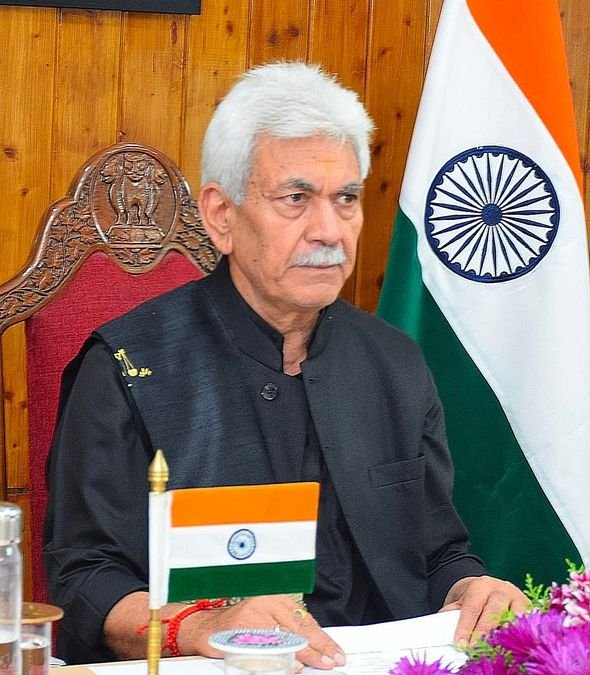
Srinagar, Oct 14: “Development achieved at the cost of nature’s stability is not truly development. Our dream of a developed India will be meaningful only when the Himalayas remain safe, strong, and vibrant,” Lieutenant Governor Manoj Sinha said on Wednesday.
In his message to the valedictory session of the 13th Sustainable Mountain Development Summit, the LG underscored the critical importance of protecting the Himalayan ecosystem.
Congratulating the Integrated Mountain Initiative (IMI) and SKUAST-Kashmir for jointly organising the Summit, the Lieutenant Governor said that building a resilient Himalayan landscape is no longer merely a subject of discussion but a matter of national importance.
The Summit, he said, had provided a platform for meaningful deliberations on issues concerning water resources, forests, land, biodiversity and climate change, while amplifying the concerns of millions of people dependent on the Himalayan ecosystem.
The Lieutenant Governor observed that the challenges posed by climate change, global warming, environmental degradation and unplanned development are becoming increasingly evident across the Himalayan region.
“Over the past two decades, we have witnessed numerous unprecedented challenges unfold before us. The natural disaster in various parts of the country and the world proves that the intensity of climate change impacts has increased, making these challenges even more serious,” he said.
He stressed that the Himalayas is the source of rivers, protector of biodiversity and a vital regulator of climate, and that any disturbance to the Himalayan ecological balance would have far-reaching consequences.
The Lieutenant Governor outlined four key pillars for future action:
First, determining science-based carrying capacity and zoning to ensure holistic planning and sustainable development.
Second, emphasising climate-resilient infrastructure and enhanced disaster preparedness through environmentally sensitive construction and strengthened community-based early warning systems integrating modern technology with traditional local knowledge.
Third, promoting regenerative and inclusive livelihoods, including high-value horticulture, organic farming, modern sericulture, eco-tourism and other components of the green economy. He stressed the need to empower youth and women as entrepreneurs and job creators.
Fourth, advocating a zero-waste and circular mountain economy through improved solid waste management, wastewater treatment and recycling systems across urban, rural and tourist destinations.
The Lieutenant Governor commended the Summit for preparing a draft policy addressing ecological security, responsible tourism, disaster management and sustainable livelihoods.
He expressed hope that the document would evolve into a robust policy and implementation framework through extensive consultations and serve as the basis for a new social contract between society and nature.
Emphasising India’s civilisational ethos of environmental stewardship, the Lieutenant Governor called for harmonising tradition with technology, local wisdom with modern science, and economic development with ecological sustainability.
“Today, as we build a developed India, we must strike a balance between tradition and technology, local knowledge and modern science, and economic and ecological development. I am fully confident that the right policies and the right decisions on the ground can carry all of these forward together,” he said.
