



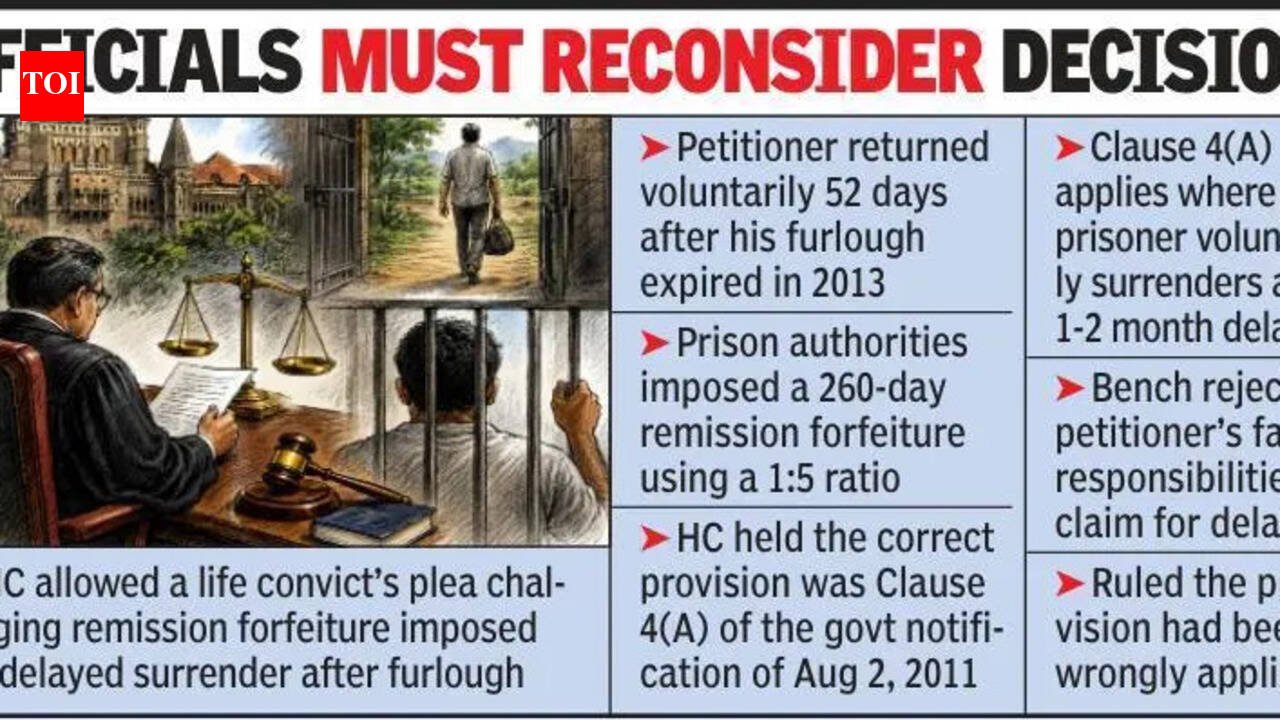
Nagpur: Nagpur bench of Bombay high court recently directed Maharashtra prison authorities to reconsider punishment imposed on a life convict for delayed surrender after furlough. It held the authorities wrongly applied a harsher remission rule despite the prisoner voluntarily returning within the period covered by a more lenient provision of the state’s remission policy.A division bench of Justice Urmila Joshi-Phalke and Justice Nivedita Mehta allowed a criminal writ petition filed by Rupesh Kadukar, a life convict currently lodged at the Open Prison in Amravati’s Morshi town. The court directed the authorities to extend the benefit of Clause 4(A) of the govt notification dated Aug 2, 2011, for his first instance of delayed surrender.Kadukar was convicted in 2011 for murder and attempted murder by Nagpur sessions court and has undergone more than 16 years of imprisonment.The petition challenged the forfeiture of 260 days’ remission imposed after he surrendered 52 days late following a 14-day furlough granted in Sept 2013. The prison authorities had applied a 1:5 remission forfeiture ratio, treating the delay under a stricter category.The petitioner through counsel Shweta Chavhan argued that since he voluntarily surrendered before the prison authorities and the delay was between one and two months, his case fell under Clause 4(A) of the govt notification, which prescribes a 1:4 remission forfeiture ratio for such cases.The state through public prosecutor VA Thakre opposed the plea, contending that the authorities had correctly applied the notification.The bench rejected petitioner’s explanation that family responsibilities caused the delay, observing “merely mentioning that due to family responsibilities he could not surrender in time is not acceptable.” However, it found merit in his legal challenge to manner in which the notification had been applied.Referring to the govt notification, court held since the petitioner voluntarily surrendered 52 days after expiry of furlough, his case fell within category applicable to prisoners returning on their own after a delay of 1 to 2 months.Accordingly, the judges directed the authorities to treat the petitioner’s first delayed surrender under Clause 4(A) and grant him the consequential benefit under the notification. The court disposed of the petition with directions to the prison authorities to reconsider the remission forfeiture in accordance with the applicable provision.


