



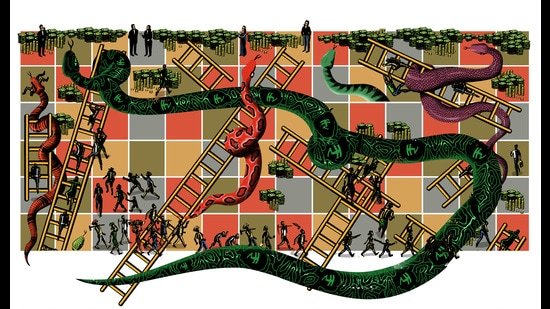
There is a tale the American writer David Foster Wallace used to tell. Two little fish meet an older one. The older fish greets them and asks, “How’s the water today?” As the young fish swim on, one asks the other, “What’s water?”
Thinking of capitalism can feel like that.
But… there is another kind of narrative about capitalism, encapsulated in a clip that does the rounds on social media every so often. It’s from 1979 and, in it, talk-show host Phil Donahue asks the economist Milton Friedman if he has ever had second thoughts about capitalism, given the inequalities in the world, the attendant greed and the concentration of power.
“Tell me, is there some society you know that doesn’t run on greed?” Friedman responds. “The world runs on individuals pursuing their separate interests… the only cases in which the masses have escaped from the kind of grinding poverty… are where they have had capitalism and largely free trade.”
Think of India before 1991, and that statement rings true.
Simple things like booking a railway ticket or getting a phone line were ordeals. So was going to the bank. Until a balance of payments crisis and the World Bank’s preconditions for aid forced the country to shed its socialist “straitjacket” and embrace capitalism.
The numbers tell the story of what happened next. The Indian economy has grown at an average rate of 6% to 7% annually since 1995, against an average growth rate of about 3.5% between 1950 and 1980.
But what is this capitalism? For Sven Beckert, Laird Bell professor of history at Harvard University and author of Capitalism: A Global History (2025), it is an economic system in which privately owned capital is productively invested to generate more capital, supported by states and embedded in global markets.
Beckert’s view complements that of economist Joseph Schumpeter (1883-1950), who posited that capitalism is adaptive: new technologies emerge, supplanting older ones, and the cycle of creative destruction continues. For Beckert, capitalism does not just adapt to technology. It adapts to the state, to political, economic, demographic and even social conditions; but in adapting, it transforms these as well.
Paul Samuelson and William Nordhaus, while discussing the developing world in their classic textbook Economics (1948), used this passage by the Irish author Francis Hackett as their epigraph: “I believe in all the proceeds of a healthy materialism—good cooking, dry houses, dry feet, sewers, drain pipes, hot water, baths, electric lights, automobiles, good roads, bright streets, long vacations away from the village pump, new ideas, fast horses, swift conversation, theatres, operas, orchestras, bands—I believe in them all for everybody.”
Delivering all this for everybody is where the problem lies; because that delivery depends on extraction. Growth was somewhat more equitable in the Global North, during the “golden years” of the West, Beckert points out, because the homes and gadgets and salaries were fuelled by cheap oil from the global South: the Middle East, South America and Africa.
When these countries decided they too wanted a piece of the prosperity they were funding, it was an economic crisis almost at the level of the Great Depression.
But capitalism adapted.
The World War 2-era Bretton Woods agreement that linked exchange rates to the US dollar, providing a level of financial stability, was dissolved in 1971. Floating exchange rates meant that capital was now free to go where the returns were best. And it did.
Production moved to countries where wages were many times lower, and worker benefits and rights were non-existent. The West’s industrial heartland hollowed out.
But this is just the latest chapter.
***
How old is capitalism, really?
Beckert argues that it can be traced not just to the industrial revolution and the early 1800s, but to as much as 1,000 years ago.
He begins his history at the port of Aden in the 12th century (thought it could just as easily have begun at any number of such ports of the time, he admits). Still, Aden was the crossroads of trade between the Arab world and India.
Trade with India and China had for centuries been the driving economic force in the Old World (the world before the West made it to the Americas). Beckert traces the course of capital and its impact from Aden, through the adventures of Vasco da Gama, colonialism and empire.
As colonised countries eventually fought to free themselves from this resource-sucking mutation of governance, unlikely alliances formed between industrialists and workers, united by the shared enemy of colonial extraction.
In India, industrial houses such as Godrej, Tata and Birla allied with the independence movement (Ardeshir Godrej was a pallbearer at Bal Gangadhar Tilak’s funeral in 1920). They believed India could build world-class goods, if it was allowed to. And, of course, they would go on to do just that.
Decolonisation produced wildly different outcomes around the world, depending on how strong domestic capital was, how much state capacity existed, and how geopolitical pressures shaped the choices available. What was common everywhere was the rupture: a meaningful break with the colonial order that began, slowly, to shift the centre of the global economy away from the North Atlantic.
India had to choose between a newly empowered working class and the entrepreneurial community it needed in order to create jobs for the new nation. Like many former colonies, it cracked down on the working class. And over time, the bureaucracy ossified, helping a few and hindering the rest.
India’s 1991 moment was not a beginning. It was a consequence. A necessary stage of a system that has routinely shed one skin and acquired another.
The software revolution would be the catalyst for the next such evolution. But we’d been here before. In the industrial revolution too, fewer people were required to deliver the same services, and those who were displaced were rarely the beneficiaries of creation.
When Adam Smith wrote The Wealth of Nations in 1776, capital was restricted and largely bound by geography, as was labour. Fast-forward 200 years and capital could go anywhere, though labour was still constrained by visa and immigration laws.
Now, capitalism has used technology and the power of the state to largely delink labour from geography. Developers in India serve companies in the US. Or go onsite on H1-B visas. What were once elite white-collar jobs in the West are performed elsewhere, at a fraction of the cost.
This benefited India (albeit in a wildly unequal manner). But now, swathes of the Indian workforce are at nearly as much risk as their Western counterparts from the latest tool of creative destruction: Artificial intelligence.
AI is set to further weaken the bargaining power of the employee. It is meanwhile empowering a new generation of tribute-seekers: entrepreneurs who rail against the state while demanding bailouts and government intervention.
Amid an intensifying gamification of capitalism, financial markets move from boom to bust with increasing regularity, and wild new frontiers emerge, ranging from cryptocurrency and NFTs to “prediction platforms” such as Polymarket, where fortunes have been made on events ranging from the death of the Ayatollah to the dates of future attacks by the US on Iran.
There is a more fundamental effect that late-stage capitalism has had on society.
Beckert’s book begins with the 1639 trial of Robert Keayne, who was convicted “for the ‘very evil’ and ‘corrupt practice’ of overcharging his customers and placing profit above the community’s needs”. About 350 years later, Friedman was talking to Donahue about greed being a driving force of progress, a sentiment echoed by Michael Douglas’s Gordon Gekko in the popular Oliver Stone film Wall Street (1987).
“Greed, for lack of a better word, is good,” Gecko famously says. “Greed is right. Greed works. Greed clarifies, cuts through, and captures the essence of the evolutionary spirit.”
This is the capitalist manifesto, and it has transformed what was once a deadly sin into the sea we all must swim in.
After eight years researching how this system has evolved, what does Beckert make of where we are?
.
‘WE BUILT THIS REALITY, AND WE CAN RESHAPE IT’
The world we live in was built by us, and can be rebuilt, says Beckert. Amid labour’s lost power, US-China bust-ups and a world, in many ways, at war with itself, are there really grounds for a cautious optimism? Excerpt from an interview.
* There have been several histories of capitalism. What made you want to tell this story?
I wanted us to understand, historically, how we came to the point we find ourselves at today.
The capitalist revolution is a radical departure from other ways of organising economic life. The book aims to tell this story from a truly global perspective, because so much of our thinking about capitalism has been fundamentally Eurocentric: a story about Florence, Genoa, Venice, Amsterdam, London, Manchester, New York City.
Much of the rest of the world simply doesn’t appear in those histories. But I think you cannot understand capitalism without bringing the entire globe and all the world’s people into the narrative and analysis.
* One of the most striking observations in the book is how ideological the project of capital has been. The idea of the primacy of markets for instance has become “conventional wisdom”. The labour movement, by contrast, never managed anything comparable after the 1970s. Why?
That’s a great observation, and I totally agree. I think the reason is partly — or decisively — that the labour movement, institutionally and ideologically, emerged in a particular moment in the history of capitalism: the late-19th century. This was a moment of heavy industry, of male industrial workers, and of economic activities strongly attached to the nation-state. And thus the nation-state became the focus of labour’s mobilisation.
Fast-forward a hundred years to 1970, and capitalism had changed drastically — but labour’s way of thinking, and the way labour was organised, was still rooted in that moment a century earlier. It was thus ill-equipped for the challenges of the 21st century.
You’re absolutely right… labour and social democratic political forces have had a very hard time articulating the kind of coherent, powerful vision of society that certain economists managed to construct. I think that’s partly because so much of what remains of organised labour is still rooted in an earlier moment in capitalism’s history.
* One reading of your book is that the West is slowly moving away from neoliberalism, particularly after the downturn of 2008. But the Global South seems to be moving in the opposite direction, embracing aspects of the neoliberal consensus. Is that how you see it?
Yes, I think that’s a very good observation. But we have to be careful about timing.
In the 1990s and 2000s, neoliberalism was at its height, in India and in the West. The attacks against neoliberalism that now come, especially from the political right in the West, are of very recent vintage. They really began to gather force after the economic crisis of 2008-09.
My expectation — based on my observation that capitalism is always a global production, at every moment of its history — would be that what we are going to see is not just a shift of some parts of the world into a different kind of post-neoliberal political economy. I would think this is something that will eventually structure the political economy of the world as a whole.
* China is something of an anomaly: strikingly capitalist in many respects, yet organised by a powerful state. How does it fit in?
That is something I find very difficult to figure out.
If I look at China in the last 30 years from the perspective of a scholar of capitalism, I find two things. First, as you say, China certainly becomes very important to global capitalism. Indeed, I think the whole neoliberal revolution in the West is, in a way, deeply related to the Chinese economy becoming a much more important part of the global capitalist economy.
Look at China itself, and one sees many facets that are almost definitional to capitalism: expansion of markets, massive movement of farmers into industry, prevalence of private capital in the economy. All this speaks to China having experienced a rapid form of capitalist development — indeed the most rapid the world has ever seen.
On the other hand, economic life in China is still structured by a very powerful state, and by pretty substantial state investment in productive facilities, especially in basic industries. And of course the Chinese state sees its model not as capitalist but as “socialism with Chinese characteristics”.
What you can certainly say is that the Chinese model of economic development is strikingly successful. It has produced the world’s fastest economic growth ever. And China is becoming a very important cornerstone of the global capitalist economy.
* Would it be fair to draw a parallel between cheap oil in the post-war Golden Age and Chinese manufacturing in the neoliberal era — both enabling, in different ways, a kind of prosperity that papered over structural tensions.
Yes, absolutely. Cheap oil was important to the Golden Age. It enabled the productivity advances in Western industry, and because of those very significant productivity advances, there was an ability and a willingness to distribute some of the profits to the working-class.
I think the Chinese economic take-off is deeply related to the neoliberal revolution, and in some ways enabled it. What was happening in much of the industrialised West was that many industrial jobs disappeared; especially well-paid jobs. Wages generally stagnated, and productivity growth slowed drastically. But the Western working class still had access to an enormous number of consumer goods, partly because they were being manufactured in China, Cambodia, Vietnam, etc, at very low prices.
That enabled workers to purchase more things even though their salaries had not increased very much over time. So yes, I think the one enables the other. The neoliberal revolution, of course, also enabled Chinese development, because it opened up new markets for Chinese exports, which was absolutely crucial for the Chinese economy.
* The shift in the 1970s from a stakeholder model of corporate governance to one centred on shareholder returns — was that one of the transformative moments in capitalism’s history?
I think that was part of the transformation. In the 1950s and ’60s, workers came to share a significant part of productivity gains. Wages rose dramatically, benefits and working conditions improved, people worked fewer hours. There was a real sharing of productivity advances.
What we see now is that productivity advances — whether from the computer revolution, or those that might come in the future from the AI revolution — are not broadly shared. They are basically captured by a very small group of people. We are talking about a few dozen people. This is a kind of oligarchic concentration of economic power that is actually quite rare in the history of capitalism.
I don’t think this is best explained by looking at the attitudes of the individuals involved. It’s better explained by distributions of power. In the 1950s, General Motors or the Ford Motor Company faced very powerful trade unions. They also faced an American state that was invested in the idea of redistributing some of the productivity advances of American industry and creating a more inclusive society. That became much less pronounced in the 1980s and thereafter. As a result, both the power of labour and the willingness of the state to support redistribution decreased. That has had a real impact on where the gains of productivity advances — the gains of economic growth — are going. And this is a global process, not limited to the West.
* There is a contrast between how the world dealt with chlorofluorocarbons (CFCs) and the hole in the ozone layer in the 1970s and ’80s, and how we’ve dealt with carbon emissions. Companies accepted the CFC ban; the hole eventually healed. Why has climate been so different?
The CFC industry is much smaller than the fossil-fuel industry. The political influence that the producers of CFCs could muster in the 1970s was much less significant than the political power that the fossil-fuel industry enjoys today, especially in the US. That explains part of the difference.
But the CFC example does show that we have the capacity to address such issues.
When it comes to fossil fuels, we are certainly capable now of producing a great deal of energy without burning oil, coal or gas. What is missing, often, is the political will.
The broader question about capitalism and the environment is a little more complicated. There is a massive explosion in the use of natural resources, and we are using them way beyond the carrying capacity of the world. We are undermining the ecological basis for our very existence on this planet.
Meanwhile, capitalism must expand. This is one of its fundamental logics. It is continued movement, a state of permanent revolution. The natural environment doesn’t permanently expand. Nature has a logic different from that of capitalism. There is a definite tension between the dynamics of capitalism as such and the dynamics of nature.
* Yet you describe yourself as cautiously optimistic…
I see that the economic world we live in is created by us. We are not powerless in the face of economic laws. We have shaped them in the past, and there can be such change again.
We live in a world that was constructed by us and our ancestors, and it can be constructed in different ways. We need to think about how we want to organise that world… how we want to live.
We are the architects of our future. We should remind ourselves of that.
(K Narayanan writes on films, videogames, books and, occasionally, technology)


