



A 2021 World Wide Fund for Nature study estimates that the world loses or wastes 2 kg of every 5 kg of food grown. An earlier Food and Agriculture Organization estimate put it at one kg in every three.
What both organisations agree on is that we are losing and wasting far too much.
Globally, food grown on an area larger than the Indian subcontinent is lost at the farm level every year. In India alone, the water embedded in food lost between farm and retail could cover household water needs for the country.
Much of the loss happens before the crop leaves the field, either because it is left unharvested, improperly harvested, or damaged in the process. Then, in much of India, unlike Punjab, markets are not close to farms; distance and poor logistics mean the smallest farmers in the poorest states lose the most.
The scale is striking. India loses (not wastes) enough rice to feed 70 million people a year — and rice is among the least loss-prone crops. More is then lost between mandi and retail. But even this pales when compared with how much we waste at home, and in restaurants, offices and retail stores.
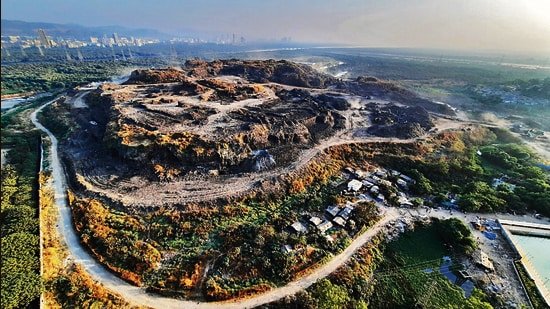
When my Sundaram Climate Institute studied the impacts of food waste, we found that nobody wants a waste dump near their home. Why would they? These rotting mounds emit methane, attract stray animals, become breeding grounds for mosquitoes, and belch smoke (especially when piles of waste are set on fire), which, as I noted in an earlier column, triggers chronic inflammation, among other things.
A commonly cited number for carbon emissions associated with food loss and waste (FLW) is 8% to 10% of global greenhouse-gas emissions. Seen that way, if global FLW were a country, it would emit more than India.
Meanwhile, a study published in the journal Nature Food in 2023, on the cradle-to-grave emissions of food systems, found that FLW accounted for 9.3 billion tonnes of CO2-eq emissions — or, a full 18% of global emissions, higher than any country but China.
Now contrast the outrage directed at a coal plant against the relative silence around FLW. In that contrast lies the problem.
***
Food loss and waste is bad. Everyone knows that. Why do we underestimate its potency?
Is it because it masquerades as a municipal or farmer problem, when it is in fact a geostrategic and climate issue? Or is it because solving the problem would require us to acknowledge our role in it, and actually work on being part of the solution?
The problem can be solved. The first step in the change is better data. In 2022, the government of India commissioned NABCONS (the consultancy service of the National Bank for Agriculture and Rural Development, or NABARD) to survey 68,453 respondents across entire supply chains — farmers, wholesalers, retailers, transporters, processors, storage operators — to map losses between field and store. It was a mammoth effort, but with two problems that limit its usefulness.
The first is old data. In my textile factory, I cannot hope to improve today’s production with data from three months ago, let alone three years ago. The same logic holds: reducing food loss requires continuous monitoring, not a once-a-decade survey. Think continuous glucose monitors to manage diabetes.
The second is sampling. NABCONS drew 10 farmers at random from each village in their study. But all farmers do not lose equally. The smallest farmers lose the most between field and market, as agricultural economist Ashok Gulati and his colleagues at the Indian Council for Research on International Economic Relations (ICRIER) found in a 2024 study. A sample blind to that skew will undercount losses precisely where they are worst. If I reckon my production by drawing on data from my best machines, my factory will shut down.
Meanwhile, the loss between field and market — 72 freight trains a day, according to the 2022 NABCONS data, which is a conservative estimate — costs the country ₹1.52 lakh crore a year. Or roughly what the central government spends on education.
It is a cost borne largely by the farmer.
The Ministry of Food Processing Industries, whose budget is about 1/50th of that figure, commissioned the study that tells us this. That’s a tragedy.
***
Food loss is only part of the story. Households, restaurants, and offices account for 40% to 60% of FLW, in the form of waste. Here, the data is thinner still. Merely managing these millions of tonnes of waste is a daunting task.
Managing 17 kg is easier. Why 17 kg? Because that’s what my home sent out each day, 11 years ago. And the lessons from bringing that down to under 700 gm apply to managing the lakhs of tonnes our cities produce daily.
When I began managing my waste, I had no idea how to begin. So, taking a cue from my factory, I began by measuring. I still keep a daily log, in a slightly unwieldy Excel sheet. I’ll spare you the details (they’re in my 2018 book, The Climate Solution), but at the heart of it lies this: gather granular data, and don’t lie to yourself.
Within weeks, patterns began to emerge. We learned that we generated about 17 kg of waste daily, most of it from the garden while, inside the house, the kitchen was the epicentre of waste.
By then, I had become familiar with solutions in this space (and had begun investing in some of them), and knew that the alchemical key of transforming waste to value lay in segregating into wet and dry, so each could be processed separately. But how to do it?
The Japanese philosophy of poka yoke or idiot-proofing, which we practice in the factory, came to the rescue: design for ease of use, not for virtue-signalling. That was possible only by observing how and when waste was generated. What worked for us were three dustbins, placed side by side, with no lids: one for rotten food and leftovers (which go into the biogas plant), another for compostable materials, including food and packaging, and the last for dry waste.
Now segregation did not need an additional second. The next big lesson was that no step should be smelly or unpleasant; it had to all be clean enough and easy enough that nobody had to summon willpower or conscience to follow the new rules.
Once the waste was segregated, solutions came easily. We tried anaerobic composting for a while before switching to a biogas plant. It is less cumbersome, takes in virtually all our food waste, and yields a little less than a cylinder a month (which is especially nice in times like these, when everyone is anxious about cooking gas).
The garden waste and biodegradable packaging go into compost bins, generating feed for the garden that has helped lower the amount of water it uses. Why? As we saw in a previous column, every extra gm of carbon in the soil helps store more water.
The open dustbins attract no flies or insects because the waste is managed periodically.
Each process is designed to be easy, and so is followed. We have had dignitaries — ministers, activists, professors and diplomats — visit and peer into our dustbins and I ask them to go close to the biogas plant (a little bigger than a household fridge) and take a deep breath. It does not smell.
And so, the system has held. Over 11 years, a single home has kept more than 55 tonnes of waste out of the landfill, while generating biogas, compost and even some cash (dry waste has an active market in India). The principle is simple: design for ease, based on granular data. Precision matters. This would never have happened if we didn’t know precisely where, when and what type of waste we generated.
The approach is scalable. Indore, which has successfully implemented waste segregation, converts over 500 tonnes of wet waste a day into compressed natural gas (CNG) and powers 400 city buses with it, diverting any remaining gas to the domestic sector. It is also earning crores, through this system, in carbon credits.
I’ve invested in a company called Carbon Masters that converts over 100 tonnes of wet waste a day into biogas that it supplies to restaurants in Bengaluru and parts of Telangana. Amid the West Asia crisis, they have seen demand soar. Last week, I called Som Narayan, one of the co-founders. To my surprise, he did not pick up; more unusually still, did not call back. When I finally managed to reach him, the excitement in his voice was palpable. “Sorry,” he said. “I’ve been on calls till 10.30 pm. For the first time in ten years, customers are calling us.”
Som tells me the Bengaluru municipal corporation is proactively helping solve supply logistics issues and discussing long-term contracts, which could help the company scale. Carbon Masters makes fertiliser too, another major, heavily-subsidised import.
What if the Strait of Hormuz opens tomorrow, I asked him. “Doesn’t matter,” Som said. “Governments and customers are realising it is stupid to rely on a single energy source, and an imported one at that.”
Let’s be honest: it is time to rethink our approach. The technology is here; the markets exist. Why aren’t there companies like Carbon Masters in every city? Why is Indore still relatively unique? One reason is that waste management is not seen as strategically important. Another is that carve-outs and subsidies have only served to distort price signals and blunt the market’s ability to innovate. Third is governance and the financial capacity of cities.
Why would we gather data on waste if we’re only going to set it on fire? And why wouldn’t we burn it, when we see it as having no value?
If we are serious about climate, we should use the markets to drive us in new directions. Will there be short-term pain? Certainly. But the likely outcome is an equilibrium, with greater energy-independence, better climate resilience, stronger farm incomes and cleaner cities. That’s a trade-off worth making.
(Mridula Ramesh is a climate-tech investor and author. She can be reached on tradeoffs@climaction.net. The views expressed are personal)


