






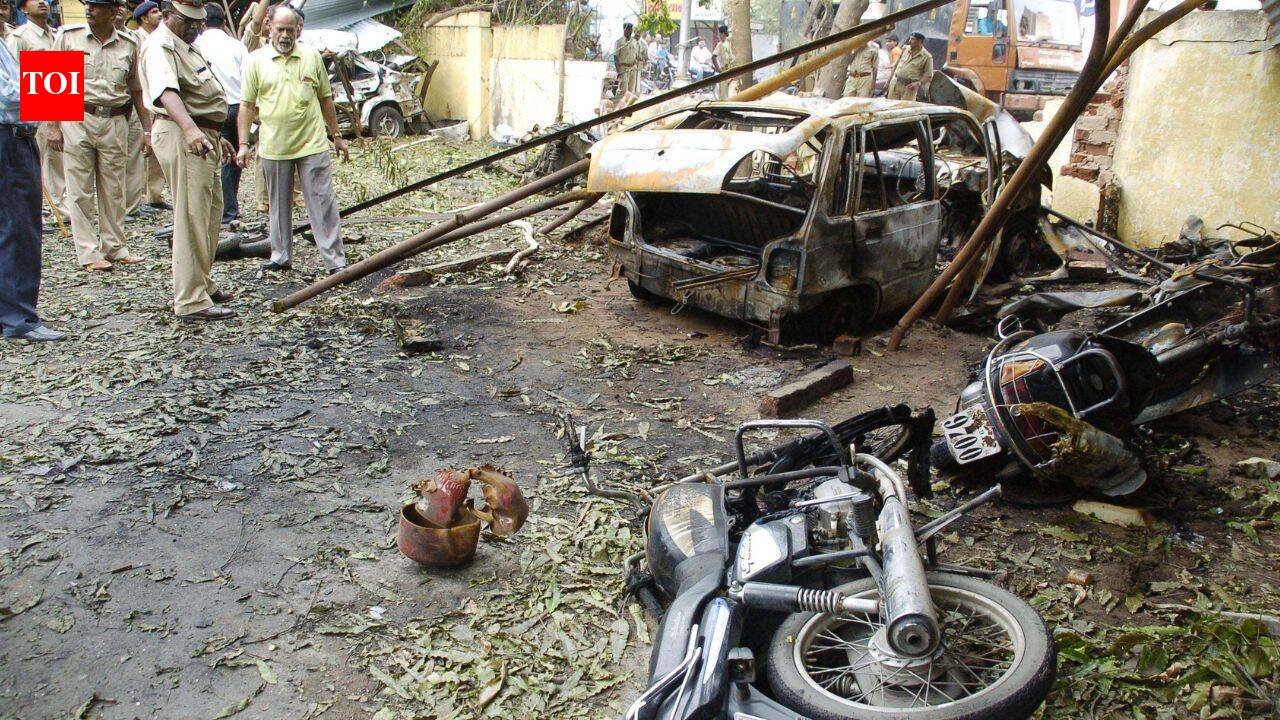
AHMEDABAD: In an unprecedented verdict, Gujarat High Court on Tuesday upheld the death penalty for 38 persons and life imprisonment for 11 others in connection with the 2008 serial blasts case in Ahmedabad city in which 56 persons were killed and 246 others sustained injuries. This is the highest number of death sentences confirmed by a high court in India, special prosecutor Mitesh Amin said.Upholding the order passed by a special court in Feb 2022, a bench of Justice Alpesh Kogje and Justice Samir Dave confirmed the death sentence by allowing an application filed by the state govt. The judges said that they dismissed all the appeals filed by the convicts challenging their conviction.The trial court had convicted them under IPC charges, the Unlawful Activities Prevention Act (UAPA), the Explosive Substances Act and the Damage to Public Property Act for murder, attempt to commit murder, criminal conspiracy, attempting to wage war against the nation, sedition, for participation in unlawful activities and terrorist activity.HC also directed the state govt to pay compensation to victims: Rs10 lakh to the nearest kin of those killed, Rs5 lakh for grievous injuries and Rs1 lakh for simple injuries. The payment has been ordered to be paid till March 31, 2027, Amin said.Families of the victims described the judgement as a significant victory, but not the end of their fight. They believe “complete justice” will be delivered only when the case is finally concluded and the sentences are carried out swiftly. Alpeshkumar Shah, who lost his brother, Chirag, in a tiffin blast in Maninagar, said, “Terrorists have no humanity. They should not benefit from prolonged trials. We are satisfied with the verdict, but justice should not take decades. We only hope the sentences are carried out swiftly,” he said.Defence lawyer Khalid Shaikh said, “The convicts have to approach Supreme Court against the HC verdict.”On July 26, 2008, 21 explosions ripped through the city of Ahmedabad and bombs were planted in Surat as well. Investigations into the case revealed that some of the former members of the proscribed Students Islamic Movement of India (SIMI) formed a new outfit, naming it Indian Mujahideen, and they became active under the banner of the new organisation.More than 100 persons were named accused and 78 were put on trial. Of them, 28 persons were acquitted by the trial court, and one accused, who turned an approver, was pardoned.The trial was conducted after merging 35 different cases—20 FIRs lodged in Ahmedabad for the blasts and 15 in Surat, where bombs did not go off. Those convicted received sentences under the UAPA, IPC, the Explosive Substances Act and other laws.Among those acquitted were Mubin Shaikh and Mansur Pirbhoy, who were accused of hatching conspiracy and of sending threat mails and claiming responsibility for the terror strike. While the trial court pardoned one approver, it convicted four other approvers, who later retracted their statements.The 2008 blasts were also described as the first terror strikes to target hospitals, and emails sent by the accused claimed the attacks were in revenge for the 2002 post-Godhra violence in Gujarat.Among the 49 convicts are former SIMI leader Safdar Nagori and his associates from 11 states, including Gujarat, Madhya Pradesh, Keralam and Uttar Pradesh.Another special prosecutor, Amit Patel, said, “HC began hearing on this case in March 2025 on a daily basis, but since January this year, the bench has been hearing the case for the entire day.”The trial lasted 13 years, with the prosecution examining 1,163 witnesses before nine different judges. There were 26 star witnesses, whose identities were concealed for their safety.The proceedings also saw controversies and hindrances, including an alleged attempt by 24 accused to escape from jail. On Feb 11, 2013, Sabarmati jail authorities discovered a 213-foot-long tunnel dug within the prison.


