





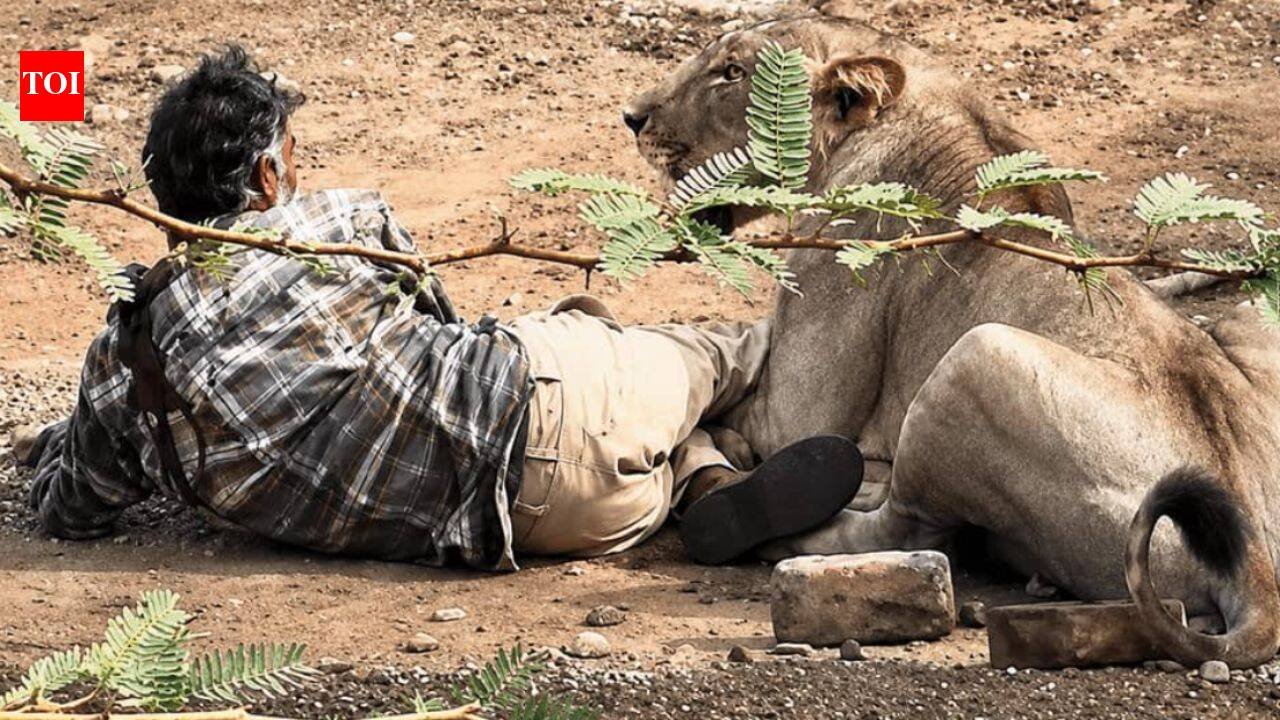
AHMEDABAD: It was a stare-down contest with death, and Kalu Parmar knew the slightest mistake could be his last. Pinned to the ground by a subadult lion for nearly 30 minutes in Garajiya village of Palitana taluka on Monday, the Maldhari herder says he survived by staying still, looking into its eyes and refusing to panic.In the end, death blinked first. “I was looking at death up close, and every second felt like my last,” says Parmar. Since the video of his encounter went viral two days ago, Parmar has become known as the man who faced a predator with extraordinary composure and a gentle touch.
“I had tied my cow and was standing in the courtyard. As I turned to go into the house, something pounced on me. I was on the ground before I could even make sense of what had happened. It took me a few seconds to realise it was a lion,” he recalls.For years, Vagha Siddha kept telling other villagers to leave the lions alone. The 65-year-old from Chaturi village in Gujarat’s Amreli district would rebuke neighbours for harassing or photographing the animals. Then, on June 24, everything changed. A lioness snatched his five-year-old grandson from just outside their home.Today, Siddha says he would kill a lion to protect his family. “I don’t care if forest officials send me to jail ,” he says.The attack was so close to the house that even the Gujarat forest department called it highly unusual. That day, nearly 500 villagers chased the lioness for close to a kilometre before they cornered her in the bushes. “Recovering the body was harder still. She just would not release it. She kept lunging at the crowd each time they closed in,” recalls Himat Vora from a neighbouring village.“We trusted the lions. Now, we don’t,” says Haresh Siddha, the boy’s uncle. That trust took generations to build, and it is what has made lion conservation a success in Gujarat.A century ago, the Asiatic lion was hunted to near-extinction. Today, Gujarat is home to 891 of them, and the IUCN, a global environmental organisation, recognises the state as the species’ last stronghold. The return from the brink is usually credited to monitoring and legal protection. But the real reason is harder to measure.Testing toleranceThe Chaturi attack was the fourth fatal one in 15 days. On June 11, a seven-year-old was killed at Ghantiyan in Bagasara. On June 16, a 30-year-old man was killed in Rajula and partly eaten, and on June 17, 30-year-old Nagji Gujariya was killed in Mahuva. “Lions frequently move through our private lands,” says Gujariya’s mother, Devu. “The forest department seems to believe the lions should never be harmed, even when they kill people or livestock.“Mauling on cameraOn Sunday night , a lion entered Thavi village in Amreli’s Savarkundla belt and attacked young cattle-herder Raju Vaghela as he slept in the cattle shed outside his home. Neighbours armed with sticks drove the lion away.On Monday morning, in Garajiya village of Palitana taluka in Bhavnagar, a subadult lion pinned Maldhari herder Kalu Parmar to the ground for nearly half an hour, as villagers shouted and threw stones. Parmar escaped with claw injuries.Govt figures show deaths from lion attacks climbing from two a year in 2020-21 to seven in 2024-25, before easing to five last year; injuries peaked at 42 in 2024-25 and fell to 13 the year after. But four deaths in a fortnight, and two maulings on consecutive days, represent an alarming departure.
Cub dead, lions capturedThe attacks have left people frightened and furious. They once called the lions their pride, but now they just want them gone. What worries forest officials the most is what this anger could lead to. “Our biggest fear is that people may attack and kill lions, like it happens in some tiger landscapes,” says a senior official.There are already signs of hostility towards lions. In June , an eight-month-old lion cub was found dead with severe injuries near Junagadh, and a man was arrested under the Wildlife Protection Act.The forest department has been pulling lions out of the trouble spots. At least 30 were captured across Saurashtra in June. The state’s principal chief conservator of forests, Jaipal Singh, was quoted by PTI as saying, “Of those, five or six suspected man-eaters are being kept in captivity.”‘They abuse and assault us’A conservation model built on tolerance can collapse quickly when trust begins to disappear. For now, all anger is aimed at forest staff.After the Chaturi boy was killed, nearly 2,000 people gathered outside the govt hospital in Khambha, many ready to confront officials, until local leaders stepped in. Senior officers asked state forest and environment minister Arjun Modhwadia to visit the family and defuse the anger among the people. The minister met the family and assured residents that the govt would frame a standard operating procedure to prevent such attacks.For frontline staff, facing angry crowds has become part of the job. “Villagers abuse us and sometimes even assault us. We can only stay calm and try to reason with them,” says forester Anil Rathod. Beat guard Pravin Baloch says villagers once seized his motorcycle keys and forced him to call senior officials, demanding that the lion responsible be caught. Police often have to step in.The forest is fullThere are more lions than Gir can hold, and they have spread beyond its boundaries. Amreli district has 339, ahead of Gir Somnath’s 222 and Bhavnagar’s 116, and many now live on gauchar (grazing) and revenue land, in coastal areas and on farms. “Lions now move across coastal villages,” says sarpanch Savji Babu.Studies of Gir’s lions have found they hunt largely at night, resting through the day, arranging their movements around human activity. In Gir, the Maldhari herders have had the better part of 150 years to learn to live beside them. Outside Gir, many communities are still learning how to share space.Reels and crowdsSome villagers argue the lions themselves have changed, insisting these are not the “original Gir lions”, but animals brought from “elsewhere”. Officials reject this contention, though they concede that constant disturbance from people may be affecting the way lions behave.Ajit Bhatt, a conservation activist in Amreli, blames illegal lion shows and tourism driven by social media. “There are WhatsApp groups and mobile apps that immediately alert people whenever a lion makes a kill near revenue areas,” he says. “People record videos, make reels and disturb lions. Irritated animals may later attack villagers.“But lions preying on humans is baffling,” he adds.Bhushan Pandya, a wildlife photographer, says, “Without the cooperation and support of local communities, conservation of lions in Gujarat is not possible.” For communities living near lions, that relationship has also been supported by compensation. Govt provides Rs 10 lakh for human deaths caused by wild animals. For livestock, it’s between Rs 25,000 and Rs 50,000.
Frontline demandsBut maintaining that relationship requires more than compensation. The forest department says it is short of nearly everything it needs. Officials want hydraulic vehicles to lift large animals, new vans, modern rescue centres, insurance for staff, and more petrol than the 30 litres a month a beat guard is currently allowed.The lions have redrawn their territory but the administrative map has yet to catch up, say sources. A lion can move a few metres and cross from one forest division into another; where those jurisdictions overlap, rescue and response can slow down.Meanwhile, fear has begun to reshape ordinary routines. Some parents have stopped sending their children to school, unwilling to risk the walk. What unsettles them most is that they never saw the change coming.The lion was the one wild thing they had always felt safe around. Now, they are no longer sure they know the animal at all.


