



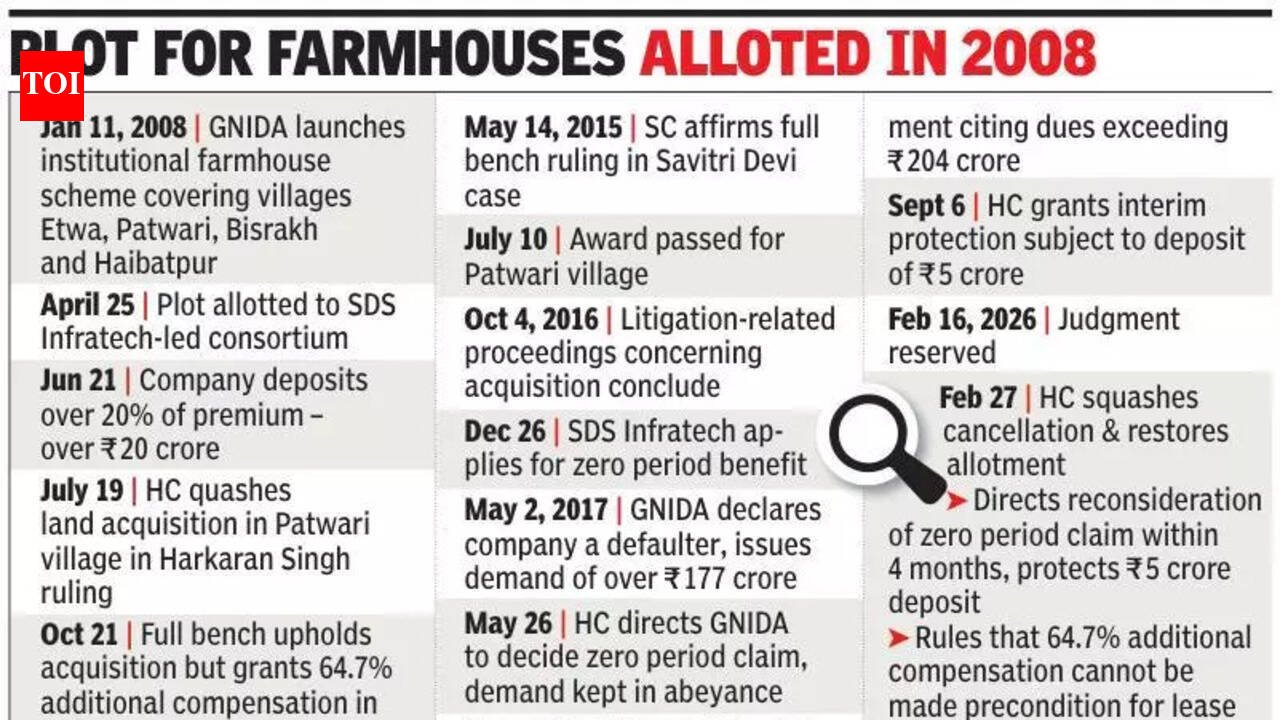
Noida: Allahabad high court has restored a farmhouse plot worth over Rs 100 crore to a company setting aside a cancellation order nine years back with immediate effect.A division bench of justices Mahesh Chandra Tripathi and Kunal Ravi Singh, on Thursday, restored the 3.8 lakh sqm plot in Greater Noida to SDS Infratech, setting aside Greater Noida Authority’s order to canel the allotment in 2017 and directing it to take a decision on the developer’s demand for a zero-period relief within four months.The bench allowed the writ petition in part and quashed the Aug 17, 2017, order that had cancelled the April 25, 2011, allotment of the plot.The dispute stemmed from GNIDA’s institutional farmhouse scheme floated in 2011, covering land in Etwa, Patwari, Bisrakh and Haibatpur villages. An SDS Infratech–led consortium was allotted the land parcel for Rs 103 crore and deposited Rs 20.6 crore — about 20% of the premium — which, under the scheme brochure, required the Authority to issue a checklist for execution of the lease deed.GNIDA cancelled the allotment after the developer failed to pay subsequent instalments, treating it as a chronic defaulter. The Authority said that by April 30, 2017, outstanding dues, including interest, had crossed Rs 204 crore. It maintained that payment obligations were independent under the brochure and that only about 6,831 sqm of the land fell in Patwari village, arguing that acquisition-related litigation did not justify withholding payments.The developer, however, contended that the land acquisition in Patwari was quashed by the High Court on July 19, 2011, and remained under legal scrutiny for several years — through the full bench ruling in Gajraj on Oct 21, 2011, the Supreme Court’s decision in Savitri Devi on May 14, 2015, and related proceedings that continued until Oct 2016.It sought zero period from July 19, 2011 until issuance of the checklist, arguing that litigation uncertainty over title and possession continued at least until Oct 4, 2016. The lease deed was never executed and possession was not handed over, it said, and therefore instalment liability could not be enforced in the absence of reciprocal performance.The company earlier filed a writ petition in 2013 challenging GNIDA’s demand for 64.7% additional compensation and again approached the HC in 2017 against a demand of Rs 177 crore. On May 26, 2017, the court directed GNIDA to decide its zero period claim by a reasoned order and kept the demand in abeyance. Despite this, GNIDA cancelled the allotment on in 2017. The HC later granted interim protection subject to deposit of Rs 5 crore.In its final directions, the court ordered GNIDA to place the zero period claim before its standing committee within four weeks of receiving a certified copy of the judgment.


