



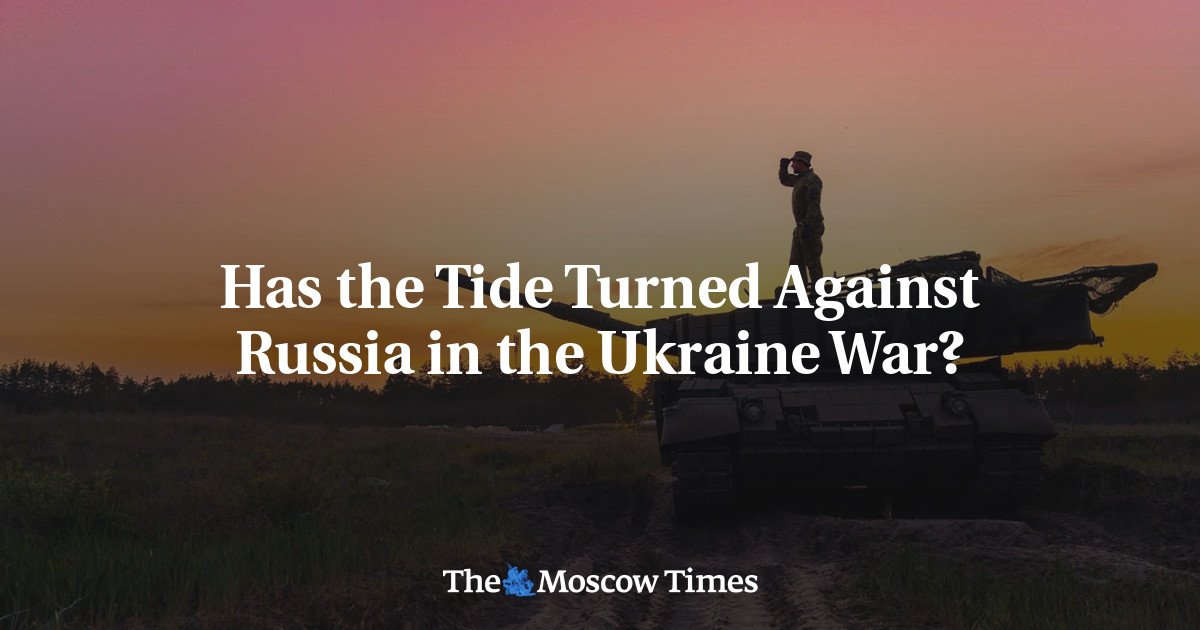
Ukraine’s recent battlefield gains and growing ability to disrupt Russian logistics appear to be eroding Moscow’s battlefield advantage — a shift that could eventually force the Kremlin to consider more decisive action, experts say.
While Russian forces continue to make slow advances in the Donetsk region, the main focus of their offensive, some analysts say the balance on the battlefield is beginning to tilt in Ukraine’s favor.
The Kremlin repeated this week that “the war could be ended before the end of the year or even within a day” if Kyiv withdraws from the occupied regions which Moscow considers its territory.
But some analysts argue that if Ukraine sustains its pressure for the next few months and Russia fails to adapt, Moscow could be forced to choose between a politically risky mobilization to escalate its fight or returning to the negotiating table.
Front line
The war has largely remained a positional conflict since late 2023, with neither side able to achieve an operational breakthrough, the U.S. think-tank Institute for the Study of War (ISW) said.
Neither Russia nor Ukraine has been able to mass enough infantry or heavy equipment near the front line to conduct large-scale maneuver warfare, it added.
While estimates vary, analysts broadly agree that Russia’s rate of territorial gains has slowed significantly this year.
General Staff of the Armed Forces of Ukraine
Russian forces captured 104 square kilometers of Ukrainian territory between the start of 2026 and May 26 compared with 1,619 square kilometers during the same period of 2025, the ISW said.
According to the Ukrainian OSINT project DeepState, Russia lost around 40 square kilometers in areas around Donetsk, Zaporizhzhia and Dnipropetrovsk last week, marking its largest weekly territorial loss since late 2023.
DeepState also estimated Moscow captured only 20 square kilometers of Ukrainian territory in May, the lowest monthly total since the fall of 2023.
Military analyst Yury Fedorov said the battlefield situation could represent “a potential turning point or the conditions for one in Ukraine’s favor” at the tactical level.
“But the overall trend is clear,” Fedorov told The Moscow Times.
According to DeepState, Ukraine has recently made gains in the south of the Donetsk region as well as parts of the Zaporizhzhia and Dnipropetrovsk regions.
Ukrainian military analyst Ivan Stupak said one of the key areas of fighting remains around Zaporizhzhia, a major city with a pre-war population of around 700,000, where Ukrainian forces have repelled Russian advances to within roughly 20 kilometers of the city.
This summer, the town of Kostiantynivka is likely to become the main battleground, he said. The town is one of three major urban centers in the Donetsk region that remain under Ukrainian control, alongside Kramatorsk and Sloviansk.
Stupak said Russia has little chance of reaching Kramatorsk or Sloviansk this year, adding that it would be a “huge achievement” for Moscow if it managed to capture Kostiantynivka in 2026.
Fighting for Sloviansk and Kramatorsk is unlikely to begin before next spring at the current pace of operations, he said.
General Staff of the Armed Forces of Ukraine
Drones and logistics
Experts say Ukraine’s improving position is closely tied to its expanding drone capabilities and its ability to strike Russian logistical infrastructure.
“Russia is losing its former advantage” in medium-range drones, Fedorov said.
“The number of assault operations it carries out is not accompanied by any meaningful gains,” he said, adding that the effectiveness of Russian offensive operations had declined sharply in many sectors of the front.
Ukraine has also expanded its ability to strike targets far behind Russian lines, reportedly reaching locations up to 150 kilometers (93 miles) from the front, including the land route that links Russia with the annexed Crimea peninsula.
According to Bloomberg, Ukraine carried out a record 30 strikes on Russian oil infrastructure last month, hitting the Novorossiysk terminal and eight of Russia’s 10 largest refineries.
Last week, Ukraine also announced what it called “a logistics lockdown” to increase pressure on Russia’s rear areas and reduce its ability to conduct active assault operations.
“Ukraine’s degradation of the Russian air defense network through concentrated strikes against radars and air defense systems allows subsequent Ukrainian strikes to target other valuable assets in the Russian rear,” the ISW said last week.
Russian military bloggers confirmed that Ukrainian strikes are creating growing logistical difficulties, causing fuel shortages and seriously hampering personnel rotations and ammunition supplies.
Rybar, a widely followed pro-war Telegram channel reportedly run by a former Defense Ministry employee, said Ukrainian drone strikes were creating problems “far beyond” fuel shortages and supply disruptions in Crimea.
Another Russian military Telegram channel, Donetsk Infantry, said Ukraine’s drone campaign had “undermined” the traditional concept of a secure rear area.
“Now, in the deep rear areas, any target is reachable. In the near future — no later than six months — as technology develops, this will extend to deeper rear areas, especially Russia’s Rostov region,” it said.
General Staff of the Armed Forces of Ukraine
Ukraine’s drone campaign is likely to intensify further once Kyiv receives a new 45 billion euro ($52 billion) European aid package expected this month, including 6 billion euros ($6.9 billion) earmarked for drones, Stupak said.
Ukraine currently launches about 5,500 drones per day, he said.
“The ‘wall of drones’ is working. In addition, drones are now being automated so that a single operator can control two or three drones simultaneously in the air. All of this is affecting the front line,” he added.
Pro-Kremlin Rybar also said that Ukrainian drone operators “are systematically working to disrupt Russian army supply lines,” a trend that is particularly visible in statistics on strikes and attempted attacks on various types of transport in occupied Donetsk, Luhansk, Zaporizhzhia and Kherson regions.
Even so, some analysts caution against overstating the impact.
Ruslan Leviev, founder of the Conflict Intelligence Team monitoring group, said Russia’s logistical problems are still not as severe as “they are being portrayed in the media.”
“So far, there have not been that many of these cases [vehicles hit by Ukrainian drones]” to cut supply routes, he said, referring to attacks on the land bridge that links Russia with Crimea and the southern areas of the occupied territories.
“Of course, these [attacks] still create problems for the Russian military…We are seeing reports that Russian long-haul truck drivers are now unwilling to transport fuel tankers through these areas even for high pay,” he said. “But there is still no real cutting of supply routes or [Ukrainian military] control over these roads.”
Manpower pressures
Both sides continue to face challenges replenishing personnel losses as the war has dragged into its fifth year.
Russia has suffered roughly 1.2 million killed and wounded since the start of the war, according to estimates by the U.S.-based think tank Center for Strategic and International Studies. A separate tally by the exiled news outlet Mediazona and BBC Russian have verified the deaths of more than 221,000 Russian military personnel.
To avoid a new round of mobilization, widely seen as a highly unpopular measure, Moscow has increasingly relied on more covert methods to replenish its forces, including substantial financial incentives to attract low-income Russians and foreign nationals.
While Russia has repeatedly promised not to deploy conscripts to the front lines, rights advocates and independent media have reported that some are pressured into signing military contracts that allow deployment to Ukraine. Students are also routinely encouraged to sign up for Russia’s drone forces.
Ukraine last released official casualty figures in February, acknowledging that 55,000 of its servicemen had been killed. The website Ukraine Losses, which tracks military deaths using open-source information, estimates the number at more than 97,850.
General Staff of the Armed Forces of Ukraine
Turning point or not?
While Ukraine has gained some tactical advantages, experts stress that Kyiv would need a sustained period of superiority in order to put Russia on the back foot — something that has yet to materialize.
Stupak said Ukraine lacks the resources needed for a large-scale offensive aimed at retaking all occupied territory.
“Both the economy and society are exhausted. Any serious offensive would require hundreds of tanks, thousands of personnel and substantial air support — and [Ukraine] has none of those resources,” Stupak said.
Instead, he said, Kyiv’s immediate objective is to halt Russian advances rather than launch a major counteroffensive.
Leviev echoed that assessment, saying Ukraine is not currently dictating conditions on the battlefield.
“There are new challenges and new threats for the Russian army, which it will have to deal with and try to adapt to. It is possible that the Russian army will not cope with them and then this problem will become more acute,” he said.
“But this should not lead to conclusions that…a large-scale Ukrainian offensive is about to take place that will liberate vast territories,” he said.
For now, Fedorov said, the significance of Ukraine’s recent gains lies in their potential impact on Russia’s stated objective of capturing the remainder of the Donetsk region and advancing deeper into Zaporizhzhia.
If current trends continue, Russia’s diminishing advantage could become a serious problem for Moscow by the fall, he said.
“That would place Russia in a very difficult position,” Fedorov told The Moscow Times.
In the worst-case scenario for Russia, Fedorov said, “the choice would be either mass mobilization — which may not produce the expected results — or ending hostilities and pursuing a diplomatic solution.”
A Message from The Moscow Times:
Dear readers,
We are facing unprecedented challenges. Russia’s Prosecutor General’s Office has designated The Moscow Times as an “undesirable” organization, criminalizing our work and putting our staff at risk of prosecution. This follows our earlier unjust labeling as a “foreign agent.”
These actions are direct attempts to silence independent journalism in Russia. The authorities claim our work “discredits the decisions of the Russian leadership.” We see things differently: we strive to provide accurate, unbiased reporting on Russia.
We, the journalists of The Moscow Times, refuse to be silenced. But to continue our work, we need your help.
Your support, no matter how small, makes a world of difference. If you can, please support us monthly starting from just $2. It’s quick to set up, and every contribution makes a significant impact.
By supporting The Moscow Times, you’re defending open, independent journalism in the face of repression. Thank you for standing with us.
Continue
Not ready to support today?
Remind me later.
×
Remind me next month
Thank you! Your reminder is set.


