






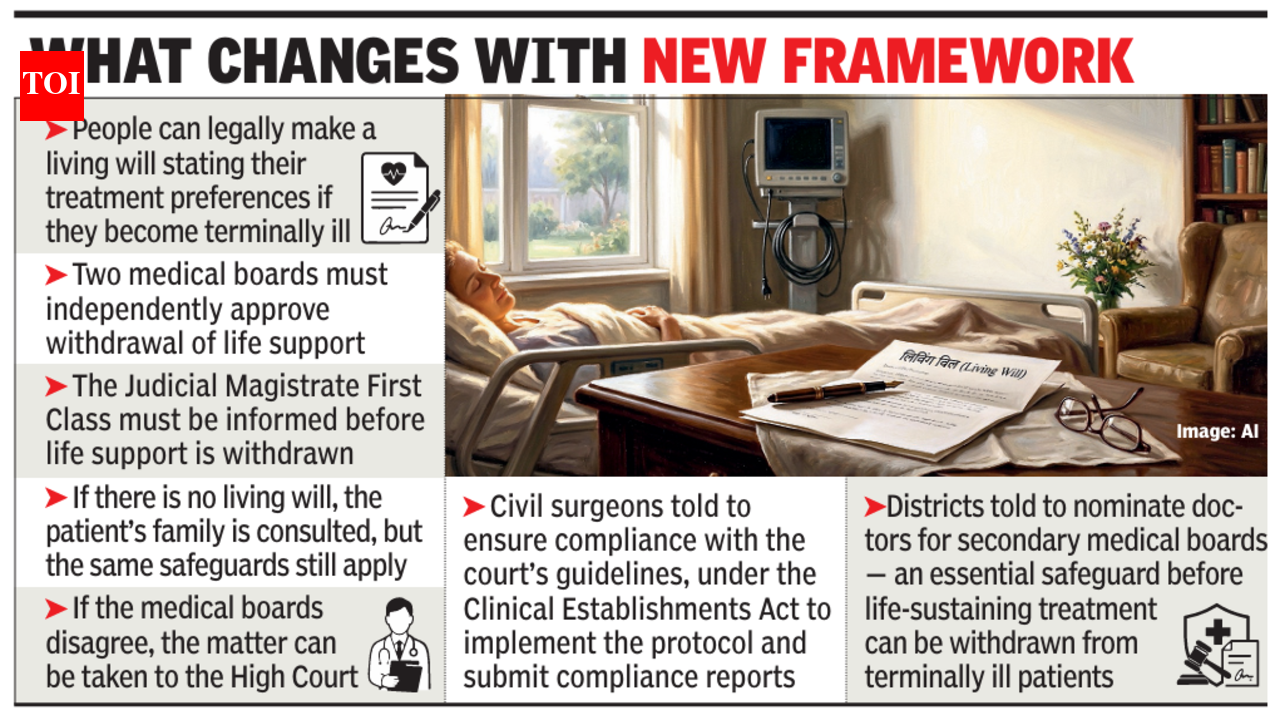
Gurgaon: Haryana govt has begun putting into practice Supreme Court’s judgment on right to die with dignity, asking hospitals across the state to follow a legally defined protocol for end-of-life care, appoint specialist medical boards and implement the framework governing living wills.The health department has asked civil surgeons to ensure compliance with the court’s guidelines, while districts have been told to nominate doctors for secondary medical boards — an essential safeguard before life-sustaining treatment can be withdrawn from terminally ill patients.In Gurgaon, the civil surgeon has directed all hospitals registered under the Clinical Establishments Act to implement the protocol and submit compliance reports.
CJP Jantar Mantar Protest Updates
The district has nominated physician Kajal, anaesthesiologist Suman Khurb and anaesthetist Kusum to its secondary medical board.The framework results from Supreme Court’s judgment in “Common Cause vs Union of India” case. While the apex court recognised the right to die with dignity under Article 21 in its March 9, 2018, verdict, it substantially simplified the procedure for living wills and withdrawal of life support through its Jan 24, 2023, order, making the safeguards more practical for hospitals and families.A living will, or advance medical directive, allows an adult to record in advance how they wish to be treated if they become terminally ill and lose the ability to communicate or make medical decisions. It must be signed voluntarily, witnessed by two persons and attested by a notary or gazetted officer. The person must also nominate a guardian or close relative to represent their wishes if required.The guidelines make it clear that neither a doctor nor a family member can unilaterally decide to withdraw life support.“If a patient has a valid living will and doctors conclude that further treatment is medically futile, the hospital must first constitute a primary medical board comprising the treating doctor and two specialists,” a health department official said.If the primary board recommends withdrawal of treatment, the case must be independently reviewed by a secondary medical board comprising a doctor nominated by the chief medical officer and two specialists. Life support can be withdrawn or withheld only if both boards reach the same conclusion and the jurisdictional judicial magistrate first class is informed.The same safeguards apply even if no living will exists. In such cases, the treating doctor must consult the patient’s family or guardian, after which both medical boards must independently assess the patient before any decision is taken.Officials said the framework is intended to remove the legal uncertainty that often forced hospitals to continue treatment despite there being no realistic chance of recovery. The health department will review implementation on July 29 at a meeting chaired by additional chief secretary (health) Mani Ram before submitting a compliance report to the Supreme Court.


