



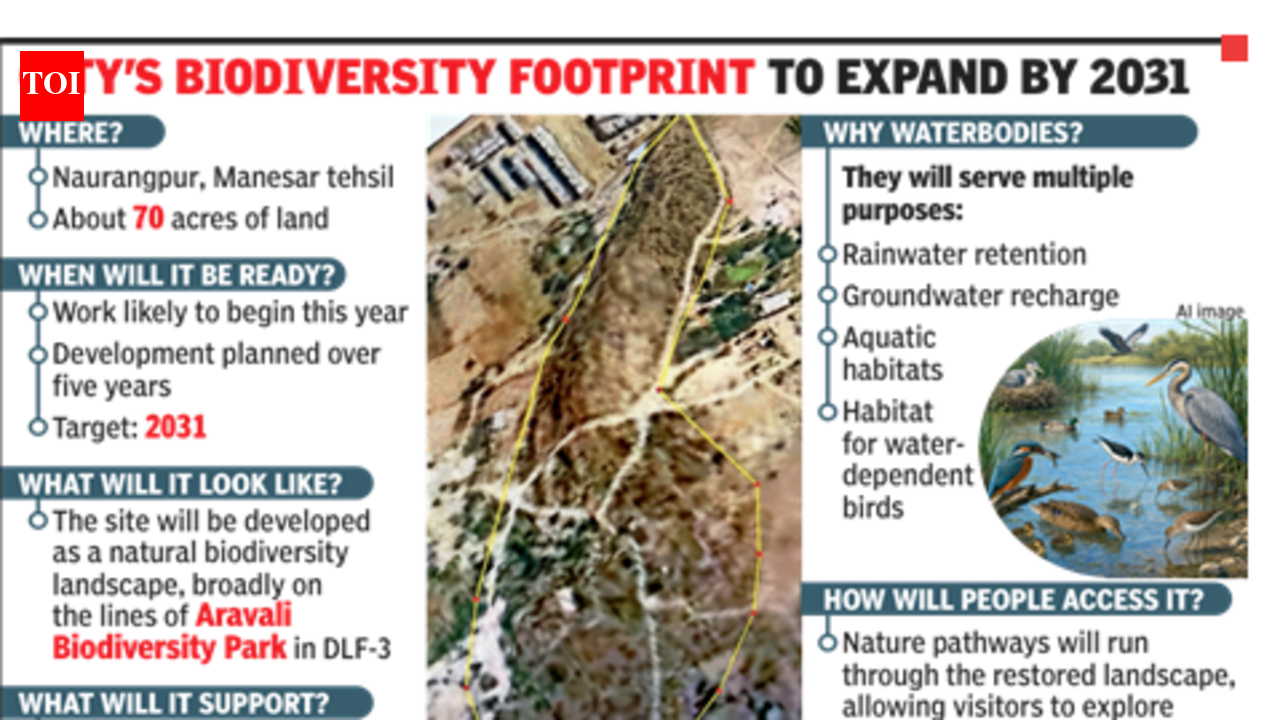
Gurgaon: By 2031, the city is set to get a new biodiversity park. A 70-acre patch of land at Naurangpur — in Manesar tehsil — is set to become the city’s next major biodiversity landscape.Haryana forest department, which is planning to begin the work this year, will develop the site over five years.The land, currently with MCM, will be developed broadly on the lines of Aravali Biodiversity Park in DLF-3.Officials and ecological restoration experts say the aim is not to create another conventional urban park with lawns and ornamental plantations.Instead, the site will be designed around natural habitats that can support native Aravali plants, grasslands, waterbodies, birds, butterflies, insects and reptiles.A forest official said, “The park will have nature pathways through the restored landscape, allowing visitors to access different sections while keeping disturbance to sensitive habitats limited. Waterbodies will be an important part of the plan, serving as rainwater retention and recharge areas as well as habitats for aquatic life and water-dependent birds.”The five-year timeline is important because creating a biodiversity landscape involves more than planting saplings. Native vegetation needs time to establish, different habitats have to develop and wildlife gradually returns as suitable conditions emerge.Vijay Dhasmana, an ecological restoration and rewilding practitioner who spearheaded the restoration of Aravali Biodiversity Park, said Naurangpur should be treated as a habitat restoration project rather than a landscaping exercise.“The idea is to develop this Aravali landscape as a biodiversity hotspot for species native to the Aravalis. The focus should be on creating the right habitat for the entire range of biodiversity, from plants and geckos to butterflies and birds, rather than simply creating a landscaped green space. The park should also include an interpretation centre, guided trails and programmes for schools so that children can learn about the Aravalis and use the site as a living classroom. Aravali Biodiversity Park itself took many years to develop because Aravali species and habitats take time to establish. The Naurangpur park should therefore be seen as a long-term ecological restoration and conservation project,” Dhasmana told TOI.The plantation plan will focus on native species suited to the semi-arid Aravali landscape. Rather than creating a uniform canopy, the park will have a mix of trees, shrubs, herbs, climbers and grasses, along with grassland and scrub areas.The approach draws from the experience of Aravali Biodiversity Park, a 392-acre former mining site near the Delhi-Gurgaon border that was once heavily degraded by mining, stone crushing, tree felling, grazing and waste dumping. Restoration there focused on bringing back native Aravali vegetation rather than creating a landscaped green space. Today, the park supports more than 300 native plant species and provides habitat for a wide range of birds and other wildlife. It also functions as a water conservation and groundwater recharge area, carbon sink, education space and recreational site.The project comes amid rapid changes in the surrounding landscape. An ecological assessment of Naurangpur and neighbouring villages found a decline in forest and agricultural areas over the past decade, accompanied by a sharp increase in built-up land. It also recorded a decline in waterbodies.Against this backdrop, the proposed park could provide habitat for native species while helping retain rainwater, recharge groundwater and create a large green space for the city.As to the five-year plan, Aravali Biodiversity Park itself followed a similar process, including the removal of invasive Prosopis juliflora and the introduction of native species collected from surviving Aravali forests.The site later became India’s first area recognised internationally as an Other Effective Area Based Conservation Measure, acknowledging its contribution to biodiversity conservation outside conventional protected areas.


