






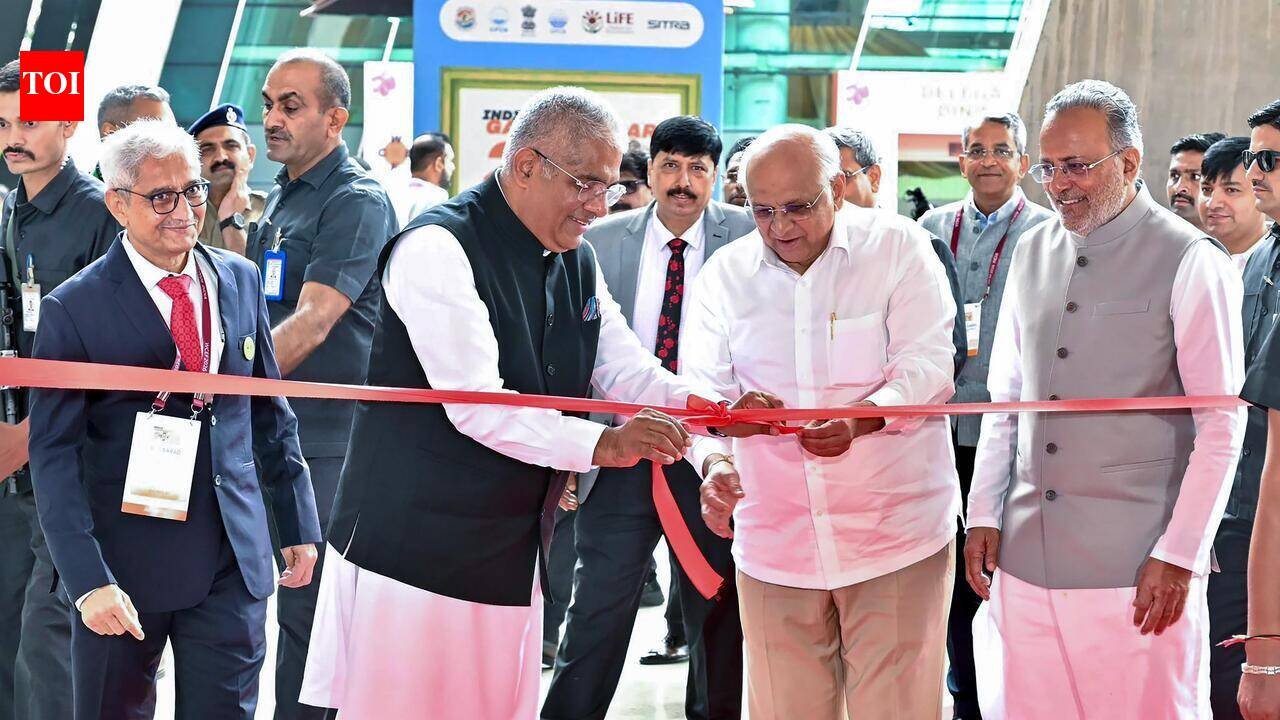
Gandhinagar: Gujarat’s efforts to turn waste into wealth, including a circular-economy model being implemented at Somnath temple, will get a global showcase as the 10th World Circular Economy Forum (WCEF) opened at Mahatma Mandir here on Tuesday.Chief Minister Bhupendra Patel, who inaugurated WCEF-2026 in the presence of Union environment minister Bhupender Yadav, said the forum would give Gujarat an opportunity to showcase its best practices to the world and learn from global models.“Development and the environment are not contradictory to each other. We need greenery alongside growth and ecology alongside industry,” Patel said. He added that the ‘waste to wealth’ approach was not merely a waste-management model but could give a new momentum to the rural economy.More than 2,000 stakeholders, scientists and entrepreneurs from around 66 countries are participating in the four-day forum, being held in South Asia for the first time. The event, which continues till Sept 18, will focus on reducing global emissions, circular business models and sustainable economic growth. An international expo featuring more than 125 stalls showcasing green innovations, waste-to-wealth models and recycling technologies was also inaugurated.Patel cited the Somnath temple as a prime example of circular economy practices. Offerings such as flowers, ‘bilipatra’, milk, water, ‘panchamrut’ and clothes are processed rather than discarded. The liquid collected during the ‘abhishek’ ritual is scientifically purified and distributed to devotees as ‘Som-Ganga Jal’. Organic waste is converted into compost, while plastic waste is used to make paver blocks, with local women’s self-help groups involved in the initiative.Yadav said circular economy was much more than waste disposal or recycling, describing it as a philosophy covering the entire lifecycle of resources, from design and production to consumption, reuse, repair and remanufacturing. “The true success of a circular economy lies not in how much waste we recycle, but in how many resources we can conserve for future generations,” he said.Yadav said India had also put mechanisms such as extended producer responsibility in place under Environment Protection Act for managing plastic, e-waste, batteries, scrap metal and construction and demolition waste.State forest and environment minister Arjun Modhwadia said India’s circular economy market was projected to cross $2 trillion by 2050 and could generate around one crore jobs. Gujarat, he said, had the country’s largest hazardous-waste resource recovery system and a strong circular-economy ecosystem, with 1,242 recycling facilities and 19 core processing units. About 63% of waste in the state was recycled last year, he said. Gujarat also has 41 e-waste recyclers and 12 refurbishers.The forum is being jointly organised by the Union environment ministry, CPCB, Gujarat govt, GPCB, Finland’s Innovation Fund Sitra and the govt of Finland. Speakers from Netherlands and Finland also stressed the importance of circularity amid climate change, geopolitical tensions and supply-chain uncertainties.Finland ambassador Mikko Kivikoski said hosting the 10th edition in India for the first time was significant as it would bring the needs and solutions of the Global South and emerging economies to the centre of the circular-economy debate.


