


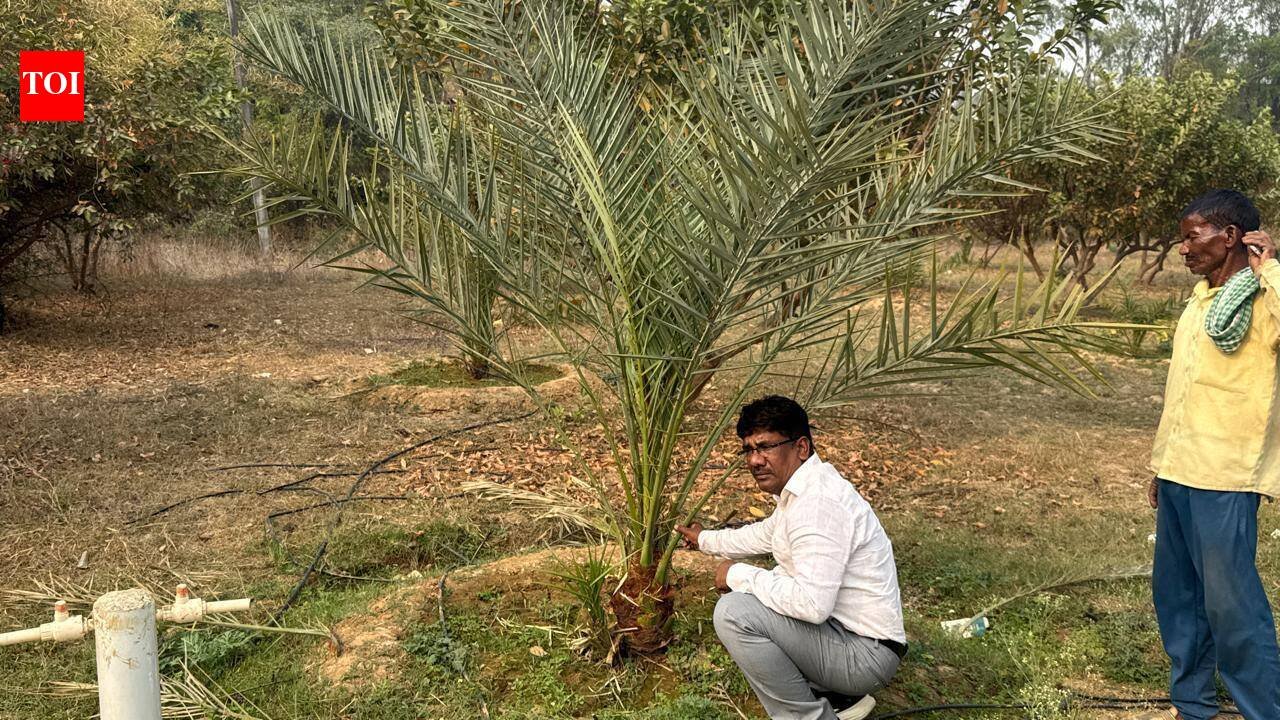
Prayagraj: Moving beyond traditional agriculture and horticulture toward the cultivation of high-value commercial crops, the state government is raising awareness and encouraging farmers to select crops suited to the changing conditions.The introduction of date palm cultivation — following the earlier promotion of dragon fruit—is part of fresh initiative by the government.Farmers are now grappling with unexpected climatic shifts. Scanty monsoon rainfall is making the cultivation of traditional, irrigation-dependent crops a loss-making proposition. Recognizing the need for horticultural innovation to address the prevailing issue, date palm cultivation has been introduced. The plant yields excellent produce even in desert-like or arid climates, under intense sunlight, and with minimal water. Consequently, it is expected to thrive in the climate of the ‘Patha’ region in Prayagraj.A specific date palm variety has been selected based on the climate and soil conditions of Prayagraj’s Patha region. District Horticulture Officer (Prayagraj) Mewaram told TOI that the ‘Barhi’ variety is the best choice, considering both farmer preference and market demand. He added, “ It’s most distinctive feature is that it belongs to the rare category of date palms whose fruit can be consumed while still raw and yellow”.While most date palm varieties are highly astringent when unripe, the Barhi variety is crisp, sweet, and delicious—reminiscent of an apple or guava—in its yellow stage. Upon full ripening, the pulp becomes buttery-soft, juicy, and honey-sweet.“ It’s ready for harvesting by late June or early July” said Mewaram adding “ The fruit is picked before the onset of monsoon rains, thereby completely eliminating the risk of rot caused by rain and humidity”Moreover, there is no need to dry the fruit to produce chhuhara (dried dates) or pind khajoor (pressed dates). It is sold in the market as fresh fruit immediately after being harvested from the tree, saving both processing time and costs. A mature tree yields an average of 100 to 150 kilograms of fruit annually.Several districts in Uttar Pradesh possess agro-climatic conditions favorable for date palm cultivation. Given these suitable conditions, cultivation was initiated in Mirzapur. Following Mirzapur, Prayagraj is the second district in the state to launch this initiative.Mewaram, ,meanwhile, said that the Shankargarh area and the arid belt of the Patha region have been found suitable for this crop. Consequently, 200 date palm saplings are being planted in this pocket. The planting is scheduled for September. The trees will begin to bear fruit and enter the production phase within the next three years. These are the regions where cultivation of crops requiring low rainfall and humidity—such as dragon fruit—is already underway.The Horticulture and Food Processing department of the state is implementing a special scheme to promote date palm cultivation in the state.Subsidies are sanctioned under the ‘Mission for Integrated Development of Horticulture’ and the ‘Rashtriya Krishi Vikas Yojana’ (National Agriculture Development Scheme).Mewaram claimed a subsidy of up to 40% is provided for commercial date palm cultivation in UP. The average input cost for establishing a date palm orchard is estimated at approximately Rs 4 lakh per hectare. Based on this, farmers receive a subsidy of up to Rs 1.60 lakh per hectare. Since the survival rate of date palm plants grown from seeds is very low, the subsidy is applicable only to plants produced through tissue culture.
