






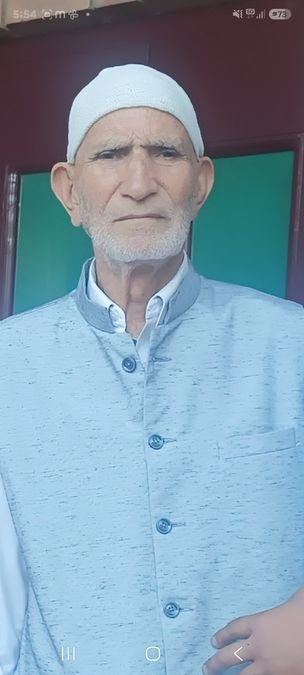
Srinagar, Oct 01: Ghulam Qadir Hafroo, a veteran trade union leader, former teacher and long-time advocate of workers and weaker sections, has passed away, bringing to an end a public life spanning several decades and marked by his involvement in employees’ movements, farmers’ issues and political activism.
Born in 1934 at Hafroo Chadoora in Budgam, Hafroo joined the School Education Department as a teacher. Alongside his teaching career, he became associated with the All J&K Low Paid Employees Federation and later served as its provincial president at a time when low-paid government employees were facing serious economic difficulties.
Hafroo was among the prominent leaders of the federation’s sustained agitation in 1967, which eventually led the government of the time to concede the legitimate demands raised by the employees.
The 1967 agitation remained one of the important phases of his trade union career and established his role as a leader who worked primarily on issues concerning low-paid employees and other sections of the workforce.
After his retirement from government service, Hafroo continued his involvement in public and social issues instead of withdrawing from organised activity. He became associated with the J&K Kisan Tehrik and the J&K Apple Federation, taking up issues concerning farmers, apple growers and other sections dependent on their livelihoods.
He was also associated with the CPI(M) for several decades and served as a member of its State Committee for more than 20 years.
Those who knew Hafroo closely recall that his public activism existed alongside a long career as a teacher, with former students remembering him for his intellectual depth, simplicity and close engagement with them.
“Ghulam Qadir Sir was a great human being, a man of remarkable intellectual depth, a great teacher and, above all, a truly down-to-earth person,” said Arshad, one of his former students.
For his students, Hafroo’s influence extended beyond the classroom. He is remembered as a teacher who imparted lessons that continued to remain relevant to them long after they had completed their schooling.
“I am sure all of us who had the privilege of being taught by this great man will agree that it is not merely difficult, but almost impossible, to find a teacher like him,” Arshad said.
His former students also recall his adherence to his political beliefs, particularly during periods when holding on to those convictions was difficult.
“He stood firm by his ideology even during the toughest of times, completely unbothered by the possibility of death. He never compromised on his principles, even when death was looming over him and people around him were falling prey to its harsh consequences,” Arshad said.
Hafroo’s activism was not limited to organisational politics. Those associated with him remember him for raising issues concerning people with limited means and for intervening on behalf of those who had little access to institutional power.
“He was a veteran trade union leader, always at the forefront of helping the needy and raising his voice for the voiceless,” Arshad said. “He had the courage to call a spade a spade and never hesitated to stand by what he believed was right.”
Hafroo’s public work consequently brought him into contact with different sections of society, from government employees and teachers to farmers and apple growers. His association with these causes continued for decades, including after his retirement from government service.
For those who studied under him, however, his identity as a teacher remained central to how they remembered him.
“For us, he was more than a teacher or a trade union leader; he was a member of our family. His passing is, therefore, a deeply personal loss for all of us,” Arshad said.
Hafroo’s demise has thus brought to a close the life of a man whose public engagement began in the classroom but continued through organised employees’ movements, farmers’ and growers’ organisations and political activism.
His contribution to trade union activity, particularly the 1967 employees’ agitation, his work among farmers and apple growers, and his long association with the CPI(M) form the principal strands of his public life, while generations of his students remember him for the personal influence he exercised as a teacher.


