



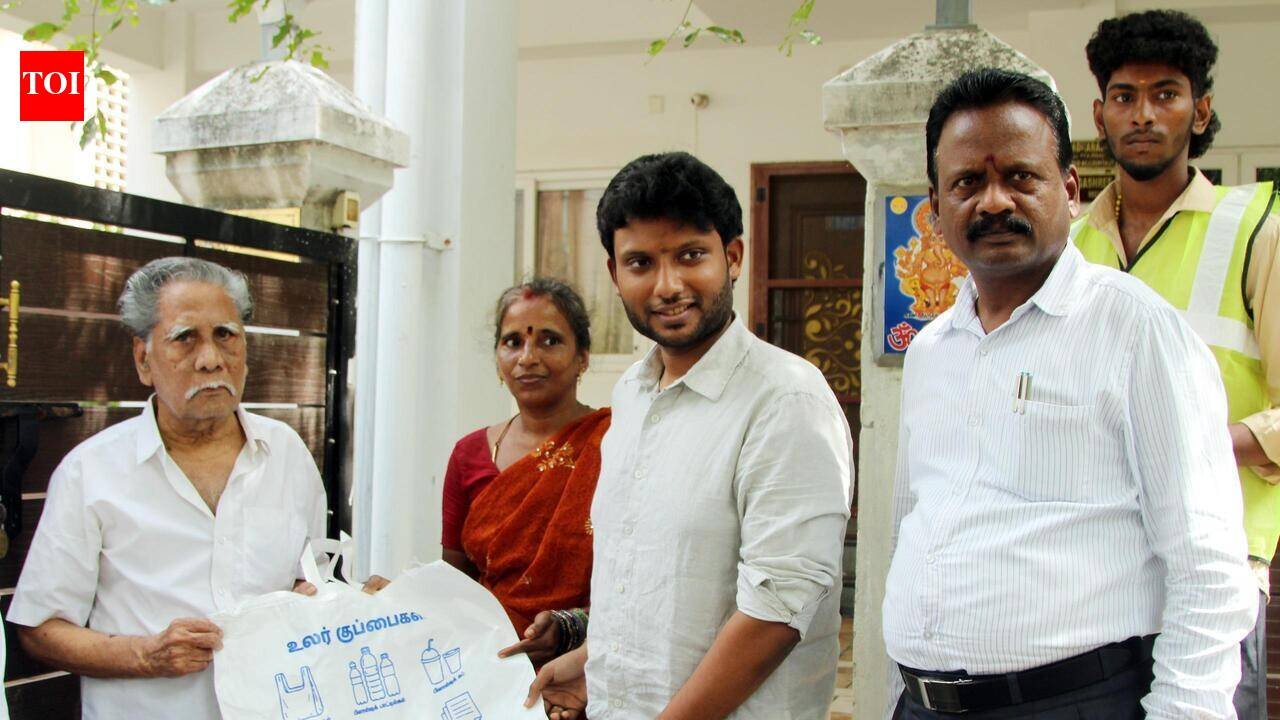
Chennai: Greater Chennai Corporation (GCC) on Saturday launched a 40-day door-to-door campaign across five south Chennai zones to encourage households to segregate waste at the source, with field workers using stickers on houses to track compliance. The civic body said it will enforce penalties under the Solid Waste Management Rules, 2026 for violations from next month.The campaign, “Kuppai Pirippom – Naalai Kaapom”, was rolled out across Valasaravakkam, Alandur, Adyar, Perungudi, and Sholinganallur zones. GCC has identified 10,000 households in each zone for the drive.On Saturday, GCC officials, MLAs and councillors visited the families to spread awareness. Each household received a dry-waste collection bag and an awareness kit explaining what constitutes dry waste, how it should be segregated at source and how it should be handed over.The aim is to provide households with a practical solution for collecting dry waste separately while making segregation more visible, GCC officials said. “This campaign is about spreading awareness and monitoring. When workers go to collect the garbage, they will check if segregation is done and mark it on a sticker pasted outside homes,” an official said.“From next month, fines will be collected,” she said, adding that the campaign will be spread to other regions too.GCC collects around 6,150 tonnes of garbage every day. How much of this is segregated at the household level determines how much can be composted or recycled rather than being dumped at Kodungaiyur and Perungudi dumpyards.The campaign will involve repeated visits by GCC and Urbaser Sumeet field teams over the 40 days. The teams will reinforce segregation practices, address implementation difficulties and monitor household participation. At the end of the campaign, GCC plans to assess participation, waste collection performance and changes in source-segregation practices. Poornima K, a resident of Adyar, said, “All houses must use separate bins for wet and dry waste. Sometimes, even when we separate the waste, conservancy workers mix it up. That shouldn’t happen anymore.”


