



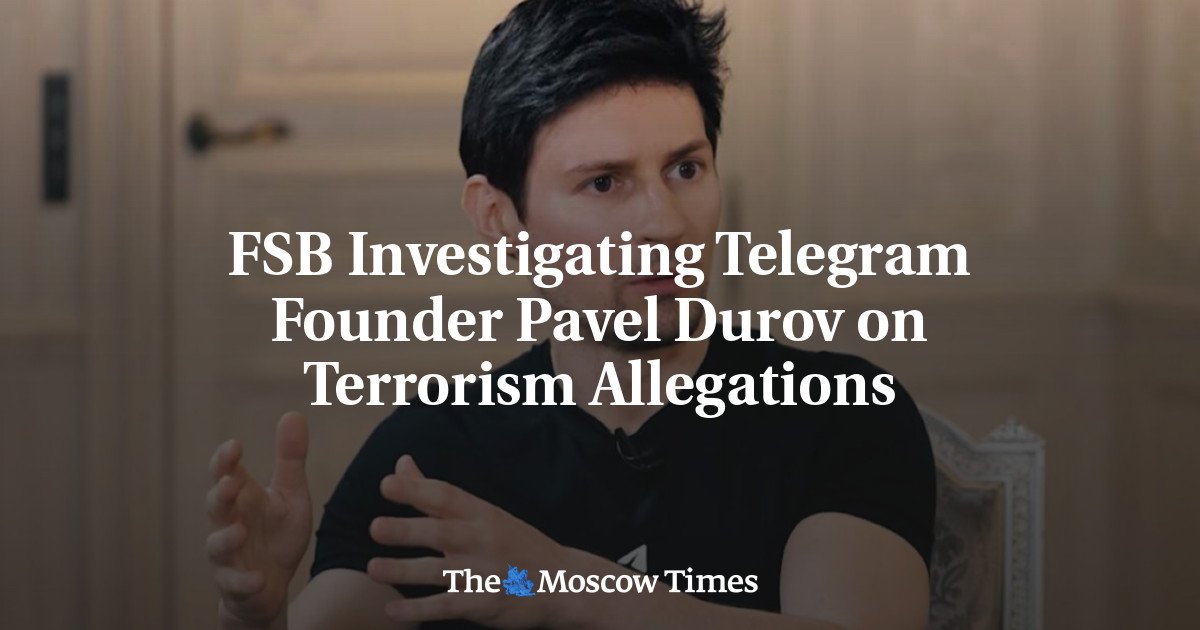
Russia is ramping up its pressure on Telegram after media reports revealed early on Monday that the FSB security service is investigating Pavel Durov, the billionaire founder of the popular messaging app, on accusations of terrorism.
The investigation, first reported by the government newspaper Rossiskaya Gazeta and the pro-Kremlin tabloid Komsomolskaya Pravda, comes as Russian state regulators introduce an increasing number of restrictions on Telegram for allegedly serving as a haven for criminal activity.
According to FSB documents cited in the reports, intelligence agencies from NATO countries and Ukraine are using Telegram as a tool of “hybrid warfare” against Russia, including for organizing political unrest, as well as acts of terrorism and sabotage.
The FSB claims Telegram has refused to provide encryption keys that would allow it to access messages sent by suspected criminals.
That refusal, the security service argues, has allowed various groups to carry out deadly attacks inside Russia, including assassinations of senior military officials and terrorist acts such as the March 2024 mass shooting at Crocus City Hall outside Moscow.
“Pavel Durov’s actions are being investigated as part of a criminal case under Part 1.1 of Article 205.1, ‘assistance to terrorist activity,’” the Komsomolskaya Pravda report read.
Telegram did not immediately respond to the allegations. Durov, who lives in Dubai and also holds French and UAE citizenship, has not commented on the reported investigation.
The charge of aiding terrorist activities carries a maximum prison sentence of 15 years.
Authorities in Moscow argue that their clampdown on messaging apps like Telegram and WhatsApp is based on security concerns as the country faces an increasing number of attacks blamed on Ukraine and its allies.
Western intelligence agencies like the CIA have been openly trying to recruit Russians in recent years, but none have taken responsibility for killings or acts of sabotage inside Russia.
Telegram, which has around 90 million users in Russia, is becoming more difficult to use without a virtual private network, or VPN, as the state media regulator Roskomnadzor slows download speeds and blocks video and voice calls on the platform.
The company has dismissed accusations that it is enabling criminal and terrorist activity, calling the restrictions an attempt to force Russians to switch to the state-backed messenger Max, which critics, including Durov, say was created for mass surveillance and censorship


