





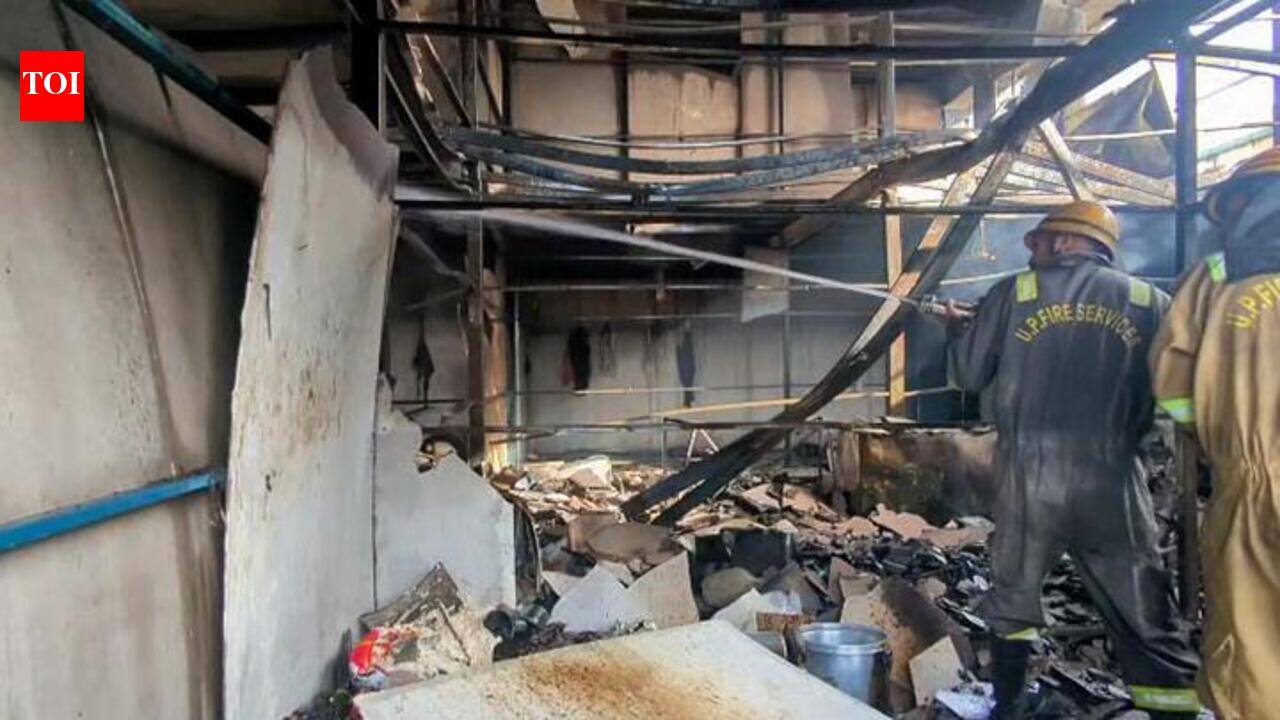
Noida: As a shrill alarm cuts the air, a clutch of firefighters move towards a smoke-filled building — calm, methodical and working with the kind of precision that comes from knowing a lost minute or a faulty piece of equipment can cost a life. Outside, another group sets up ladders for the upper floors and trains water jet at the building.This, however, is a typical drill, held every Tuesday and Thursday, for the 214 firefighters at the nine fire stations across the city.Firefighting, chief fire officer (Noida) Pradeep Chaubey told TOI, starts long before a fire actually breaks out. “Preparedness, that is knowing how and when to use breathing apparatus (BA) sets, ladders, rescue tools, hoses and other firefighting equipment, helps firemen improve coordination and communication during emergencies and is the backbone of firefighting.”A firefighter, who had just completed once such drill on Tuesday, said no two incidents were alike. “A residential fire, an industrial blaze and a hospital emergency all require different strategies,” the official said.From the moment an alert reaches a fire station, firemen just get 50 seconds to pull on an active protective uniform, lace up boots and board a tender till one is assigned, dispatched and details circulated through official communication groups.
Personnel have a target of leaving the station within 50 seconds of receiving an alert, just enough time to pull on a dangri, lace up boots and board the vehicle
Each unit comprises six personnel: a driver, a leading fireman and four firefighters. For high-risk buildings, the protocol expands. “According to the DG’s order, three fire stations must send tenders when any fire is reported, barring incidents in garbage dumps. As a CFO, I have also made a rule that all officers will rush to incidents at hotels or hospitals, where there is a possibility of people being trapped,” Chaubey said.The operation does not begin at the scene. As the tender moves, firefighters are already at work — establishing contact with building staff, mapping layouts, locating the fire and accounting for trapped occupants. Simultaneously, the team divides into two groups: one focused on life-saving, the other on containment.In high-rises, hospitals and hotels, hydraulic platforms and ladders reach the upper floors while firefighters, equipped with breathing apparatus, enter smoke-filled rooms. A rescue commander reads the situation continuously, adjusting strategy as conditions shift. Only once all occupants are accounted for does the team turn its full attention to the fire. When the flames are out, a thorough inspection follows to rule out reignition. If anyone is hurt, the team also arranges medical assistance on the spot.
Firefighters evacuate people stuck in the building housing a restaurant where a fire broke out
“When we know there is someone trapped in a fire, our job is to run towards the fire when everyone else is running away from it,” Chaubey said. There are moments when that instinct puts their own personnel at risk. “There have been many instances in which we have had to save our own officers, who may have collapsed due to the impact of the smoke. In such cases, we rescue them, move them to safety and continue battling the flames.”There are also incidents where the objective shifts, from rescue to recovery. “Emotions are kept at bay. Of course, we all get affected during cases when we have to recover bodies from fires. Major fires, like the blast at Badalpur, stay with us for a long time, as do the horrifying images from the spot,” he said.The Jan 2025 explosion at Shri Banke Bihari Chemical Plant in Greater Noida’s Badalpur sent chemical drums hurtling 50 to 100 feet into the air in rapid succession.Another fire, more challenging still, broke out this March at the basement of a power meter manufacturing factory in Sector 4 of Noida Phase 1 that left one dead and at least 38 people injured, most while trying to escape the building. “Smoke was so thick it was impenetrable and forced the team to work blind. A firefighter had lost consciousness after inhaling smoke,” the CFO said.Firefighters usually carry breathing apparatus sets that allow 35 minutes of operation in heavy smoke, along with thermal imaging cameras, triple-layer suits and insulated boots1.3k fires this yearIn a district where highrises multiply by the year, the busiest single day logged 32 calls, while the daily average is seven. In 2025, the department attended 2,535 fires, while the count till May this year stands at 1,380.Officials said May is the peak month, when extreme heat, surging electricity demand and ageing infrastructure combine to produce anywhere between 300 and 500 fires. Also, some areas are more vulnerable than others. Phase 1, with its ageing wiring and congested construction, sees a disproportionate number of calls. Sites 4, 5 and C, under UPSIDA jurisdiction, present their own complications. Access remains the central challenge. “Narrow lanes in unauthorised colonies regularly block large tenders. Sometimes reaching the house itself becomes a challenge because the roads are too narrow or the address is difficult to locate,” an official said. Peak-hour traffic does the same. Officials continue to appeal to motorists to make way — a few seconds of clearance, they say, can determine an outcome.According to Chaubey, unserviced air conditioners, electrical appliances left running, and inattention during religious gatherings account for a large share of household fires. He recalled an incident in Gaur City where a family left a geyser switched on before going on vacation. By the time the call came in, the fire had spread far.


