





It is possible to write a history of India by studying the feet of its citizens. A political party comes to power with the promise of establishing Ram Rajya. It wasn’t exactly Ram, though, but his padukas or wooden sandals that sat on the throne in Ayodhya, a spiritual symbolism that marks devotion and can be found condensed in a name such as Ram Charan (the feet of Ram). How does the Indian State treat the feet of its citizens?

The haunting image of a torn sandal of a migrant worker walking to his home town hundreds of kilometres away to escape the hurriedly declared lockdown. Broken Foot, an exhibition documenting their plight, would feature, among other striking visuals of feet and walking, Balaji Ponna’s artwork, Walking Under an Empty Sky, which showed a single sandal, broken, kept together by wires, and, on it, almost like a hologram, the Indian map. There are Neeraj Priyadarshi’s photos of that time, recording the Indian State through the feet of these people walking in “a state of emergency”. In his photo of a man walking to Muzaffarpur, the latter’s slippers are tucked into his shirt collar, at the back of his head; his face is not shown, and his worn-out slippers have become his face in the photo. There are several others, including one of the journalist Salman Ravi offering his shoes to a labourer walking to his hometown, carrying a child in his arms — the state of a nation in its citizens’ barefoot lives and broken slippers.
Those walking in the opposite direction were not spared. Police hammered rows of iron nails into the tarmac so that farmers from Punjab and Haryana, protesting against the government, wouldn’t be able to walk into Delhi. Artist Kulpreet Singh records the nails and their various shapes as an alphabet of violence used by the nation-State against its farmers. “The government will plant nails and razor wires for us, we will plant flowers for it,” said one of the protesting farmers. Before this, of course, was the unleashing of demonetisation. Photos of the time show long rows of slippers and sandals, placeholder queues for citizens waiting outside banks. It bore a strange evocation of Ram Rajya — as Ram’s padukas once stood in for him, the tired citizens’ shoes did for them. Protesters at Shaheen Bagh a few years later, when forced to evacuate the site by the declaration of the Janata Curfew because of Covid, did something similar — they left their footwear behind to show their “symbolic presence”.
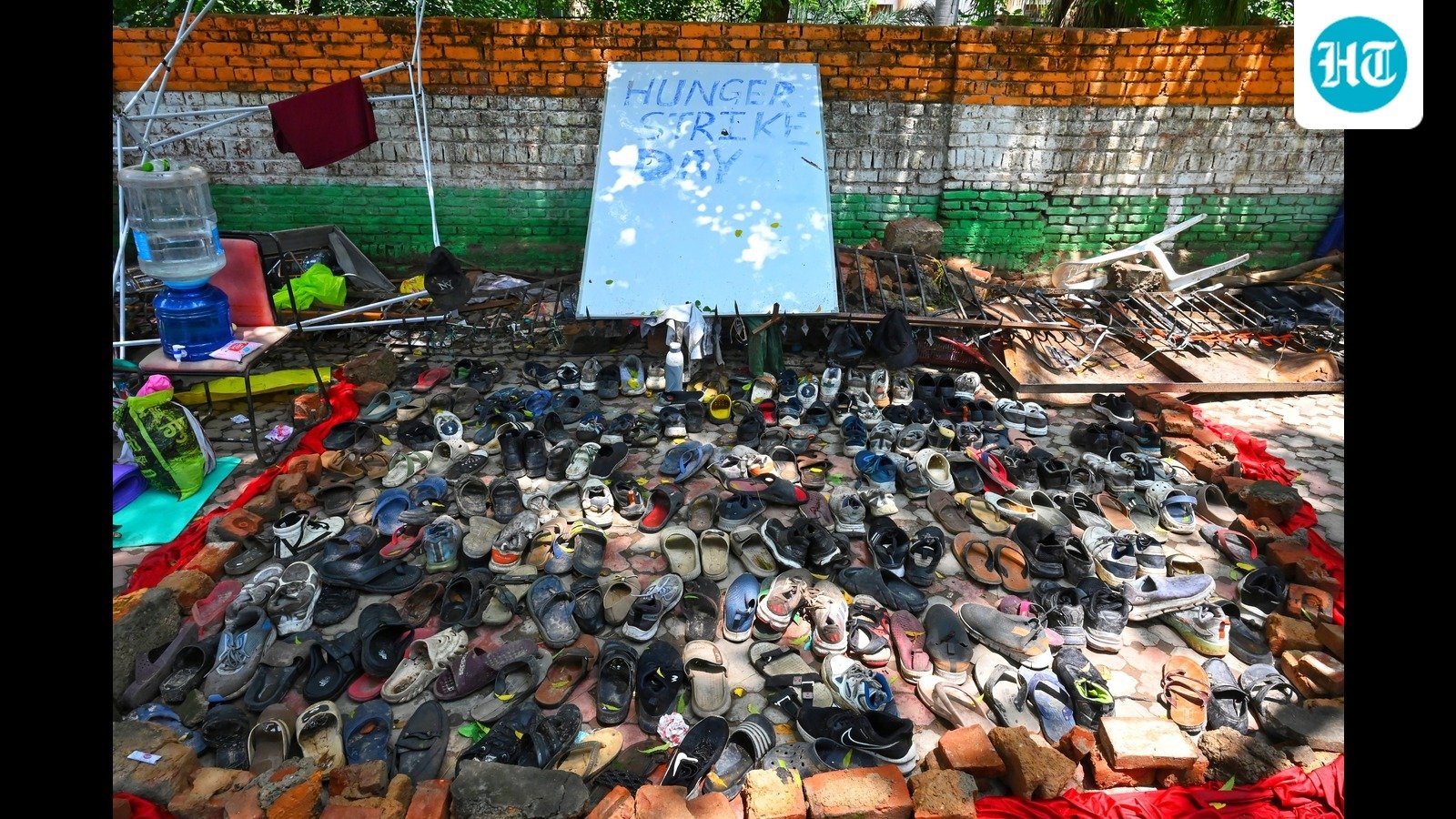
On July 20, 2026, students and other protesters, in trying to protect themselves from lathi charge and teargassing, ran, their sandals and shoes falling off their feet near the Constitution Club of India, Sansad Marg, and Jantar Mantar. There was a congregation of shoes there, besides those gathered in potholes, recording a moment of our history, one of survival and resistance. Rahul Gandhi’s shoe, one of a pair that must have fallen off while he was being dragged away by the police from sit-in, must be there too. (The 9/11 Memorial Museum in America is home to the “shoes of its survivors”; the United States Holocaust Memorial Museum displays shoes recovered from Nazi killing centres.)
I wonder what the Indian State will do with these shoes — put them up for sale, like they do contraband and uncleared goods? Or like they are in Ernest Hemingway’s moving six-word story: “For sale: baby shoes, never worn?” A “For sale: shoes worn by protesters”? There is, of course, a minor Indian tradition of referring to people through the footwear trope. Not only the constituency called chatukar, the proverbial bootlicker, but also those who have been identified with it, in a metonymic manner. Mamata Banerjee, who’s often been derisively called hawai choti (rubber slippers) by her detractors, referencing her preferred footwear; MF Husain, who wore no footwear at all. But it was not to them that my mind went when I saw a young, good-natured man collecting the hurriedly abandoned footwear the next morning. It rushed to Premchand, a photograph of him with his wife, a photo made famous by the writer’s torn shoes, and from there to an essay that was inspired by it — Harishankar Parsai’s Premchand Ke Phatey Jootey(Premchand’s Torn Shoes). Parsai writes about a literary ancestor’s shoes, looking at it both as material thing and metaphor: “Shoes have always been dearer than caps.” How could I not have thought of these lines when faced with images of the shoes in Jantar Mantar: “You are laughing at me or at all of us, at those who have concealed their toes by grazing their soles, at those who prefer to detour when faced with an obstacle. You are saying, ‘I tore my shoes by kicking continuously against the obstacle so that my toe peeped out but my foot was safe, and I continued walking. However, in your concern to conceal your toe, you are ruining your sole. How will you walk?”’ (translated by Sonakshi Srivastava).
If I had a fabular imagination, I might have been able to imagine a Cinderella-like situation, the police knocking on every door in the country, trying to find out the owner of these shoes. What might be the result? Cinderella was rewarded with her Prince Charming. What would the citizen of the left-behind footwear be given — reward or punishment? Or would it be a variation of joota chhupai, a custom of the bride’s family stealing the groom’s shoes for a ransom? “Jootey de do …”
Sumana Roy is an award winning poet. The views expressed are personal


