






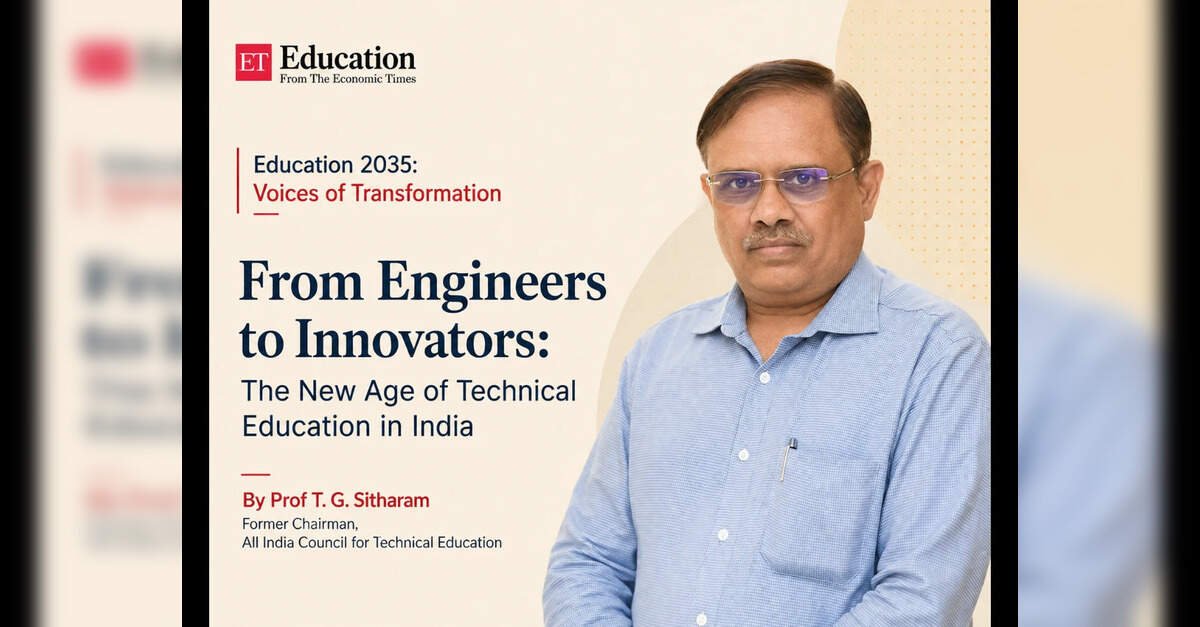
By Prof T G Sitharam
India’s technical education system has undergone a major transformation over the last 25 years. Between 2000 and 2025, the country witnessed steady growth in research, patents, high-technology exports, startups, and innovation-driven learning. The introduction of the National Education Policy (NEP) 2020 further accelerated this shift, moving education from being degree-oriented to skill-driven, technology-enabled, and innovation-focused.
Learning today is very different from the past. Students now have access to multidisciplinary courses, flexible learning pathways, and outcome-based education. There is greater emphasis on research, innovation, critical thinking, and real-world problem-solving. Entrepreneurship and industry certifications have become important components of technical education.
Initiatives such as Smart India Hackathon, Kavach, and Toycathon have emerged as strong platforms for innovation and problem-solving. These programmes encourage students to tackle real-world challenges through teamwork, creativity, and rapid prototyping while nurturing an entrepreneurial mindset. Mandatory internships and dedicated internship portals have also strengthened practical exposure and industry engagement for students.
India has been producing nearly 1.25 to 1.5 million engineers annually over the past two decades. However, rapid expansion also exposed concerns around employability, as many graduates were not adequately prepared for industry requirements. This led to a stronger focus on practical skills, critical thinking, entrepreneurship, and advanced skilling in emerging technologies such as artificial intelligence (AI), robotics, drones, 3D printing, cybersecurity, quantum technologies, and semiconductors.
After 2010, India’s growing IT sector created strong demand for software, computing, and data-related skills, prompting education systems to adapt. New disciplines such as data science, cloud computing, and AI became integral to engineering education. Government initiatives including SWAYAM, NEAT, and Skill India expanded access to quality learning and vocational training.
Institutions also responded to NEP 2020 by introducing interdisciplinary programmes, AICTE Idea Labs, Atal Tinkering Labs, 3D printing and prototyping labs, Centres of Excellence, Centres for Future Skills, and stronger industry partnerships to promote experiential learning.
The most significant transformation came after 2020, when AI and data science programmes expanded rapidly across engineering colleges. Although AI-related courses began around 2018 in over 1,200 institutions, artificial intelligence became central to curriculum and pedagogy by 2025. India’s AI talent pool reached nearly 600,000–650,000 professionals in 2024 and is projected to exceed 1.25 million by 2027, accounting for nearly 16 per cent of the global AI talent pool.
AI is no longer just a subject of study; it is increasingly embedded into education systems through personalised learning, automated assessments, and career guidance tools. At the same time, faculty development programmes, including CEEE initiatives, PG certificate programmes, and online FDPs, have helped upskill nearly 300,000 teachers in emerging technologies.
New technologies such as robotics, augmented and virtual reality, semiconductors, cybersecurity, and quantum computing are also becoming part of mainstream technical education. Institutions are establishing innovation labs and industry-linked centres to provide students with hands-on learning opportunities. By 2025, more than half of students at secondary and tertiary levels had some exposure to vocational training, reflecting a stronger focus on employability-oriented education.
Despite this progress, challenges remain. India’s share in global AI patents has declined to below 5 per cent in recent years, highlighting gaps in deep-tech research and innovation. There also continues to be a mismatch between graduate skills and industry expectations, making continuous curriculum reform and stronger academia-industry collaboration essential.
Another defining development has been the rapid rise of startups and entrepreneurship. India is now among the world’s largest startup ecosystems, with many ventures driven by AI and deep technology. Students are increasingly becoming job creators rather than only job seekers.
India’s journey from 2000 to 2025 reflects a clear shift—from quantity to quality, from scale to skill, from knowledge to application, and from employment to innovation. As the country moves towards the vision of Viksit Bharat 2047, the next phase of technical education will depend on deeper research capabilities, higher quality standards, future-ready skills, and stronger alignment with rapidly evolving technological frontiers. India’s campuses must increasingly emerge as hubs of innovation and deep-tech entrepreneurship.
This article is written by Prof T. G. Sitharam, Former Chairman, All India Council for Technical Education and former Director of IIT Guwahati.
DISCLAIMER: The views expressed are solely of the author and ETEducation does not necessarily subscribe to it. ETEducation will not be responsible for any damage caused to any person or organisation directly or indirectly.


