






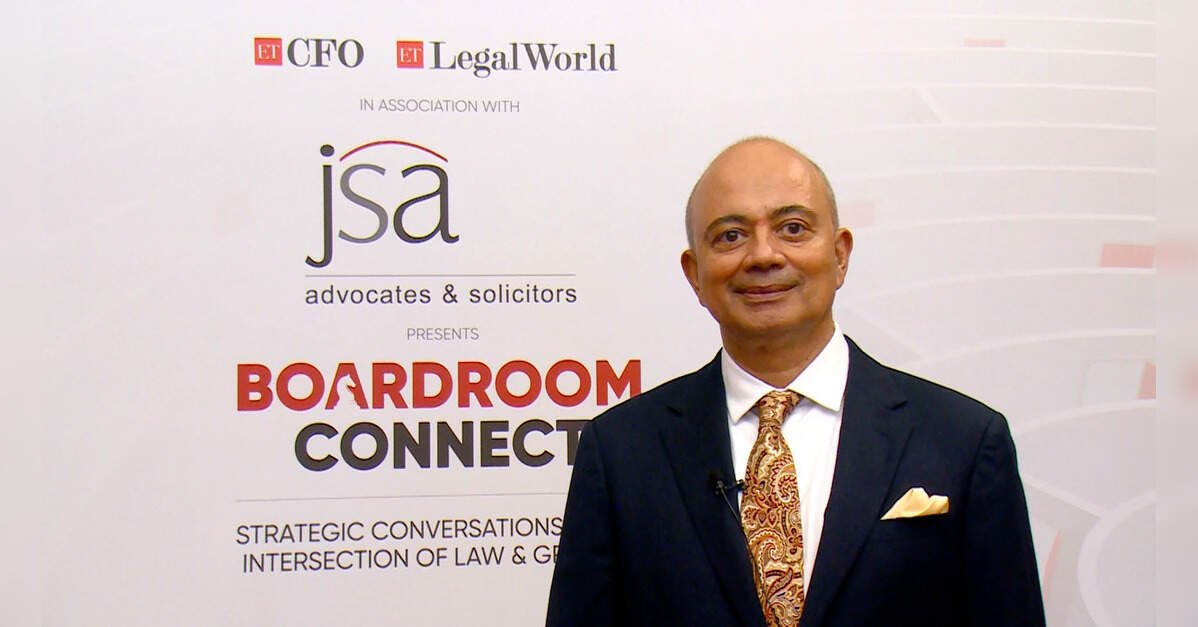
India’s Global Capability Centres (GCCs) need to move beyond their traditional back-office and cost-centre roles to become strategic partners in the development of enterprises, technologies and products, Sajai Singh, Partner at JSA, said at the JSA Boardroom Connect Bengaluru Edition hosted by ETLegalWorld and ETCFO in association with JSA Advocates & Solicitors on September 3.
Speaking on the sidelines of the event, Singh said the discussion examined how GCCs are increasingly taking strategic ownership, while also looking at India’s traditional advantages of cost arbitrage and availability of talent.
“One of the issues that struck me was the fact that while there is a lot of development that happens in India, there aren’t that many patents in India,” Singh said.
He pointed to semiconductor development as an example, noting that despite the presence of a large workforce engaged in the sector, semiconductor patents and intellectual property ownership in India remain limited.
“So there is a huge workforce that’s doing, say, semiconductor development. So the semiconductor patents that are in India or IP ownership that is in India is very limited,” he said.
Singh said this should be an area of focus for India, particularly as the country seeks to attract higher-value activities and strategic investments.
According to Singh, India has several elements needed to support such a transition, including policies, incentives, infrastructure, capital and talent. However, implementation remains an important challenge.
“We have policies, we have incentives, we have a lot in India. In addition to the infrastructure, the capital, the talent. But it’s maybe the implementation,” he said.
Citing an example from the Make in India initiative, Singh said delays in receiving government incentives and lack of clarity among teams implementing policies can hinder foreign investment.
“There wasn’t clarity in the team that was actually implementing the policy. So these are things that hinder foreign investment,” he said.
Singh said addressing such implementation-related issues could help India strengthen its position as a destination for foreign investment, particularly by encouraging companies to view India not merely as a back-office location but as a strategic partner.
“These are things that we could change and change India and make India definitely an attractive or an even more attractive destination for foreign investment for not just a back office but a strategic partner in the overall development of any enterprise, any business, any technology, any kind of product,” he said.
The JSA Boardroom Connect Bengaluru Edition focused on “Unlocking Innovation, Investment and Strategic Growth”, with discussions around the evolving role of GCCs, technology, intellectual property, regulatory frameworks and the legal and policy enablers required for strategic growth in India.


