






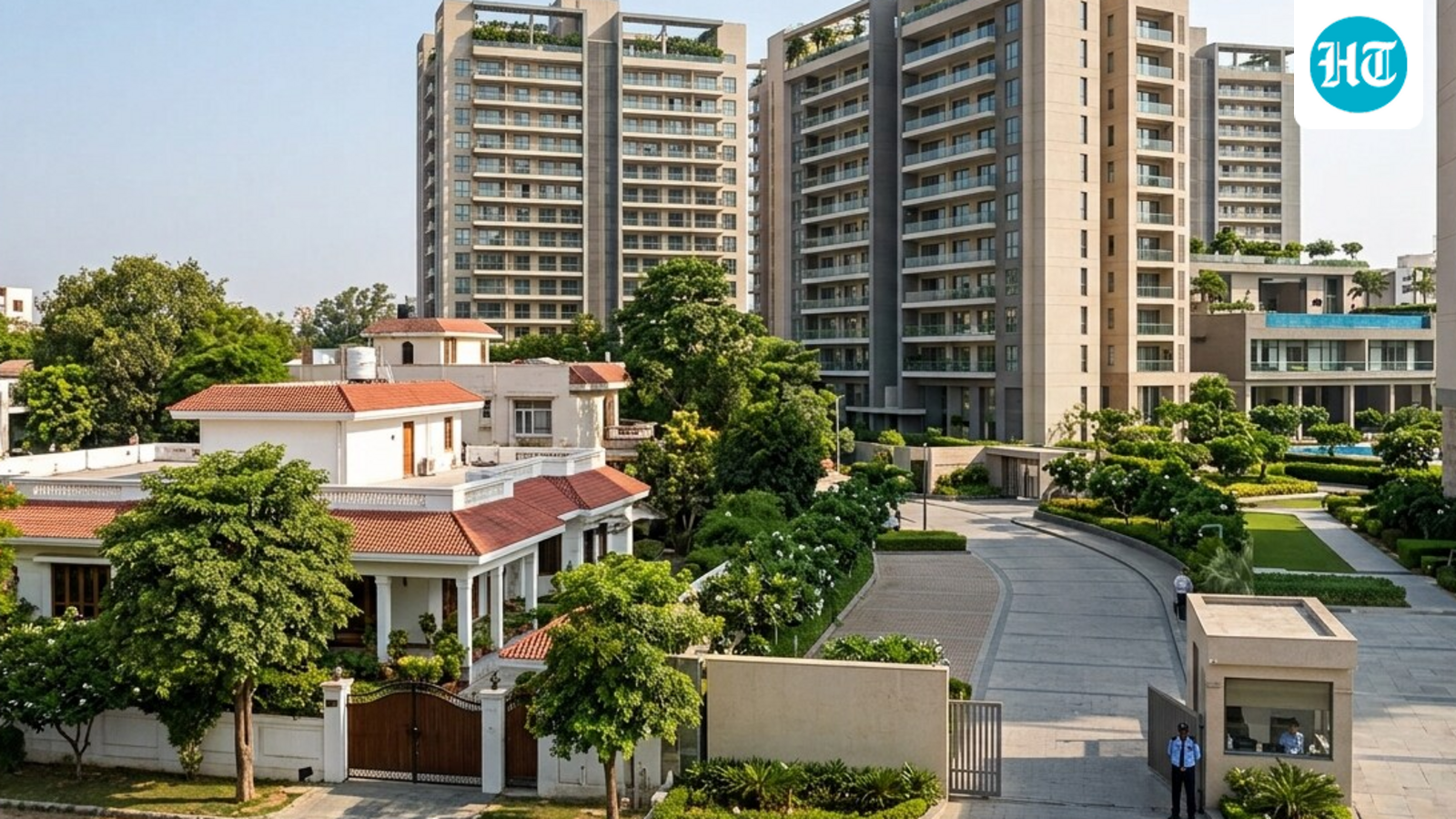
Once defined by sprawling bungalows, farmhouses and independent builder floors, Delhi’s luxury housing market is gradually embracing gated high-rise communities. Developers are transforming former industrial estates and mill lands into residential developments offering spacious apartments, clubhouses, landscaped greens, dedicated parking, round-the-clock security and professional management.

The appeal lies in upgrading lifestyles without leaving familiar neighbourhoods, social networks, schools and clubs. With prime land scarce and conventional housing supply constrained, the ₹15-crore and above price point is emerging as a sweet spot for some projects, attracting end-users, established families buying larger homes and those purchasing apartments for younger family members.
“Delhi is seeing the emergence of several gated residential communities, many of them developed on former mill and industrial land parcels acquired by real estate developers. Historically, the city’s residential supply has largely comprised redevelopment projects, with plots and bungalows being converted into builder floors and apartments,” said Shveta Jain, Managing Director and Head, Residential Services at Savills India.
Delhi’s emerging luxury housing story
The transformation is visible across the capital, from DLF’s integrated residential development in Moti Nagar to Godrej’s ultra-luxury offering near Connaught Place, as well as newer projects in Kirti Nagar and near New Friends Colony.
One of the most prominent examples is DLF Midtown, a large residential ecosystem on Shivaji Marg in West Delhi. The development builds on a residential community that took shape through Capital Greens I and II, launched in 2009, followed by Capital Greens III in 2010. Together, the three developments are home to more than 2,700 families. In January 2022, DLF launched ONE Midtown, a luxury condominium within the larger development, in partnership with Singapore’s sovereign wealth fund GIC. The project comprises four 39-storey towers offering 913 residences in two-, three- and four-bedroom configurations. Amenities include a dedicated clubhouse spanning approximately 21,200 sq ft, multi-tier security and technology-enabled, round-the-clock management.
The changing landscape is also reflected in projects by other developers.
Godrej Connaught One, developed by Godrej Projects North, is an ultra-luxury residential tower on Lady Hardinge Road in central Delhi. Godrej Properties announced its joint venture with the TDI Group in December 2021 to develop the project, with a development potential of approximately 1.25 lakh sq ft.
In South Delhi, Kreeva Swaranya near New Friends Colony is positioned at the ultra-luxury end of the market. Spread across 2.07 acres, the project comprises 114 apartments across three towers, with 3.5-BHK, 4.5-BHK and 5.5-BHK configurations ranging from approximately 3,700 sq ft to 5,500 sq ft. The residences occupy the eighth to 27th floors, with club facilities on the fourth to sixth floors. Each floor has two apartments, with lifts opening directly into the living areas. The project also offers views of the Lotus Temple and includes a 1-lakh-sq-ft clubhouse. Prices start at ₹15 crore.
Further west, TARC Kailasa is being developed across 6.12 acres in Kirti Nagar. The project comprises five towers and around 412 luxury apartments in 3.5-BHK and 4.5-BHK configurations.
In central Delhi, The Amaryllis, Unity Group’s 40-acre residential township in Karol Bagh, offers homes ranging from two-bedroom apartments to six-bedroom residences and sky villas. Apartment sizes range from around 1,250 sq ft to over 5,200 sq ft.
Another distinct example is Trident Residences, which is linked to hospitality services by Trident Hotels. It reflects a growing emphasis on how luxury homes are maintained and serviced, rather than on the physical apartment alone.
Who is buying into Delhi’s new gated communities?
The buyer profile is evolving alongside the housing format. While established business families and high-net-worth individuals remain important, younger professionals and the next generation of affluent Delhi families are also showing interest in amenity-rich apartments, as are professionals such as lawyers and doctors.
For many, the decision is rooted in the neighbourhood. A family living in a bungalow or a large builder floor may want to upgrade to a more contemporary home within a 10-km radius while remaining close to their existing social circle, schools, clubs, and workplaces. In some cases, parents are buying apartments for their adult children in the same locality, allowing the younger generation to enjoy modern amenities without moving far from the family home.
“Demand in Delhi has remained resilient and is largely end-user-driven, with buyers typically coming from the neighbourhood. Going forward, we expect significantly more supply to enter the market as developers acquire industrial land parcels and convert them into gated communities with modern amenities. This trend is likely to grow, adding to Delhi’s luxury housing stock,” said Jain.
“The buyer base comprises end-users, professionals and business owners. The ticket sizes are often comparable to those of builder floors in the same localities, but gated communities can command significantly higher rentals. Buyers include Delhi residents who need more space as their families grow, as well as NRIs who prefer gated developments that are easier to maintain and manage,” said Jain.
The trend reflects an evolving luxury housing market in Delhi, where the key constraint has been a shortage of suitable supply rather than a lack of demand. Buyers are increasingly seeking gated communities for the security, parking facilities and professional management they offer. The buyer profile is also getting younger.
Policy changes, including the easing of regulatory norms and amendments to the Master Plan for Delhi 2021, along with the proposed Master Plan for Delhi 2041 and the transit-oriented development (TOD) policy, could facilitate the addition of more housing stock in the coming years, she said.
A different proposition from Gurugram and Noida
At first glance, Delhi’s new luxury condominiums might appear to compete directly with the high-rise developments of Gurugram and Noida. But industry observers point to a more localised pattern of demand.
For many buyers, the priority is to remain within a familiar neighbourhood rather than move to another NCR market. Workplace geography also influences choices. Professionals working in Gurugram may gravitate towards builder floors or gated communities in Vasant Vihar and Shanti Niketan. Those working in Noida or running factories there may prefer locations in South Delhi, including Okhla.
Also Read: Why Delhi-NCR’s rich are checking into 5-star branded residences
“These developments are not necessarily competing directly with residential projects in Noida and Gurugram, as demand in Delhi remains largely neighbourhood-driven and exceeds the available supply. The builder-floor market, meanwhile, caters to a distinct segment, with some individual floors spanning as much as 6000 sq ft and supply remaining limited,” explains Jain.
“Buyer preferences are also highly localised. Someone living in Maharani Bagh or South Extension may prefer a gated community in South Delhi rather than North Delhi, owing to proximity to their existing residence, social networks and club memberships. Similarly, professionals working in Gurugram may prefer builder floors or gated communities in Vasant Vihar and Shanti Niketan, while those working in Noida or operating factories there may favour developments in South Delhi, including the Okhla area,” she said.
The opportunity, therefore, is not necessarily to displace Gurugram or Noida as residential destinations. It is to address unmet demand among buyers who want a more organised residential experience without leaving Delhi.
According to Mayank Jain, CEO of Kreeva, the company’s recently launched project has attracted interest from high-net-worth and ultra-high-net-worth individuals, including industrialists, business owners, doctors, and fashion designers from South Delhi and other affluent neighbourhoods. Some families living nearby are also considering apartments for their children.
The proposition also appeals to non-resident Indians (NRIs), who may prefer a professionally managed apartment over a standalone property that requires more hands-on maintenance, adds Jain.
Prices rise as supply struggles to keep pace
The shift is unfolding against a backdrop of price appreciation in several of Delhi’s established luxury neighbourhoods.
According to data shared by Savills, plotted developments in southwest Delhi, including Shanti Niketan, Anand Niketan, Westend and Vasant Vihar, recorded price appreciation of up to 12% in the first half of 2026. The increase was driven by a supply-and-demand mismatch, alongside pent-up demand for spacious homes.
Builder-floor prices also rose sharply in prime locations. South-central Delhi neighbourhoods, including Jor Bagh, Golf Links and Malcha Marg, recorded a 25% increase. Central Delhi’s second micro-market, covering Amrita Shergill Marg, Aurangzeb Road, Prithviraj Road, Sikandra Road, Tilak Marg, Ferozeshah Road, Man Singh Road, Tees January Marg and Sundar Nagar, saw prices rise by 13%, the data showed.


