






A 22-storey luxury tower on a prime plot in Turner Road, Bandra, has come under the scrutiny of the Slum Rehabilitation Authority (SRA) as the builder has allegedly deviated from the approved plan to construct permanent transit camp (PTC) tenements on six of its floors. The building — a redevelopment property — stands on the plot where the 1960s actor Mala Sinha’s bungalow, Mala Albert Sinha House, once stood.

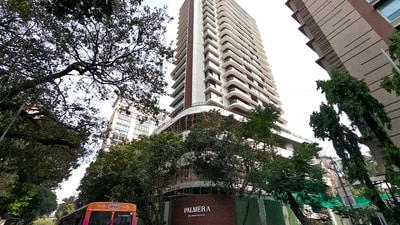
One of Mumbai’s most coveted real estate destinations, Turner Road commands premier residential prices ranging from ₹70,000 to ₹1 lakh per sq ft, with ultra-luxury properties scaling even higher.
Also Read I IIM Mumbai to study traffic congestion in Pune, suggest long-term solutions
Deviation from approved building plans
The SRA on October 6 issued a notice to developer NVK Realty LLP for allegedly deviating from the approved plans of the building, now called Palmera, under Sections 53(1) and 53(2) of the Maharashtra Regional and Town Planning (MRTP) Act, 1966. The notice directs the developer to restore the 7th to 12th floors in accordance with the approved plans within a month, failing which the firm could face prosecution.
The alleged deviations were detected during a site inspection by SRA officials on September 30, following an RTI application filed by social activist Santosh Daundkar six months ago.
The case raises questions about the implementation of Development Control and Promotion Regulations (DCPR) 2034, particularly Regulation 33(11), under which developers can receive incentive floor space index (FSI) in return for providing built-up area for PTCs to the SRA free of cost.
According to the plan approved on September 12, 2023, the six floors of the 22-storey building were reserved for PTC tenements, and once the project was completed, it was to be handed over to SRA. However, an inspection of the building by authorities showed the lacuna.
A senior SRA official confirmed that the notice had been issued to NVK Realty LLP, explaining that Regulation 33(11)—used to secure higher FSI through PTC-related provisions—provides PTCs to accommodate people displaced by infrastructure projects such as the Brihanmumbai Municipal Corporation’s (BMC) road widening, railway works, and Metro construction.
“The developer altered the units in Bandra without approval. Hence, we issued the notice,” the official said, adding that given Mumbai’s many ongoing infrastructure development projects, the city requires at least 2 lakh such PTCs for various projects.
PTC tenements
Under the regulation, developers earn incentive FSI by constructing PTC tenements. The permissible FSI scales from three for roads at least 12 metres wide to four for roads 18 metres or wider. Alternatively, subject to approval, developers may fulfil their PTC obligations at a different site by paying a premium equivalent to 40% of the difference in ready reckoner values.
In NVK Realty’s case, the PTC facility was initially planned within the Bandra building. Although a standard operating procedure was prepared to shift it to Andheri, the relocation had not yet been approved, the official said.
Also Read I FDA bans sale of loose spice powders across Maharashtra
Activist and advocate Y P Singh said the arrangement raised broader concerns about the use of regulation 33(11) for projects that ultimately comprise sale of buildings. “The irony of Regulation 33(11) is that, although the building is meant for sale, it is treated as a rehabilitation building during construction. This enables the developer to claim additional FSI and concessions, including reduced open spaces and garden areas, which are otherwise associated with SRA schemes. The transit camp obligation can subsequently be fulfilled in another building,” Singh said.
Singh also questioned the SRA’s role as the planning authority for projects under Regulation 33(11), arguing that the BMC was better equipped to scrutinise building proposals and coordinate with other departments.
Regulatory compliance
NVK Realty said it had received the notice and would comply with the requirements. Viren Shah, project manager from the NVK team said, “We have received the SRA’s MRTP notice just today. Our architect is handling the matter with the SRA. We have been told it is a minor compliance issue, and we will address it and submit the compliance.”
The whistle-blower Daundkar said: “This revelation raises serious questions about regulatory compliance and the issuance of incentive FSI.” He alleged that “other developers and affluent property owners could be benefiting from such an access which would enable construction of luxury towers with additional development rights”.
“The principal beneficiaries appear to be builders and property owners, while the government and the BMC could lose legitimate revenue through premiums and other statutory charges. The additional FSI also puts enormous pressure on Mumbai’s already strained infrastructure, particularly water supply and electricity,” he said, adding that he would approach the court if the practice continued.
Also Read I University panel flags poor facilities at Jamnalal Bajaj Institute
Meanwhile, in a separate communication, the SRA has put NVK Realty LLP’s application submitted on September 10, to club the Letter of Intent (LOI) for a separate scheme on hold. SRA said the application would not be processed until the developer complied with the directions in the October 6, notice.
When HT contacted Junaid Rokad, Mala Sinha’s son-in-law, on the matter, he said: “I am not aware of the SRA notice to the builder. However, I was aware of the six floors allotted for PTC tenements.”


