



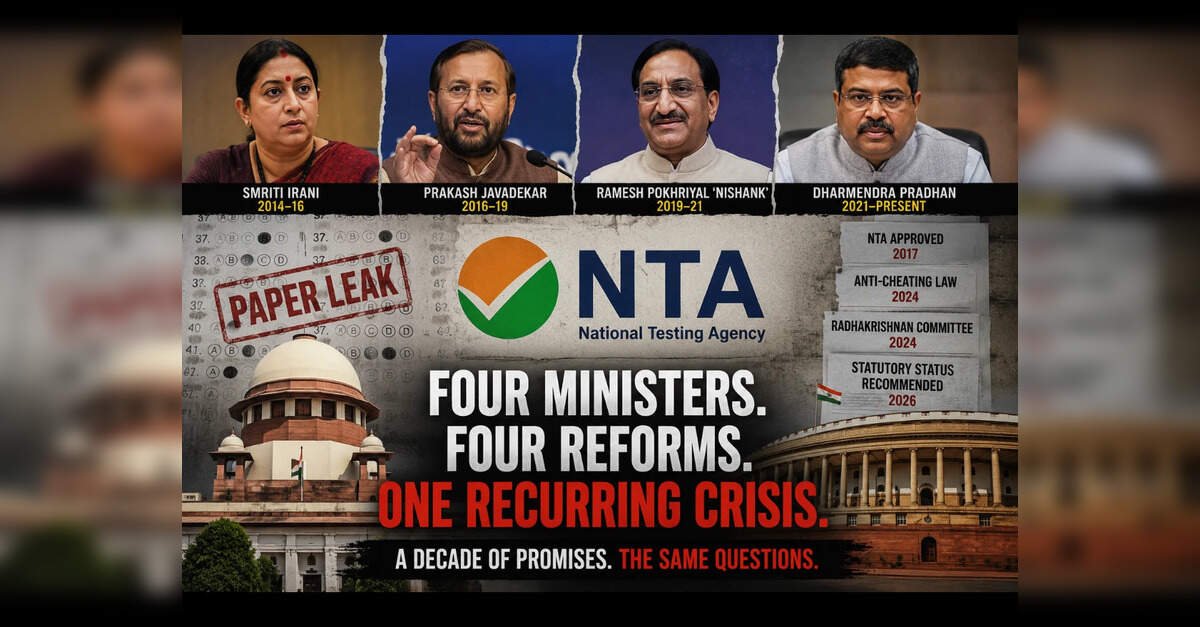
Two paper leaks. One national medical entrance exam cancelled and re-conducted for the first time in its history. Two expert committees. A dedicated anti-cheating law. A surplus of roughly Rs 448 crore sitting with the agency responsible. And India’s examination system finds itself, a decade on, back where it started.
The calls this week for Education Minister Dharmendra Pradhan‘s resignation have put the spotlight on one man. Protesters have occupied Jantar Mantar for close to a month, a hunger strike in solidarity has ended in hospitalisation, and a march toward Parliament this week was met with tear gas. Opposition parties argue accountability begins with the minister. But the record of the past decade suggests the crisis runs deeper than any one individual.
But a review of the last four education ministers, spanning twelve years and every government since 2014, tells a different story. Every single one of them, Smriti Irani, Prakash Javadekar, Ramesh Pokhriyal ‘Nishank’, and Pradhan, inherited or presided over a major examination crisis. And every reform promised after each one failed to prevent the next.
Four ministers, one recurring failure
Irani (2014–16) had the 2015 AIPMT leak, a Haryana gang using Bluetooth devices sewn into undershirts to relay answers across roughly ten states; the Supreme Court ordered a retest for the 44 identified beneficiaries.
Javadekar (2016–19) had the 2018 CBSE Class 10 Maths and Class 12 Economics leak, which reached the Prime Minister’s Office. It is widely assumed the National Testing Agency was built in response. It wasn’t: Cabinet approved the NTA‘s formation in November 2017, four months before that leak. What actually followed was Javadekar reaffirming to Parliament that the agency would start conducting exams “from 2019 onward.”
Pokhriyal (2019–21) faced no leak, but a sharper political fight: whether to hold JEE Main and NEET-UG in September 2020, mid-pandemic, over objections from students and six opposition-ruled states who moved the Supreme Court. The Court let the exams proceed.
Pradhan (2021–present) has overseen the NTA’s two worst failures. The 2024 NEET-UG leak, traced to Patna and Hazaribagh, produced 155 identified beneficiaries out of just over 23 lakh candidates, six CBI FIRs, and 45 chargesheeted individuals. The Supreme Court declined to order a retest but found that the episode “highlights several administrative and procedural flaws within NTA’s management of the exam.” Then, this May, it happened again: NEET-UG 2026 was cancelled six days after the exam once a pre-circulated “guess paper” was found to match roughly 120 of 180 actual questions. CBI’s court filings this time name two of the NTA’s own subject-expert panelists as sources of the leak. That remains CBI’s case as argued in court, not a settled verdict, but if proven, it would represent a failure within the NTA’s own question-setting process, rather than one involving transportation or distribution.
What changed each time, and what didn’t
This is the actual story, and it is worth examining closely, because the pattern is precise: each crisis produced an institutional fix, and none of the fixes prevented the next crisis.
The NTA was meant to make exams leak-proof from 2019. A leak happened inside an NTA-run exam by 2024. A dedicated criminal law, the Public Examinations (Prevention of Unfair Means) Act, came into force in the middle of that 2024 crisis, and a committee under former ISRO chairman K. Radhakrishnan was set up to recommend structural reform. The same exam leaked again in 2026, under the same minister, forcing NEET’s first full cancellation and re-conduct ever.
The reason the fixes keep falling short has less to do with any one minister than with how the NTA is actually built, funded, and held accountable. It is worth noting, in fairness, that one accountability action has actually landed in this decade: after the 2024 crisis, then NTA Director General Subodh Kumar Singh was placed on “compulsory wait” and replaced by Pradeep Singh Kharola. But that action fell on a bureaucrat, not the minister, and not the design that produced the failure, which is precisely the distinction this piece is making.
A Parliamentary Standing Committee report, made public in June 2026, found that the NTA had collected an estimated Rs 3,512.98 crore and spent Rs 3,064.77 crore conducting exams over six years. The committee noted the agency had accumulated a surplus of roughly Rs 448 crore, and recommended the funds be used to strengthen the NTA’s own capacity and its oversight of the vendors it depends on. The committee’s findings reveal a striking contrast: a regulator holding a Rs 448 crore surplus runs on a workforce that is, by its own count to Parliament, overwhelmingly non-permanent.
Told in a July 2024 Lok Sabha reply to ask about staffing, the Ministry of Education said NTA had 22 employees on deputation, 39 contractual employees, and 132 outsourced staff, a combined workforce of 193 people who are not part of any permanent cadre, running an agency responsible for exams that decide the futures of tens of millions of candidates a year. The committee’s findings suggest that the larger constraint was institutional design and capacity rather than funding alone. The NTA’s response to the committee was that it retains an average of Rs 74.5 crore a year for the next cycle’s costs, and that further surplus “can be appropriately utilised.” The same committee found the NTA had not been submitting annual reports to Parliament despite being asked to, and separately recommended the government compile a nationwide blacklist of exam vendors found responsible for irregularities. No such list currently exists; the NTA says it avoids vendors already blacklisted elsewhere, but keeps no consolidated list of its own.
A comparison with other national recruiting agencies offers further context: Parliament was told, in a written reply from Minister of State Jitendra Singh on 12 February 2026, that neither the UPSC nor the SSC has had a reported paper leak in the past five years. Why doesn’t UPSC face this repeatedly? Because it is a constitutional body running its own processes with far less outsourcing, and because institutional continuity, the same agency, largely the same internal systems, year after year, has let it close the gaps a newer, leaner organisation has not had time or mandate to close. The NTA, by contrast, remains a society registered under the Societies Registration Act, not a statutory authority with direct parliamentary accountability. That distinction, constitutional or statutory status versus a registered society, may help explain why accountability mechanisms differ between the institutions: it is the difference between an institution Parliament can compel to answer, and one it can currently only ask.
A petition now before the Supreme Court is asking the Court to convert NTA into a statutory body. Notably, the Parliamentary Standing Committee has now arrived at a similar conclusion, though it took a second leak to get there. In December 2025, the committee had firmly backed pen-and-paper exams over computer-based testing, directly opposing the Radhakrishnan Committee’s 2024 recommendation to shift toward CBT, and citing UPSC’s leak-proof record to make its case. After NEET-UG 2026 was cancelled, the same committee met again on 1 July 2026 and shifted ground: it is now engaging with a phased transition to computer-based testing, provided digital infrastructure is ready first, and it has separately recommended that NTA be granted statutory status. NTA has told the Supreme Court it is targeting a CBT rollout from 2027. In other words, the government’s own oversight committee only moved off its position after the second crisis forced the question, not the first.
A bar that has quietly shifted
The Supreme Court’s responses across two cases also reveal an important shift: in 2015, the Supreme Court ordered a retest for 44 identified AIPMT beneficiaries. In 2024, with 155 identified beneficiaries, more than three times as many, out of a far larger candidate pool, the Court declined to order one, distinguishing the case on the grounds that the 2015 leak’s network was shown to be nationwide while the 2024 leak was, at the time of the hearing, traced to two locations. Whether that distinction quietly raises the practical bar for a future retest order is a question for constitutional scholars, not this piece, but the two numbers, sitting nine years apart, invite it on their own.
The pattern behind a decade of reforms
What the decade adds up to, across four ministers, one dedicated law, one purpose-built agency, and two expert committees that took a second crisis to agree with each other, is not really a story about who was in charge when the paper leaked. It is a story about an institution that has never been given, or never taken, the accountability architecture its more reliable peers already have. Until that architecture changes, each examination scandal is likely to produce the same familiar cycle: arrests, a new committee, fresh assurances, and another promise that the next leak will be the last.


