



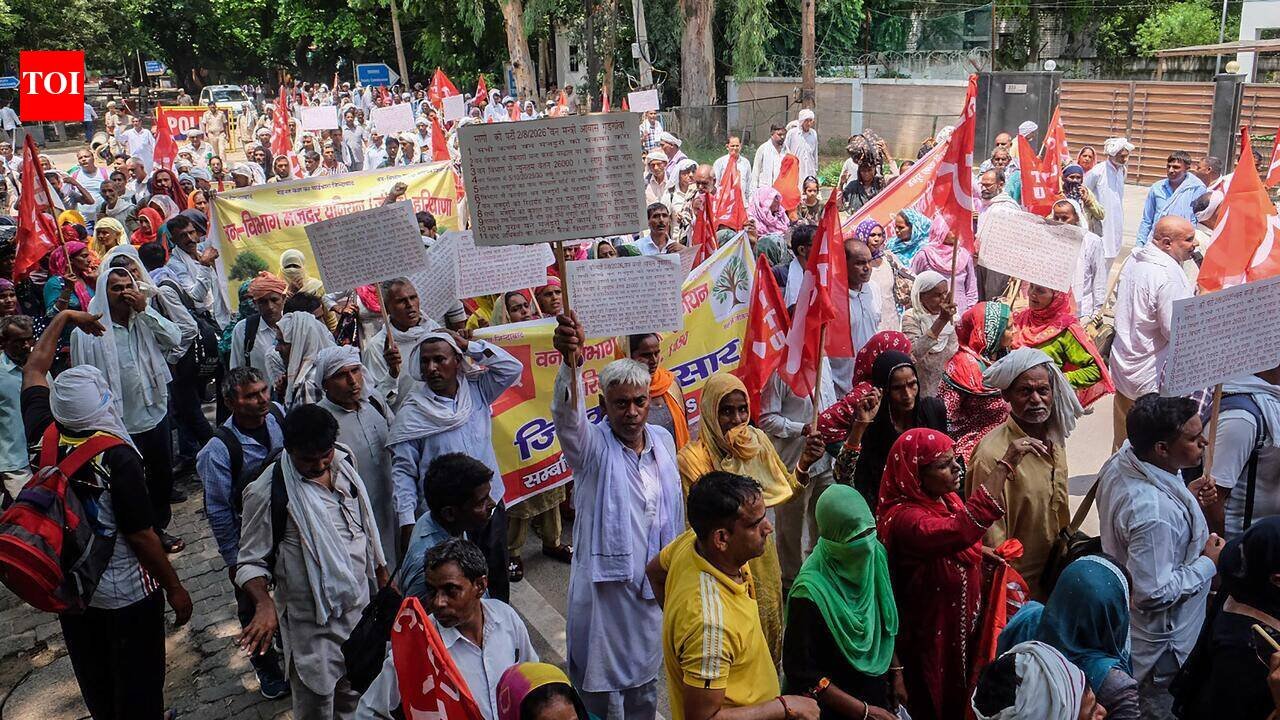
Gurgaon: Hundreds of contractual forest workers laid siege to Haryana cabinet minister Rao Narbir Singh’s official residence in Civil Lines on Sunday, demanding regularisation, equal pay and improved service conditions.Police stopped the protesters from reaching the minister’s residence after erecting multiple barricades on approach roads. The workers, carrying red flags and banners under the CITU banner, staged a sit-in near the barricades and raised slogans for several hours before dispersing peacefully. No untoward incident was reported.Heavy police deployment was made in the area, with additional force called in to maintain law and order and traffic on roads leading to the residence diverted as a precautionary measure. Police personnel formed a human chain behind the barricades to keep the crowd back.The protesters said they had gathered to press for long-pending demands that have remained unresolved despite repeated representations to the govt. Many workers said they have continued in service for several years without regular appointments, job security or the benefits available to permanent staff.“Despite carrying out the same field duties as permanent staff, including plantation, maintenance of nurseries and protection of forest areas, we continue to receive lower wages and have no employment security,” a worker said.The protesters’ charter of demands includes regularisation of contractual and daily-wage forest workers, implementation of equal pay for equal work, timely payment of wages and extension of social security benefits. They also sought a minimum monthly wage of Rs 26,000, identity cards for all workers, a retirement benefit of Rs 10 lakh, reinstatement of workers who have secured favourable court orders, re-engagement of former employees, and action against officials allegedly involved in corruption.There was no response from Rao Narbir Singh’s office on the workers’ demands.Forest department officials confirmed the contractual hiring system for forestry work has been in place since 2018-19, with labourers engaged in plantation drives, nursery maintenance, forest protection and other field operations largely hired through contractors since then.


