



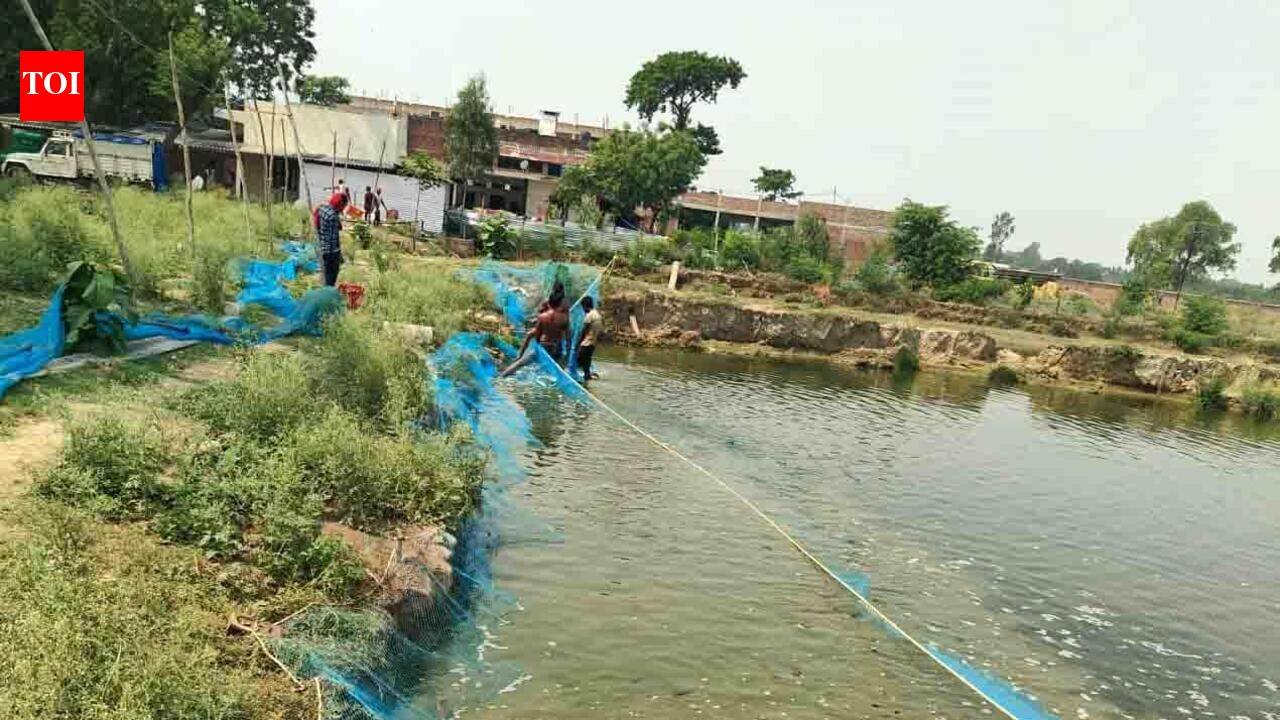
Prayagraj: In order to strengthen fishing community economically and uplift their standard of living, the state government is allocating pond leases and providing improved seeds and advanced technology. Additionally, the setting up of fisheries cooperative societies in every Nyaya Panchayat is aimed to help the community become self-reliant and receive direct benefits.Deputy Director of Fisheries ( Prayagraj Division), Vijay Pal, said that there are currently 125 fisheries cooperative societies in the division. The highest number—51 societies—have been formed in Prayagraj, followed by 21 in Fatehpur, 22 in Pratapgarh, and 21 in Kaushambi. Their formation has brought about a change in the economic status of fishing families.Fishermen are now able to get fair prices for their produce through these societies. Fish farmers no longer need to travel far for information regarding schemes like ‘Matsya Sampada Yojana’ or insurance plans and the societies facilitate this within the village itself. These societies also provide improved seeds, fertilizers, and modern fish farming techniques.The formation of these societies has opened up new employment opportunities for thousands of fish farmers, turning fish farming into an organized business.Pal explained that a society must have a minimum of 27 members, including at least six women. 5,500 families associated with the fishing community in the division have benefited from this initiative.Since the formation of these societies, families are receiving pond leases in a timely manner. The committee is facilitating the acquisition of pond leases. Middlemen have been eliminated from the fish procurement process, allowing the members to secure a higher price for their produce.Ramkumar, a member of the fishing community from Sarai Abdul Malik village in Phulpur, Prayagraj, serves as the in-charge of the Phulpur Matsyajivi Sahkari Samiti (Fishermen’s Cooperative Society). He says that the society has 55 members and has secured a lease for 40 hectares of pond land. He notes that the formation of the cooperative society has brought about significant positive changes in the lives of the members’ families. They achieve a fish yield of over 50 quintals per hectare, resulting in a total production of 2,000 quintals for the society. Consequently, the society generates sales worth ₹50 lakh. Ramkumar explains that the absence of middlemen in the production and sale of fish has led to increased profits for the members. They are also benefiting from information regarding other welfare schemes provided by the department.


