



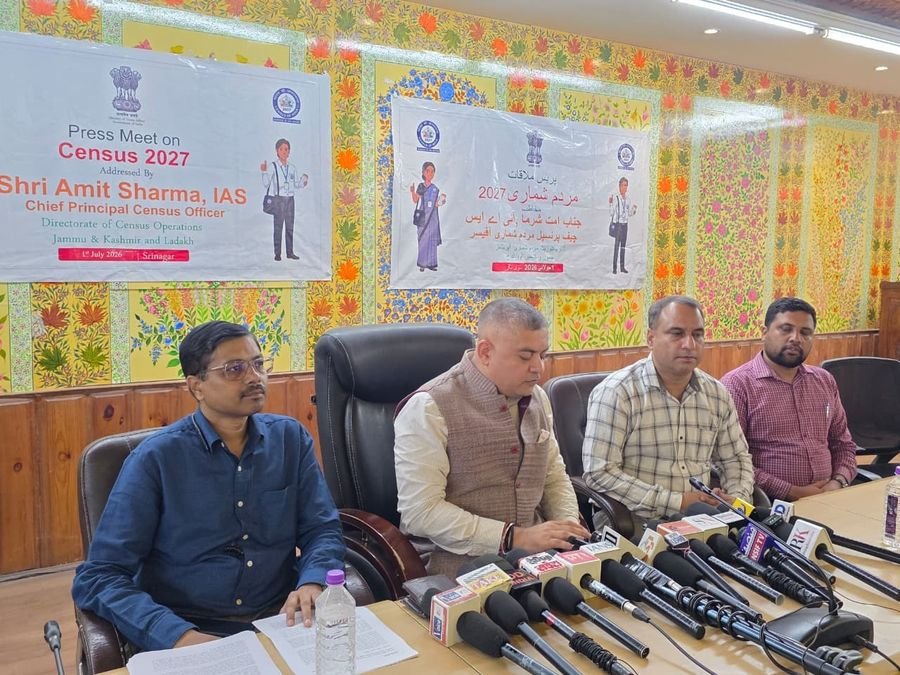
6.67 lakh J&K, 7,009 Ladakh households self-enumerate
Srinagar, Jul 01: The first phase of Census 2027, comprising House Listing Operations (HLO), has been completed across the Union Territories of Jammu & Kashmir and Ladakh, with the month-long field exercise conducted from June 1 to June 30, 2026, through end-to-end digital means without any major technical disruption.
Chief Principal Census Officer (CPCO) and Director Census Operations (DCO), Jammu & Kashmir and Ladakh, Amit Sharma, congratulated officers and field functionaries for completing the operations within prescribed timelines. He informed that 24,071 digitally mapped and geo-referenced House Listing Blocks covering 295 Census Charges were covered in Jammu & Kashmir, while 567 House Listing Blocks across 17 Charges were covered in Ladakh, covering urban, rural, border, tribal, remote, and geographically challenging areas.
The successful completion of field operations was preceded by an extensive capacity-building programme. In Jammu & Kashmir, 30 Master Trainers, 614 Field Trainers, and 29,269 Enumerators and Supervisors were trained, while in Ladakh, 2 Master Trainers, 20 Field Trainers, and 722 Enumerators and Supervisors were trained. More than 27,000 Census kits were distributed in J&K, and around 800 kits in Ladakh, before the commencement of field operations.
Referring to the Self-Enumeration phase, Sharma informed that over 6.67 lakh households in Jammu & Kashmir and 7,009 households in Ladakh voluntarily submitted their Census details through the Self-Enumeration portal before the commencement of field operations.
Sharma said preparations for the next phase of Census 2027 have commenced. Compilation of District Census Handbooks will begin from August 1, 2026, while Population Enumeration in the snow-bound areas of Jammu & Kashmir and across Ladakh will be undertaken as per the notified schedule, followed by Population Enumeration in the remaining areas in February 2027.
He attributed the successful completion of Phase I to coordinated efforts between the Directorate of Census Operations, district administrations, and field functionaries, supported by regular review meetings, field inspections, digital monitoring mechanisms, and awareness campaigns through print, electronic, and social media.


