



The World Cup began as a sprawl — 48 teams, three host nations, heat, distance, noise and the promise that football’s centre of gravity might tilt somewhere unexpected.
Two knockout rounds later, Europe has placed six teams in the quarterfinals, with Argentina and Morocco the only survivors from outside the continent.
European nations — Spain in 2010 and Germany in Brazil four years later — have won the trophy only twice outside Europe, but with France, Spain, England, Belgium, Norway and Switzerland making up three-quarters of the last eight, the chances of the continent adding to that list now feel high.
This is the most European quarterfinal line-up outside Europe since 1994. The round of 16 also ended in tears for Cristiano Ronaldo and Neymar, while the three host nations disappeared one by one.
Morocco’s players take part in a training session at the New England Revolution Training Centre in Foxborough, near Boston, on July 7 2026, during the 2026 World Cup football tournament.
| Photo Credit:
AFP
The eight teams, though, have taken very different paths to get here. Some arrived through control, some through chaos, and others through sheer stubbornness.
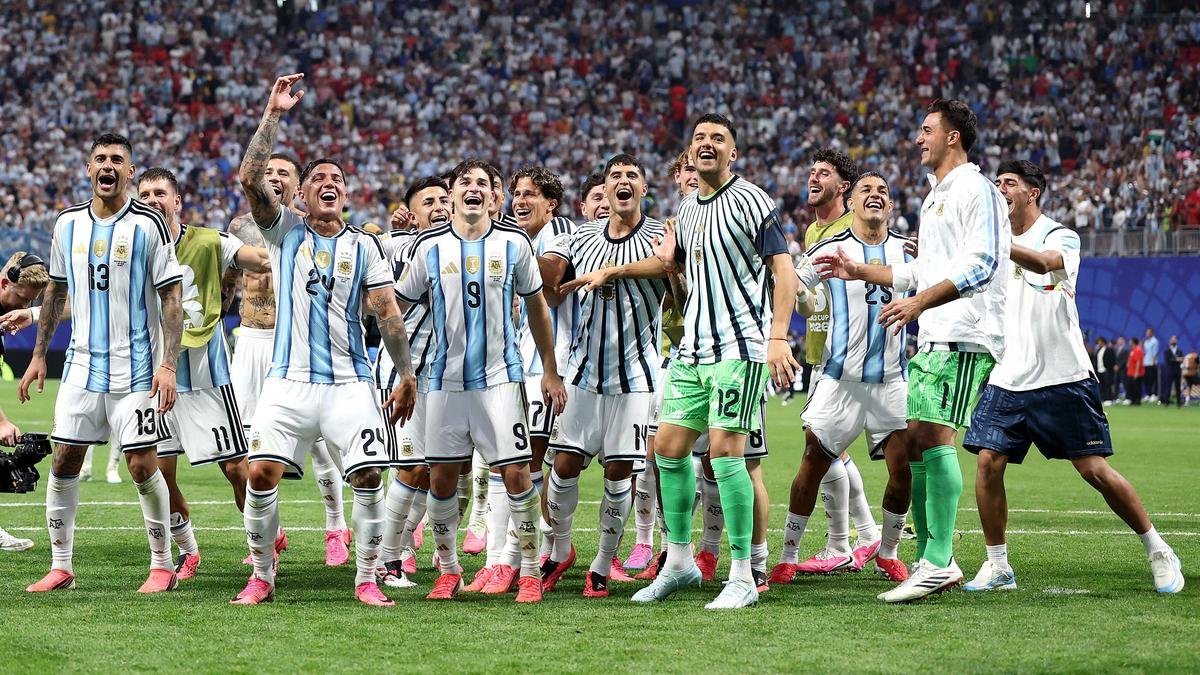
Argentina’s route has been the least serene and perhaps, for that reason, the most revealing. The defending champion had to keep answering uncomfortable questions. Cape Verde dragged it deep in their round of 32 clash and Egypt then had it staring at elimination in Atlanta before Lionel Messi and company overturned a two-goal deficit in the final stretch to win 3-2.
It has not always looked orderly, but Argentina has looked resilient. Messi’s goals continue to shape the campaign, but for Lionel Scaloni, the greater comfort will come from the fact that his team has already lived through the sort of disorder that often ends World Cups.
“We made our people suffer even though we didn’t play a bad game,” Scaloni said after the win over Egypt. “We would be out if we didn’t fight.”
France’s Malo Gusto during training
| Photo Credit:
Reuters
France, too, has been left with bruises. It swatted Sweden aside in the round of 32, but Paraguay turned the last-16 tie into a scrap, defending deep, slowing the game and forcing Didier Deschamps’ side to settle for a narrow win through Kylian Mbappe’s late penalty.
Yet France still looks the deepest squad left in the competition, with Mbappe’s seven goals giving it the tournament’s sharpest edge and Ousmane Dembele, Bradley Barcola and Michael Olise all growing in stature.
England’s quarterfinal place was earned in the most difficult setting of the lot. It’s 3-2 win over Mexico at the Azteca was a test of altitude, noise and a wall of home hostility. England was reduced to 10 men and still survived.
England’s midfielder Kobbie Mainoo takes part in a training session at the Pumas training grounds in Mexico City on July 4, 2026, on the eve of the 2026 World Cup round of 16 football match between Mexico and England.
| Photo Credit:
AFP
Norway, its next opponent, authored one of the shocks of the tournament by knocking Brazil out, with Erling Haaland scoring twice in a 2-1 win. Under Stale Solbakken, Norway can hurt teams both in transition and with the ball, and England’s defenders now face the most obvious individual duel of the round — containing Haaland without losing control of the spaces around him.
Belgium and Switzerland have reached the last eight by mastering pressure in very different ways. Belgium was too calm and too clinical for the United States, winning 4-1 despite the noise around Folarin Balogun’s controversial reinstatement and the weight of a home crowd.
Switzerland, meanwhile, held its nerve better than Colombia in a goalless last-16 tie before prevailing on penalties to reach a first World Cup quarterfinal in 72 years.
Spain, meanwhile, still has not conceded a goal and removed Portugal with a cold efficiency that looks ominous.
Spain’s players take part in a training session at the Cotton Bowl in Dallas on July 7, 2026, during the 2026 World Cup football tournament.
| Photo Credit:
AFP
The quarterfinal line-up now offers four very different tests. France against Morocco in Boston pits the tournament’s deepest squad against its most defiant underdog. Spain against Belgium in California feels like a contest between a side that monopolises the ball and one that can cut through space quickly.
England’s match against Norway in Miami may hinge on whether England can contain Haaland while still imposing its own rhythm. Argentina against Switzerland offers Messi another knockout maze against a side that rarely loses its shape or its calm.
The quarterfinals are evidence of where this World Cup has drifted. What began as a sprawling global carnival has tightened into a bracket dominated by Europe, with Argentina and Morocco left to resist the pull.
Published – July 08, 2026 08:50 pm IST


