



When Lionel Messi broke Miroslav Klose’s World Cup scoring record in Dallas, history travelled fast. Inside the stadium, supporters sent “25.9 terabytes of data” in roughly two hours — enough, Charlotte Jones notes, “to stream high-definition video for a year”.
For Jones, the Dallas Cowboys’ executive vice president and chief brand officer, the number explained what a modern stadium must do. “The greatest thing about watching the game on television is wishing you were there,” she says. “When you get to be there, the ability to share that with others is important.”
That ambition has been visible throughout the World Cup. The Cowboys’ stadium hosted nine matches, the most among World Cup venues.
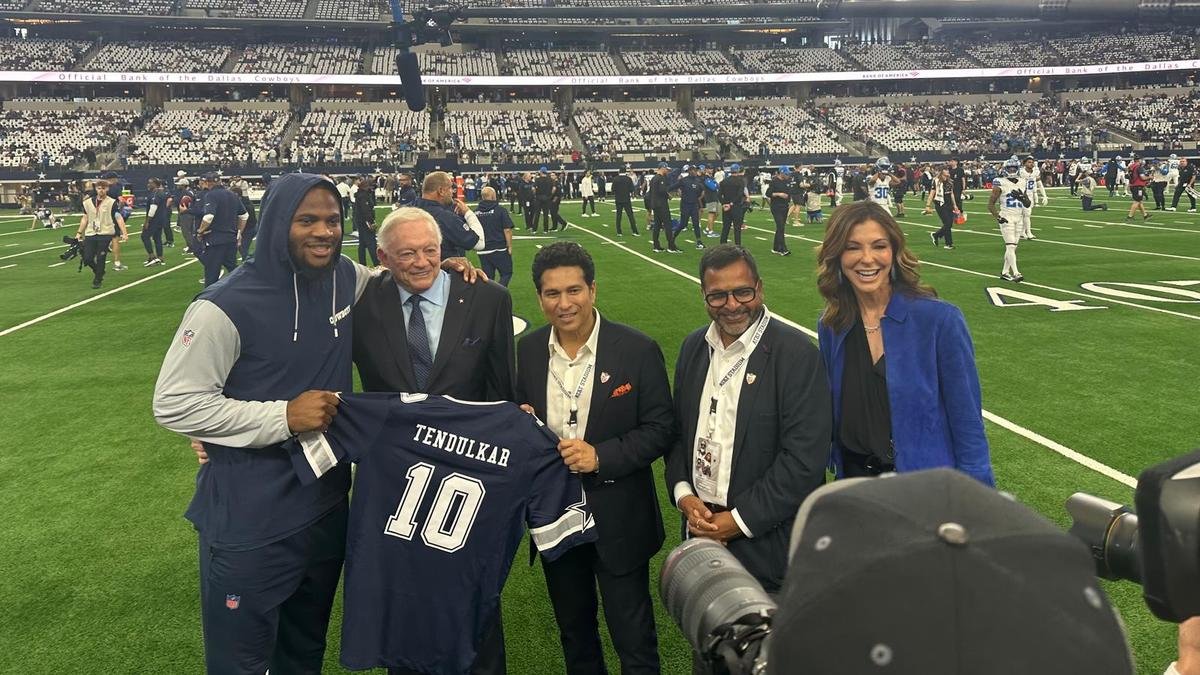
Jones traces that ability to move across sporting worlds back to another moment when Sachin Tendulkar visited the Cowboys in 2024. “It was so fun,” she says. But the visit also helped her understand the scale of one man’s cultural presence.
The Cowboys, she says, made a deliberate choice long ago not to let any one player define the organisation because stars leave and franchises must outlive them. Tendulkar represented the opposite phenomenon: an individual who had become an institution in his own right.
“I can read the story about who he is and the impact he has,” Jones says, “but if I relate it to the impact that I know we have, then I could appreciate what one man has done.”
That is also one way of understanding the Cowboys themselves. They are the world’s most valuable sports franchise, despite not having won a Super Bowl since the 1990s.
“It’s interesting because it has been just the opposite of that,” she says. “We haven’t had great success on the field since the ’90s. We won championships in the ’90s. We’ve been competitive, but we haven’t gotten back there. So, the past 30 years, the financial success has been based on everything but that.”
When the Jones family bought the Cowboys in 1989, the team was losing around $75,000 a day. “As a family, we had committed all of our financial resources to buy it,” she says. “There were no resources left over to keep feeding it. So, we had to find a way to stop the loss.”
The first shift came through sponsorship. “Back then, corporate partnerships were just advertising,” Jones says. “You put a sign in the stadium or a sign outside of the stadium, and that was just advertising.”
The Cowboys wanted something deeper. “It’s like, okay, we’re going to connect our fans to your product, and we’re going to help you drive the sales of your product.”
Television changed the scale again. Jones recalls one of the Cowboys’ earliest ownership meetings, when a network partner wanted to cut its rights fee. Rupert Murdoch, then trying to build Fox into a national television force, saw sport as the way in.
“He said, ‘I will double that fee to get in. I will build my station off of that’.” Jones says, “ever since then, the value of the media rights has escalated.”
The same thinking reshaped their stadium. “We’re only there ten days,” Jones says of the NFL home schedule. “So, the rest of the year, you had to find a way to have it be a business model.”
That meant turning the venue into more than a football ground. “Back then, most stadiums were just a financial hole,” she says.
AT&T Stadium became a concert arena, event space, tourist attraction and year-round revenue engine. “We sell stadium tours, and we have a million people come out just when nothing’s going on, just to come take a look at it,” Jones says. “It’s actually making money every week, every day.”
In recent years, the AT&T Stadium has hosted sold-out concerts of Ed Sheerasn, Beyonce, Billy Joel & Stevie Nicks and Taylor Swift.
The need to be close to the community led the Cowboys beyond the stadium development. “Only seven per cent of our fans ever go into the stadium,” Jones says. “Even though we can hold 90,000 people, that does not touch the surface of how many fans we have.”
The answer was The Star in Frisco, where the Cowboys moved their practice base, built a shared indoor stadium with the local school district and created a wider district of hotels, restaurants, retail and community spaces.
Charlotte Jones and her family had set out to build something that mattered beyond ten Sundays a year, and this Dallas summer has offered the clearest proof that the Cowboys have succeeded.
Published – July 17, 2026 07:59 pm IST


