



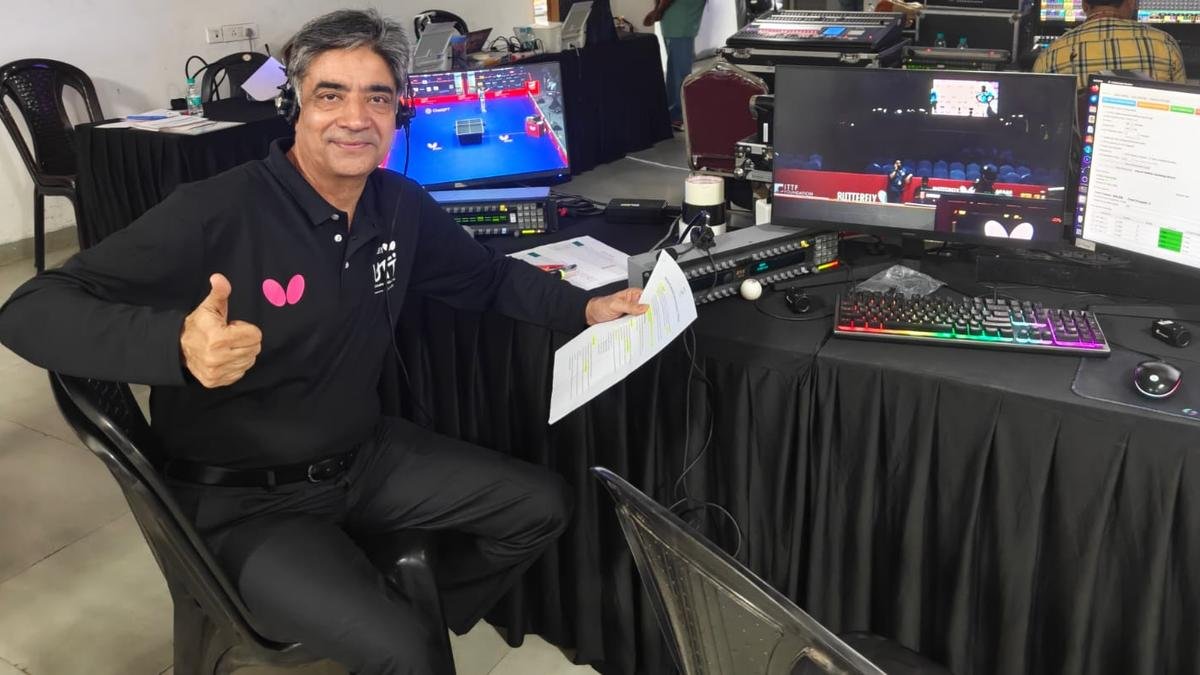
Vipin Mehra, the TTR referee, says the system has worked seamlessly, with every review producing a conclusive verdict.
| Photo Credit: Special Arrangement
Introduced in India for the first time at Ultimate Table Tennis Season 7, the Table Tennis Review (TTR) system has largely earned positive feedback from players, officials and umpires.
Vipin Mehra, the TTR referee overseeing the review process from the control room whenever players challenge an on-court decision, said here on Thursday that the system has worked seamlessly, with every review producing a conclusive verdict.
“Right now, we are not facing any technical glitches. There has not been a single challenge where the decision was inconclusive. That means we are getting perfect results,” said Mehra, an ITTF Blue Badge umpire.
The TTR software, developed by Stupa Sports, uses 14 cameras positioned around the table to adjudicate six types of challenges — serve height, serve angle, service position relative to the ball surface, ball position relative to the playing surface, ball hiding and edge-ball contact — compared to 10 in World Table Tennis (WTT) events.
According to Mehra, serve angle has emerged as the most frequently challenged aspect during UTT Season 7.
“Initially, during the first two days, most challenges were for ball hiding. Right now, almost 70 per cent of the challenges are for service angle,” the 56-year-old revealed.
Mehra said a similar trend was observed during the 2025 ITTF World Cup in Macau, wherein TTR was first introduced at a major international event and where he was the major player of the TTR team.
“Yes, in Macau, I gave 67 decisions in seven days. Out of those, 55 were for service angle,” he said.
While the technology has eased decision-making, Mehra believes it has also added to the responsibilities of the chair umpire. “For umpires, it is the biggest challenge. You already have to keep the score, control the match and make decisions on court. Suddenly, a challenge comes in. Moreover, you have to give the correct hand signals for each type of challenge. It is not easy,” he said.
During Thursday’s tie between U Mumba TT and PBG Pune Jaguars, play was briefly halted in the mixed doubles match after a dispute over whether the serve had landed on the centre line. Mehra said such situations could eventually be rectified as the technology evolves.
“I am sure that in the coming days we will get more support from technology. In doubles, whether the serve lands on the centre line is very important. That can definitely be added, but we will need additional cameras for that,” he said.s
Published – July 17, 2026 06:33 pm IST


