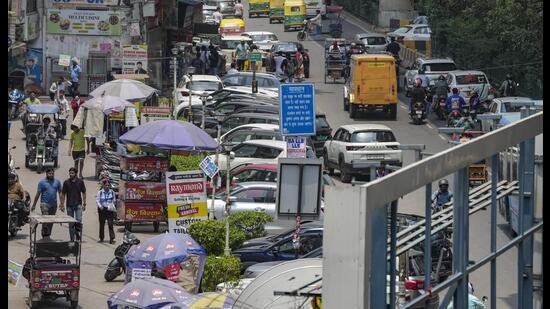
On June 19, the Supreme Court established that every citizen has a fundamental right to walk on a demarcated footpath. But for many in this country, this right exists only on paper, exercised with trepidation. Footpaths in Indian cities are under constant siege. If they are not broken, they are encroached upon by parked cars, flowerpots, extended ramps of four-storey houses, security guard cabins, construction waste, mounds of garbage, dangerously low hanging overhead wires, and shop extensions. In the Capital, only the affluent New Delhi area — the district with the least population density and maximum concentration of bureaucrats, judges and politicians — offers walkable footpaths with green cover as shade. Bengaluru and Kolkata follow a similar pattern. Mumbai, once a great walking city, has lost its footpaths to endless construction, with residents complaining that repaving is slow and of poor quality.
Footpaths in Indian cities are under constant siege. If they are not broken, they are encroached upon by parked cars, flowerpots, extended ramps of four-storey houses, security guard cabins, construction waste, mounds of garbage, dangerously low hanging overhead wires, and shop extensions. (PTI)
In a 15-part video series this month, HT found that the Capital’s footpaths were absent, inconsistent, and encroached upon — open drains and tyre shops were found on footpaths in Mukherjee Nagar, horses and garbage in Okhla, broken tiles in Lajpat Nagar, and a de facto public urinal in Panchsheel Park. Only Connaught Place, Lutyens’ Delhi, and parts of Central Delhi had walkable stretches. The rest of the city was caught in a web of jurisdictional confusion with at least 14 agencies tasked with maintaining roads and footpaths.
A 2023 report by Delhi’s Public Works Department (PWD) said that 44% of Delhi’s roads lack pedestrian pathways altogether, and only 26% of those that exist meet the standards set by the Indian Roads Congress (IRC). These guidelines dictate that footpaths should be at least 1.8 meters wide, surfaces must be free from encroachment, continuous, and non-slippery. They should have tactile paving for the visually impaired, and ramps with gentle slopes at all crossings to ensure universal accessibility. HT’s series found that little on the ground matched these guidelines.
Footpaths cannot be an afterthought. In Delhi alone, millions commute long and short distances daily on foot, navigating a maze of chaotic intersections. Delhi police data shows that 43% of road crash fatalities are pedestrians. We are at war when we are walking. It shouldn’t be like this. If footpaths can be built and maintained in Lutyens’ Delhi, why can’t they be in the rest of the city? Unfortunately, the problem of footpaths is a symptom of a wider malaise with urban governance in India’s cities. Over the past few years, it has become painfully obvious that regulatory systems have failed to keep pace with the rate of urban expansion and density, resulting in not just a deterioration in the quality of life of our citizens but also in the avoidable loss of life. Whether it be in fires inside urban jungles, poorly built buildings collapsing on their residents, roads caving in or pedestrians playing hopscotch on footpaths, the culprit is the same — apathy of the policymaker towards urban India.
This cannot continue. If India has to become developed by 2047, its engines of economic growth — cities — need to be firing on all cylinders. Poor governance and lax regulation are shackling the potential of our cities and hurting its residents. Fixing accountability will require clearing up the regulatory maze, affirming responsibility on policy bodies and bureaucrats, constant and transparent monitoring and eradicating the mindset of ad hoc governance. Functional footpaths can be the first step in this journey. After all, India can run only when its cities can walk.