



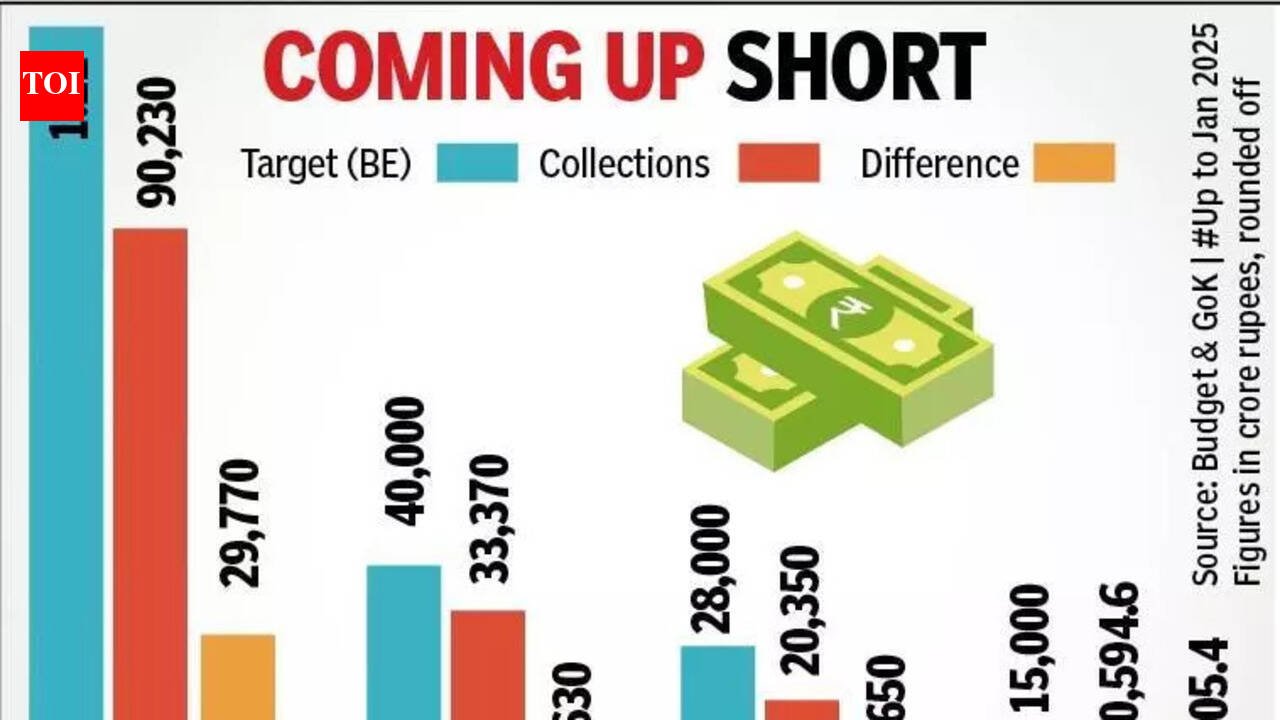
Bengaluru: Ahead of this year’s state budget, excise revenue has emerged as the most viable lever for resource mobilisation in an otherwise constrained fiscal landscape. With limited room to raise funds under other heads, the govt may rely heavily on revenue from liquor even as it balances a larger spending plan. The current fiscal numbers underline the pressure. Against the state’s own tax revenue target of nearly Rs 2 lakh crore, the govt collected around Rs 1.5 lakh crore till Jan. Bridging the shortfall before March-end appears difficult. Stamps and registration collections have lagged projections. The department mobilised Rs 20,350 crore against a target of Rs 28,000 crore. Officials told TOI that the target could be revised to Rs 25,500 crore, Rs 2,500 crore lower than what chief minister Siddaramaiah set in his 2025-26 budget. “We may end the fiscal with Rs 24,500 crore,” an official said. Non-tax revenue has also fallen short. Against a target of Rs 16,500 crore, collections stood at Rs 9,654 crore as of Jan and are expected to close at around Rs 11,500 crore. Karnataka has historically faced difficulty in substantially increasing receipts from user charges, dividends, mining royalties and other administrative streams. While the govt may announce steps to improve efficiency and plug leaks, these are unlikely to yield immediate gains. Under the GST regime, states have limited independent taxation powers. Karnataka can augment revenue only through four major heads: Excise, stamps and registration, motor vehicle taxes, and sales tax on petrol and diesel. With property registrations hit by e-khata-related issues and limited scope to raise transport or fuel taxes, excise has remained the most buoyant source this fiscal. “Commercial tax revenue suffered a short-term setback because of GST rate rationalisation,” said Prof Krishna Raj, professor and head, Centre for Economic Studies and Policy. “The revenue scenario indicates a slowdown driven by geo-politics. Since that’s expected to continue, budget estimates for next fiscal need to be realistic.” Officials cited governance disruptions for the dip in property-related revenues. “Making e-khata mandatory to register property has hit us hard,” an official said. “While issuance of e-khatas was not free of hiccups, it adversely affected registration of properties. However, a general slowdown is evident, and it has affected all sectors.” Experts say a broader solution lies in structural reform. “While states have limited room to manoeuvre, the Centre still controls direct taxes, retaining significant strength to mobilise revenue. State budgets are losing relevance. It calls for structural taxation reforms to ensure fiscal health of states,” said Vivek Mallay, indirect taxation expert. As Siddaramaiah unveils his 17th budget, the focus will be on how he balances higher spending with constrained revenues, with excise likely to remain central to his calculations. SOT revenue scenario Head Target (BE) Collections# Difference Commercial Taxes Rs 1.2-lakh-cr Rs 90,230-cr Rs 29,770-cr Excise Rs 40,000-cr Rs 33,370-cr Rs 6,630-cr Stamps & Regn Rs 28,000-cr Rs 20,350-cr Rs 7,650-cr Transport Rs 15,000-cr Rs 10,594.6-cr Rs, 4,405.4-cr Total Rs 2-lakh-cr Rs 1.5-lakh-cr Rs 48,455-cr Source: Budget & GoK | #Up to Jan 2025 | Figures rounded off


