



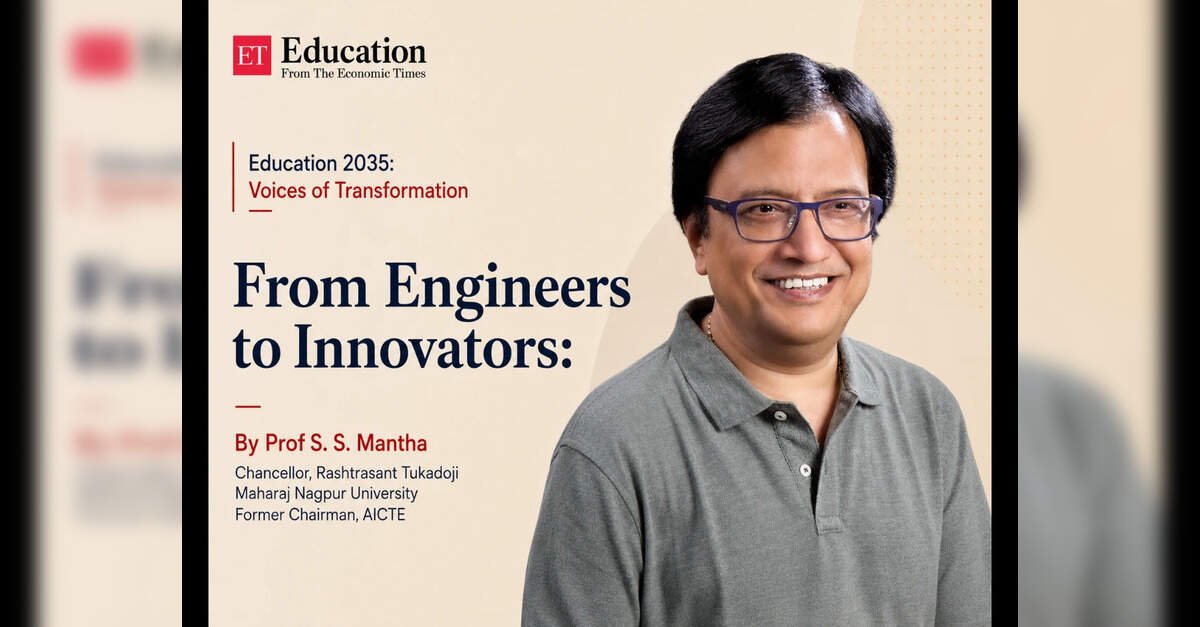
By Prof S S Mantha
Higher education today is undergoing a profound transition. The change is not merely institutional, but civilizational. Universities, once seen primarily as repositories of knowledge, are evolving into dynamic ecosystems of learning, innovation, and human development. Technology, societal expectations, economic disruptions, and deeper questions about the purpose of education in the 21st century are driving this transformation.
At the centre of this shift is a move from knowledge acquisition to capability creation. Earlier, education focused on mastering content and accumulating information. Today, information is easily accessible, and students are expected not merely to know, but to interpret, apply, innovate, and adapt. The graduates of the future will not necessarily be those who know the most, but those who can continuously learn, unlearn, and relearn.
Technology has emerged as the biggest disruptor in education. Artificial intelligence, immersive learning environments, and data-driven personalization are reshaping how knowledge is delivered and consumed. Classrooms are no longer limited to physical spaces; they are increasingly hybrid environments where digital and physical realities merge seamlessly. Students in remote regions can now access lectures from global experts, collaborate across borders, and work on real-world problems from their homes. In this sense, technology has significantly democratized education.
However, while access has expanded, meaningful engagement remains uneven. Lack of smart devices, inadequate bandwidth, and uneven digital infrastructure continue to limit participation for many learners. With the rise of multiple content platforms and ed-tech providers, the challenge today is not merely access to content, but ensuring depth of learning, mentorship, and meaningful human connection in virtual environments.
Another major shift is the growing importance of interdisciplinary and multidisciplinary learning. Contemporary challenges such as climate change, public health, and AI ethics require expertise that cuts across traditional disciplinary boundaries. Universities must therefore move away from rigid departmental silos and evolve into interconnected knowledge ecosystems where engineers study philosophy, artists learn data science, and business leaders understand environmental sustainability. Institutions of the future will need to master integrative intelligence rather than fragmented expertise.
At the same time, higher education faces serious challenges around employability. Employers increasingly seek skills such as creativity, critical thinking, adaptability, collaboration, and emotional intelligence—qualities that are not easily cultivated through conventional classroom teaching or measured through traditional examinations. As a result, universities must rethink pedagogy and assessment systems. Degrees and grades alone may no longer be sufficient indicators of capability. Increasingly, portfolios, competencies, and evidence of real-world problem-solving are becoming more important in employment markets.
Equity and inclusion also remain major concerns. Despite improvements, India’s Gross Enrolment Ratio is still around 30 per cent. While technology has widened access, it has also amplified inequalities, as students from disadvantaged backgrounds often lack digital infrastructure, mentorship, and exposure to modern learning tools. Future educational models must therefore prioritise inclusive design so that innovation does not become exclusionary.
Bridging this divide requires scholarships, digital access initiatives, localized support systems, and stronger public infrastructure. Greater use of public institutions and communication networks, including broadband and broadcasting systems, can help expand educational reach to underserved areas.
Another important issue is the mental and emotional well-being of students. In an era marked by hyper-competition, uncertainty, and constant comparison, learners face growing psychological pressures. Educational institutions must therefore move beyond viewing students merely as academic performers and instead nurture them as complete human beings.
Looking ahead, universities must expand their role beyond teaching and research to become innovation hubs and societal anchors. Rather than simply responding to change, institutions should actively shape it. Partnerships with industry, government, and communities will become increasingly important in co-creating solutions for real-world challenges.
The boundaries between education and work are also expected to blur further. Lifelong learning models will become essential, with individuals returning to universities multiple times throughout their careers to acquire new skills and knowledge.
Credentialing systems too are likely to evolve. Traditional degree structures will increasingly coexist with modular and stackable credentials, allowing learners to build flexible educational pathways. Micro-credentials, skill certifications, and experiential learning records may redefine how educational achievement is recognized.
Amid these transformations, one principle must remain central: the preservation of ethical and human values. As technology advances and knowledge expands, higher education must continue to nurture responsible citizens capable of navigating complexity with integrity, empathy, and wisdom. The future of higher education will belong to institutions that embrace flexibility, encourage curiosity, and place learners at the centre of the educational process.
This article is written by Professor Shankar S. Mantha, Chancellor of Ramdeobaba University (RBU) Nagpur. He is an eminent academician and administrator best known for his previous tenure as Chairman of the All India Council for Technical Education (AICTE)
DISCLAIMER: The views expressed are solely of the author and ETEducation does not necessarily subscribe to it. ETEducation will not be responsible for any damage caused to any person or organisation directly or indirectly.


