



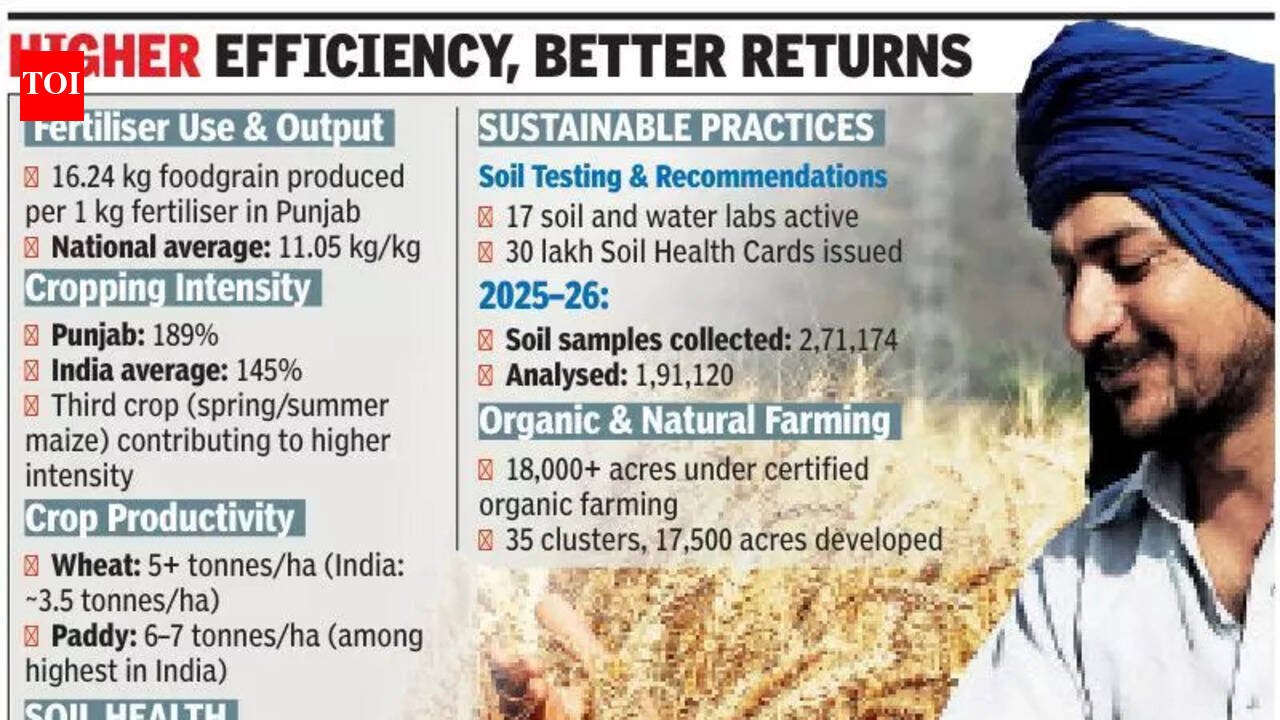
Chandigarh: Each kilogram of fertiliser used in Punjab yields approximately 16.24 kilograms of foodgrain, a figure higher than the national average. The data suggests that fertiliser application in the state not only enhanced productivity but also translated into better returns for farmers, countering claims of indiscriminate or excessive use.The figures form part of an affidavit filed by the dept of agriculture and farmers’ welfare, Punjab, before the National Green Tribunal in a case pertaining to the impact of fertiliser use on soil organic carbon, as highlighted in a study conducted by ICAR.In its submission, the dept said while concerns were raised nationally about a so-called fertiliser frenzy, Punjab’s fertiliser consumption remained comparatively lower per kilogram of foodgrain produced. The dept noted that Punjab recorded around 16.24 kg of foodgrain per kilogram of fertiliser used, compared to 11.05 kg at the national level. This, it argued, suggested that fertiliser application in Punjab not only enhanced agricultural productivity but also led to greater profitability and improved returns on investment. This could be attributed to more efficient nutrient management practices in the state.While concerns about fertiliser overuse exist at the national level, Punjab cannot be broadly categorised as a state with excessive or indiscriminate fertiliser usage leading to soil degradation. On the contrary, data and field-level trends reveal a more nuanced and improving situation.Punjab, long known as the breadbasket of India, witnessed dramatic changes in agricultural practices after the Green Revolution of the 1960s and 1970s. High-yielding varieties, increased mechanisation, and the use of chemical inputs played a crucial role in boosting productivity.According to the dept, Punjab ranks among the top states in India in terms of cropping intensity, a key indicator of agricultural efficiency. Punjab’s cropping intensity stands at approximately 189%, significantly higher than the all-India average of about 145%. In recent years, spring and summer maize emerged as a third high-yielding and fertiliser-intensive crop. This indicates that farmers in Punjab are taking more crops per year from the same land than many other states, reflecting better resource utilisation and soil management practices. The state continues to maintain high productivity levels across major crops.Wheat productivity in Punjab is over 5 tonnes per hectare, well above the national average of around 3.5 tonnes per hectare, while paddy yields consistently range between 6 and 7 tonnes per hectare, among the highest in the country. Such high yields, the dept maintained, are not possible without maintaining soil fertility and adopting efficient nutrient and water management practices.Addressing concerns about soil health, the dept placed on record long-term data on soil organic carbon, widely regarded as a key indicator of soil health. Contrary to the perception of declining soil health, soil organic carbon status in Punjab improved significantly over the decades. Soil organic carbon directly influences soil fertility, structure, and biological activity, reduces erosion, and helps mitigate climate change by sequestering atmospheric carbon. Higher levels enhance nutrient availability, water retention, and microbial activity, all of which are vital for sustainable crop production.In Punjab, the steady increase in soil organic carbon from 0.33% during 1981–90 to 0.53% during 2011–23 reflects significant improvement in soil quality and sustainability. Based on data from Punjab Agricultural University, Ludhiana, during 1981–90, only 1% of soil samples fell in the high organic carbon category above 0.75%, with an average organic carbon content of 0.33%. By 2011–23, the proportion of samples in the high category increased to 15.4%. This positive trend is attributed to improved adoption of crop residue management, promotion of organic inputs, and balanced fertilisation. With high cropping intensity, strong productivity, and improving soil health indicators, the dept argued that the narrative of widespread soil degradation in Punjab due to fertiliser use is not supported by data.The dept also highlighted steps taken to promote balanced and need-based application. Integrated Nutrient Management is being encouraged, combining biofertilisers, organic manures, and chemical fertilisers. Farmers are advised to apply fertilisers based on soil testing, and Punjab currently has 17 soil and water testing laboratories across districts.Under the Soil Health Card scheme, over 30 lakh Soil Health Cards were issued to farmers, providing crop-wise fertiliser recommendations. In the current fiscal year alone, 271,174 soil samples were collected, of which 191,120 were analysed. The implementation of the scheme led to a measurable shift towards sustainable agriculture, including a significant decrease in urea over-application and gradual improvement in soil organic carbon levels.The state also promoted organic alternatives. Over 18,000 acres were brought under certified organic farming, and 35 clusters covering 17,500 acres were developed under organic farming initiatives. Additionally, under the National Mission on Natural Farming during 2025–26, 5,410 farmers were enrolled and 5,368 acres were transitioned to natural farming practices.Data under the PM PRANAM scheme shows that in 2024–25, Punjab recorded a reduction of 2.82% in total fertiliser consumption compared to the average of the previous 3 years, with urea consumption declining by 4.97% and DAP by 12.49%. The dept maintained that this reflects a shift towards balanced nutrient use rather than indiscriminate application.


