



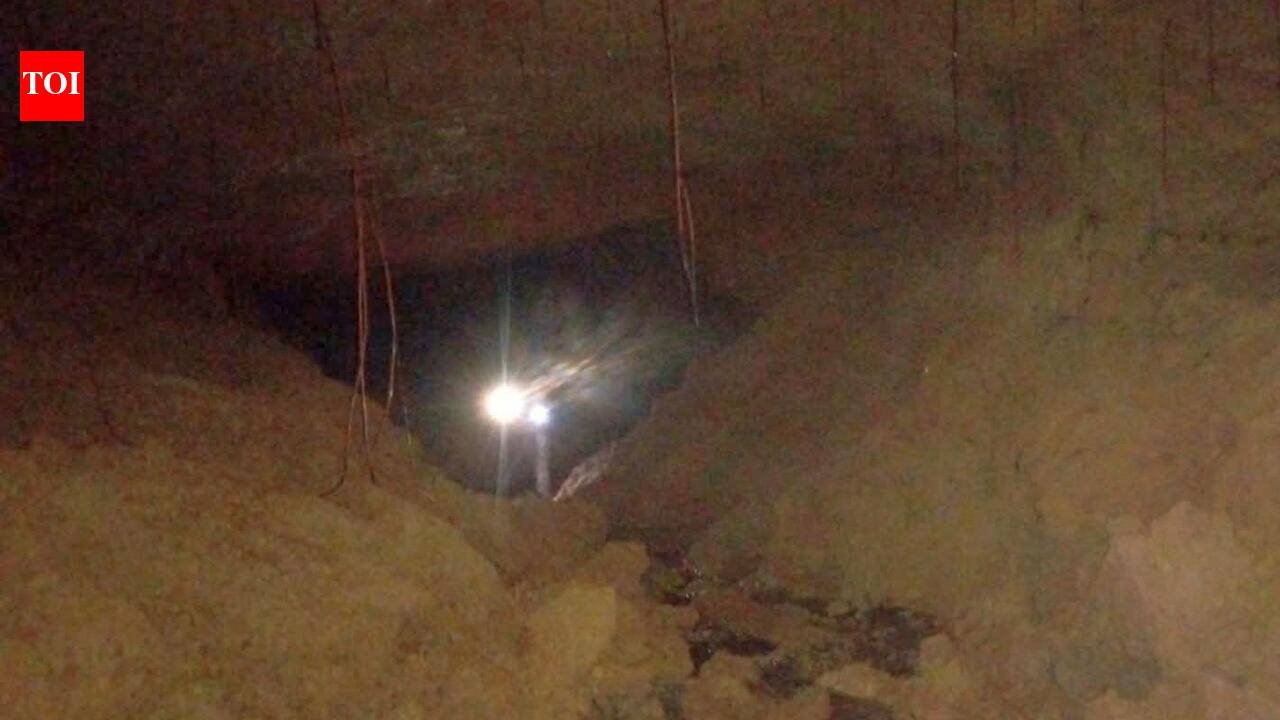
Mangaluru: A newly built house in Kasaragod’s Ottamavungal near Kuttikol has become an unlikely attraction, with curious visitors turning up to catch a glimpse of a massive underground cavity that suddenly appeared beneath it.For 45-year-old Sadan, a daily-wage tile worker, however, the unusual formation is anything but a spectacle. The cavity has cast a shadow over his plans to move into the house with his wife and two children on Aug 28.The incident came to light about two weeks ago, when an earthmover was being used to dig a pit for a septic tank near the newly constructed house. Sadan said he initially filled the pit with soil after the digging, but the soil had disappeared by the following day. When he investigated, he discovered a huge cavity beneath the ground.Soon, photographs and videos of the formation began circulating on social media, with claims that a “cave” had suddenly emerged during the digging. The site has since drawn visitors from Dakshina Kannada, Kasaragod and even Kannur.The formation is reportedly linked to soil piping, a process in which flowing water gradually erodes soil beneath a laterite surface, creating underground channels and cavities. A stream is now reportedly flowing through the cavity before entering a sinkhole and eventually reaching a pond about 50m away.For Sadan, who spent around Rs 30 lakh over three years to build the house, the discovery has been devastating. He said he took loans to construct the home, and had been looking forward to shifting into it with his family.“How can anyone sleep peacefully after seeing such a huge cavity beneath the house?” he asked.Sadan, who currently lives in his family home nearby with his mother, his family and his younger brother’s family, said he has informed the local panchayat, MLA and other officials about the situation.Officials have reportedly assured him that relief measures will be considered after a mining and geology team from Thiruvananthapuram visits the site in Sept and assesses the extent of the formation.The phenomenon is not entirely unfamiliar in Kerala. Soil piping and associated land subsidence have been studied by the National Centre for Earth Science Studies (NCESS), Thiruvananthapuram, particularly in the context of monsoon-related landslides.Two studies were commissioned by the National Disaster Management Authority in 2016 and Kerala State Disaster Mangement Authority 2020. The studies identified 139 locations in the Western Ghats affected by soil piping. The phenomenon has been reported across much of Kerala, with Kasaragod, Kannur and Malappuram among the worst-affected districts. Widespread soil piping has also been recorded in Wayanad, Idukki, Kozhikode and Thrissur.


