



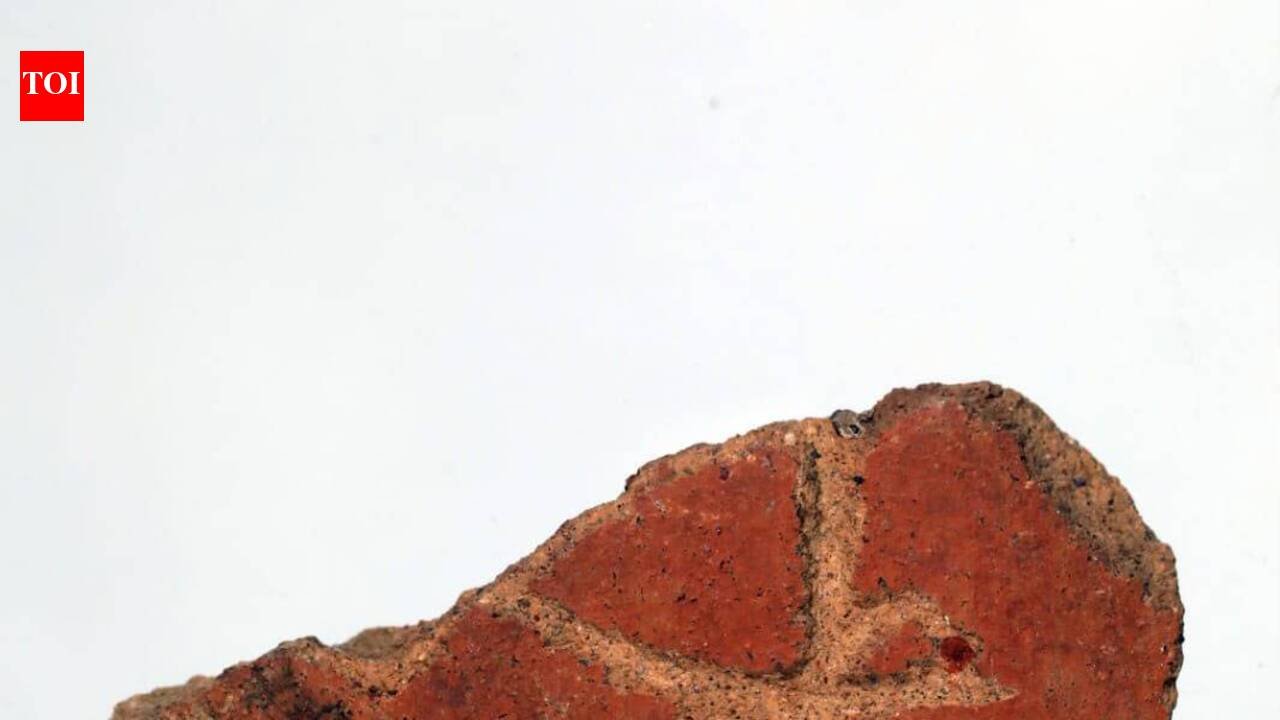
Bhubaneswar: The assessment of artefacts and structural remains unearthed during the excavation at the ancient port of Palur in Ganjam district, which concluded last year, has revealed compelling evidence of a sophisticated maritime settlement that flourished for over two millennia, shedding fresh light on the state’s early trade links with Southeast Asia.The findings were presented at a recent archaeology meeting at Utkal University attended by archaeologists from India and abroad. The excavation was jointly carried out by Odisha Institute of Maritime and South East Asian Studies and Archaeological Survey of India (ASI).Among the most significant discoveries is evidence that some red polished ware recovered from the site was fired at temperatures between 950°C and 1,000°C, far higher than the 500-600°C generally recorded in ancient Odisha ceramics. Archaeologists have described it as one of the excavation’s most remarkable scientific findings, with further laboratory studies being carried out by the ASI and IIT Mumbai.The assessment also documented 363 graffiti-marked potsherds bearing symbols, including swastikas, sun motifs, leaves, ladder designs, floral patterns and geometric markings. Archaeologist and former director of Palur excavation project Sunil Patnaik said these may have denoted ownership, merchant guilds, potters’ marks or religious symbols, offering valuable clues to the social and commercial life of the ancient port.The assemblage includes beads made of carnelian, agate, jasper, quartz and faience, besides glass bangles, ivory artefacts and shell objects, pointing to Palur’s participation in long-distance trade networks linking eastern India with Southeast Asia.Archaeologists associated with the excavation, which continued from 2023 to 2025, also identified several prestigious ceramic types, including northern black polished ware (NBPW), knobbed ware, deluxe red polished ware, chocolate slipped ware and black polished ware. The presence of NBPW, associated with the Mauryan and Early Historic periods, further strengthens evidence for the site’s antiquity, Patnaik said.The excavation also yielded net sinkers, fish bones, tortoise shells, cowries and conch shells, indicating that fishing, marine resource exploitation and port-related activities formed an integral part of the settlement’s economy.One trench exposed nine distinct cultural layers extending nearly three metres below the surface, providing an uninterrupted archaeological sequence from the pre-Mauryan period through the Early Historic and Early Medieval phases. Based on these findings, archaeologists have concluded that Palur was occupied from at least the pre-Mauryan period, significantly pushing back the antiquity of the ancient port.The assessment also lends strong support to identifying present-day Palur with ‘Paloura‘, the harbour described by the 2nd-century Greek geographer Ptolemy as a major embarkation point for voyages to Southeast Asia.Beyond the excavated mound, archaeologists documented 66 Early Historic sites in the surrounding landscape, indicating that Palur functioned as the centre of an extensive urban-maritime complex rather than an isolated port settlement.“The excavations at Palur have opened a new window onto the maritime activities of early Odisha in the broader context of the Indian Ocean trade network and trans-regional civilisation linkages,” Patnaik said. He added that further excavations are essential to gain a more comprehensive understanding of Odisha’s ancient cultural roots and its long-standing maritime connections with South and Southeast Asia.


