



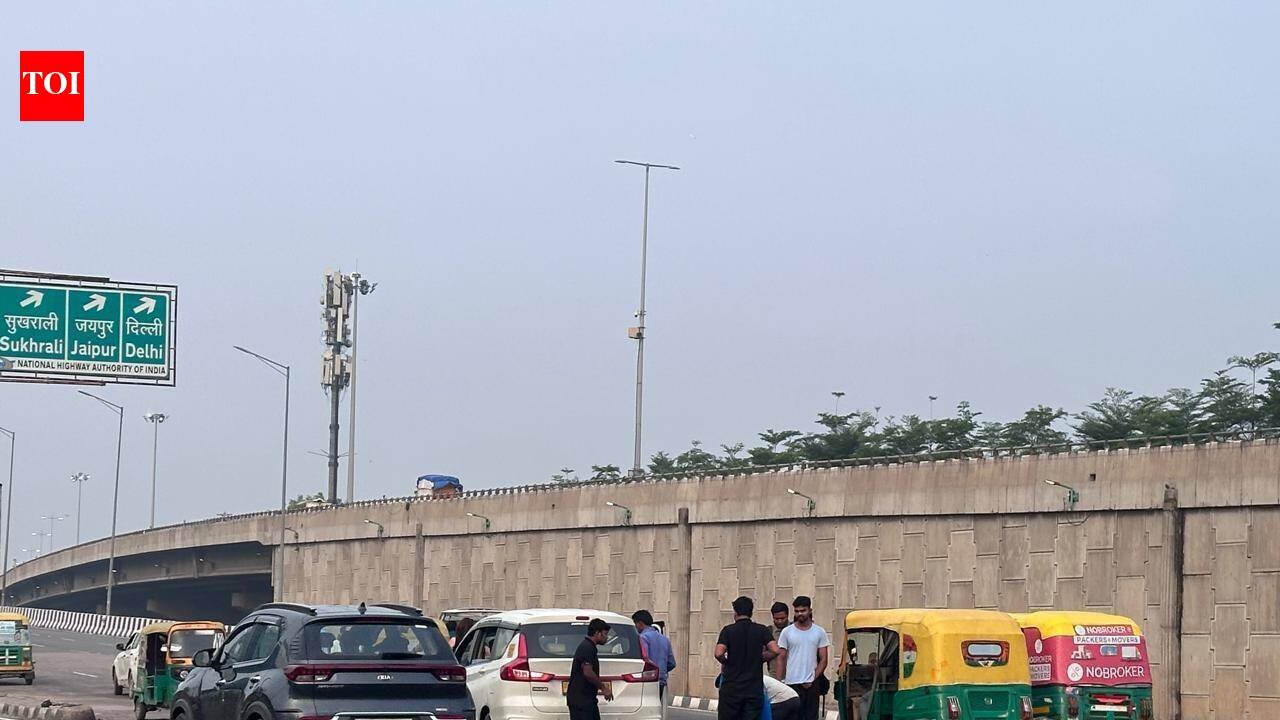
Gurgaon: A year after traffic police launched a special drive to keep slow-moving vehicles off the Delhi-Jaipur highway and Dwarka Expressway, little has changed on the ground.The issue resurfaced on Friday when a cab driver was killed on the expressway near Sector 36A after his car rammed into an e-rickshaw loaded with iron rods. They pierced the windshield on impact, fatally injuring the driver. The incident has revived questions over the continued presence of vehicles which are banned on high-speed corridors.Police barred motorcycles, scooters, tractors, e-rickshaws, three-wheelers, e-carts, multi-axle hydraulic trailers, quadricycles and non-motorised vehicles from the main carriageway of the Delhi-Jaipur highway between Sirhaul border and Kherki Daula toll plaza, and Dwarka Expressway between Kherki Daula and the Delhi border, in June last year.The order followed directions from National Highways Authority of India (NHAI) and a Punjab and Haryana high court ruling on a public interest litigation seeking curbs on slow-moving vehicles on expressways and national highways. Banned vehicles were required to use service roads instead. Police installed signboards, ran campaigns and warned of strict action, citing the high risk of fatal crashes from the speed differential between fast and slow-moving traffic.Until July 15 this year, police issued 63,428 challans for no-entry violations on the Dwarka Expressway, along with 51,654 for improper lane changes and 13,420 for driving without seat belts. Despite the volume of challans, prohibited vehicles continue to weave through high-speed traffic on the expressway almost daily.A traffic police officer attributed the violations partly to congestion on service roads. “When two-wheelers or other slow-moving vehicles get stuck in traffic on service lanes, many riders enter the main carriageway to save time or avoid congestion — a dangerous move on roads designed for much higher speeds,” the officer said.Satpal Singh, a policeman deployed at Friday’s accident site, said awareness campaigns alone haven’t changed commuter behaviour. “Despite numerous challans and repeated campaigns, people knowingly enter prohibited stretches, putting their own lives and those of other road users at risk,” Singh told TOI.Commuters say enforcement hasn’t translated into compliance. “The rules exist only on paper. Bikes, e-rickshaws and other slow-moving vehicles are on the expressway every day, forcing faster vehicles to brake suddenly or change lanes,” said Kavita Sharma, a who frequently uses the expressway.Vinay Kumar, another commuter, said violations have become routine. “People know there are restrictions, but they also know the chances of being stopped are minimal. Service roads often remain congested, so many riders simply enter the main carriageway to save time,” he said.


