






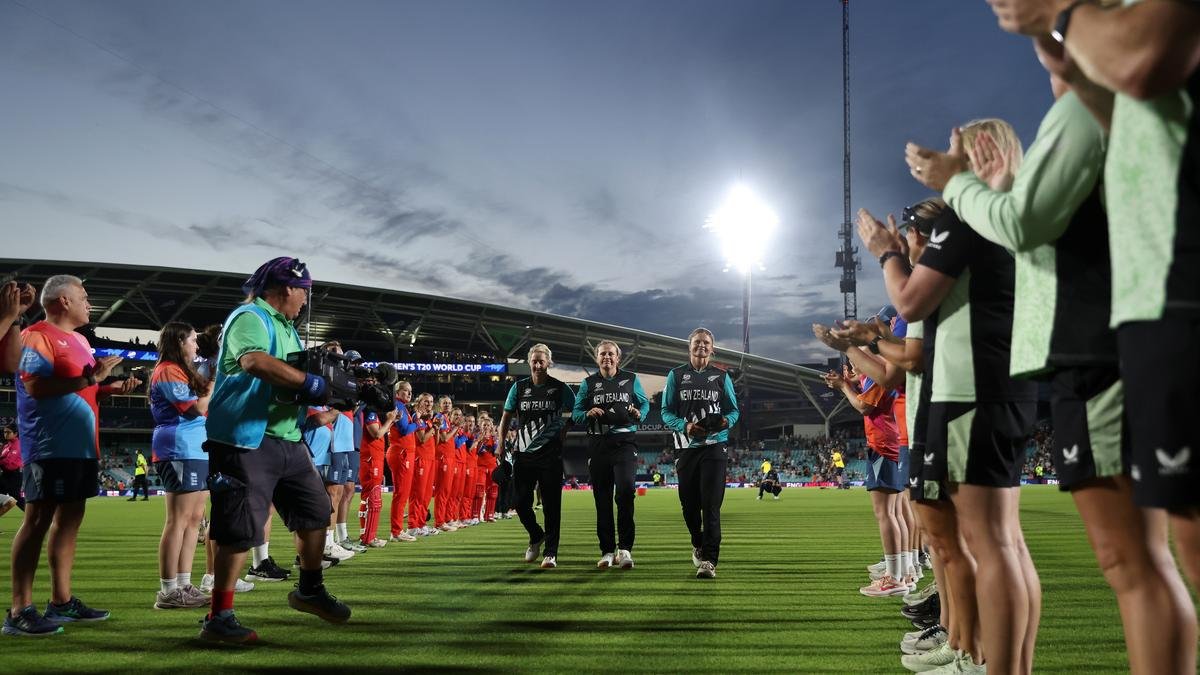
Sophie Devine stopped kindly for her fans.
She smiled into the selfie camera. She engaged for a while with the cricket fans, who had assembled in large numbers on that warm Sunday afternoon at Lord’s for the Women’s T20 World Cup match between India and Australia.
Devine’s World Cup had been over by then: New Zealand had been knocked out of the Women’s T20 World Cup.
She had announced that she would be quitting international cricket after the World Cup. Suzie Bates and Lea Tahuhu, who along with Devine were the members of the New Zealand that won the last T20 World Cup in UAE two years ago, had also played their last matches for White Ferns.
It was as if these magnificent women, who between them played 894 games for New Zealand, were making the opening statement for what would be a summer of farewells in cricket. Their countryman Kane Williamson ended his international career during the Test series in England, which overlapped with the Women’s World Cup. And there were more to follow: Ben Stokes, Heather Knight, Tammy Beaumont.
Rarely has cricket seen so many stars leaving the stage within a space of so little time. We also saw the curtain coming down on two high-profile coaching stints: of Brendon McCullum and Stephen Fleming. As if all that wasn’t enough, Garry Sobers, cricket’s greatest all-rounder of all time, bid an even more poignant farewell.
Brendon McCullum has quit as England Test coach.
| Photo Credit:
Getty Images
Devine, a quality all-rounder, has been one of the most feared batters in women’s cricket. Those who watched her make 99 off just 36 balls for Royal Challengers Bengaluru against Gujarat Titans at the Brabourne Stadium in the inaugural Women’s Premier League in 2023 were fortunate. It was the McCullum moment of the WPL. And McCullum, whose stunning hundred for Kolkata Knight Riders against RCB in the first ever match of the IPL set the tone for the world’s most glamorous cricket league, had been the biggest influence on her, she had told this correspondent in an interview.
Sense of humour, and purpose
International women’s cricket will certainly miss those big hits from Devine. Her sense of humour will be missed as much. Her interviews and press conferences have been fun.
After her sensational innings against KKR, when Devine was asked about her going after Australian all-rounder Ashleigh Gardner (24 runs in the second over of the innings), she smiled: “She has been a bully to a lot of other people over the years and I think it is only fair that she has got a bit of her own back.”
Like Gardner, many bowlers have been at the receiving end of the might of Devine’s bat over the last decade and a half, during which she scored 8096 runs and 241 wickets for New Zealand. In 2020, she became the first player – man or woman – to hit six fifty-plus scores in T20Is. She had also represented New Zealand in hockey.
Bates had made her debut for New Zealand seven months before Devine. She too was a double international, having played basketball for her country. She, in fact, represented New Zealand at the 2008 Olympics in Beijing.
Bates has finished her international career with 4758 runs in T20Is, more than any other batter, male or female. She also scored 5982 runs in ODIs, with 13 hundreds. But it hadn’t been easy for her, like other players of her generation, when women’s cricket wasn’t anywhere near as popular as it is today.
“When I was young, from 18 to 24, I studied, and we got grants from the government to study and play sports to help pay for our living allowance,” Bates had once said in an interview to The Hindu. “I took part-time roles like coaching, whether it was basketball, cricket, to earn a little bit of money on the side, and when we were away, we got reimbursed.”
If things are much easier for the women cricketers of today, they owe it to players like Bates, Devine and Tahuhu, the seamer who finished her international career with 225 wickets for New Zealand.
Remarkable transformation
Knight and Beaumont, too, have been fortunate that they could be part of the remarkable transformation the game has undergone since they debuted for England. Women’s cricket has changed so much that Knight could see her own image staring at her from all over London – at tube and bus stations and at Lord’s — this English summer thanks to the MCC’s catchy campaign to promote the historic England-India Women’s Test.
Heather Knight leaves the field after her final international innings during the Lord’s Test against India.
| Photo Credit:
Getty Images
She and Beaumont were indeed lucky that they could end their international careers with the first ever Test match for women at Lord’s. That was the 15th Test for Knight, who played 160 ODIs and 145 T20Is. She had led England to the 2017 World Cup victory at home. She was a batter that England could bank on.
Runs flowed freely from Beaumont’s bat too, during her 17-year career, in which she scored 12 hundreds and 24 fifties in ODIs. She also became the first ever woman to score a Test double hundred.
If England’s women’s team lost two of their best batters, the men’s team had to say goodbye to its inspiring captain, all-rounder extraordinaire and miracle-worker. Stokes is easily one of the most gifted cricketers of his generation and will go down in history as one of the game’s all-time greats. With two incredible innings in 2019, he won England a World Cup and an Ashes Test victory for ages.
He was also the ideal captain to implement McCullum’s brave ideas to transform England’s Test fortunes. While the verdict on Bazball may not be unanimous, the fact remains that Stokes and McCullum brought a new dimension to Test match cricket.
The complete package
Stokes will be remembered as one of the most complete cricketers: he was brilliant as a batter, bowler and fielder. Yes, his career was hampered by injuries and a few incidents outside the field that he may not like to remember. But, few cricketers in our time have given the game as many exciting moments on the field. Williamson has undoubtedly been one of the greatest batters of his generation, a part of the Fab Four alongside Joe Root, Steve Smith and Virat Kohli. He was fabulous across formats. He finished his international career with 9515 runs in Tests at an average of 54.06, 7256 in ODIs at 48.69, 2575 in T20Is at 33.44. And he hit 48 international hundreds.
Ben Stokes has ended his international career.
| Photo Credit:
Getty Images
He also led New Zealand admirably. Fittingly, he was the captain when the Kiwis won the inaugural World Test Championship, after beating India in the final. He has been admired not just for being a run-machine, but for his genial nature as well.
It was from McCullum that Williamson had taken over the New Zealand captaincy. That was in 2016. Some three years later, McCullum turned to coaching with Trinbago Knight Riders and Kolkata Knight Riders.
Then in 2022, he was appointed as England’s coach. That would prove to be perhaps the most discussed coaching job in cricket’s history. McCullum’s ultra-aggressive approach to playing Test cricket, called Bazball, gave England some great Test wins, but some chastening defeats too. Bazball had begun on a stunning note, with England notching up four magnificent against in a row at home – three against New Zealand and one against India. Some of the innings the England batters played, under McCullum, by the likes of Jonny Bairstow, Ollie Pope and Ben Duckett, were spectacular.
Sport’s greatest theatre
But Test cricket is no extension of T20 cricket. It is sport’s greatest theatre, and the most challenging mode of all sports. That is why we all love it. You cannot Bazball your way out of trouble all the time. It was bound to fail at some points of time. And it failed spectacularly in the difficult conditions of India and Australia. Finally, McCullum had to go, after the defeat to New Zealand in the home series.
But, he had shown a new way to play Test cricket. That will not be forgotten.
The other high-profile Kiwi coach’s departure too was perhaps as inevitable. Fleming’s association had been, however, much longer, and he had become one of the faces of Chennai Super Kings. He became the CSK coach in 2009 and the following year, he led the franchise to the IPL title. He helped CSK triumph again in 2011, 2018, 2021 and 2023.
He was in Chennai all along, except in 2016 and 2017 when he moved to Rising Pune Supergiant following CSK’s two-year suspension. Fleming’s at CSK had one of the IPL’s most successful coaching careers.
Garry Sobers passed away at the age of 89.
| Photo Credit:
Getty Images
There was no IPL in Sobers’ time. Even the ODIs arrived a bit too late for him (he played just one). He would have been T20 cricket’s biggest superstar. Cricket’s most versatile player, who scored 8032 runs at an average of 57.78 and took 235 wickets from 93 Tests, passed away on July 17 at the age of 89.


