





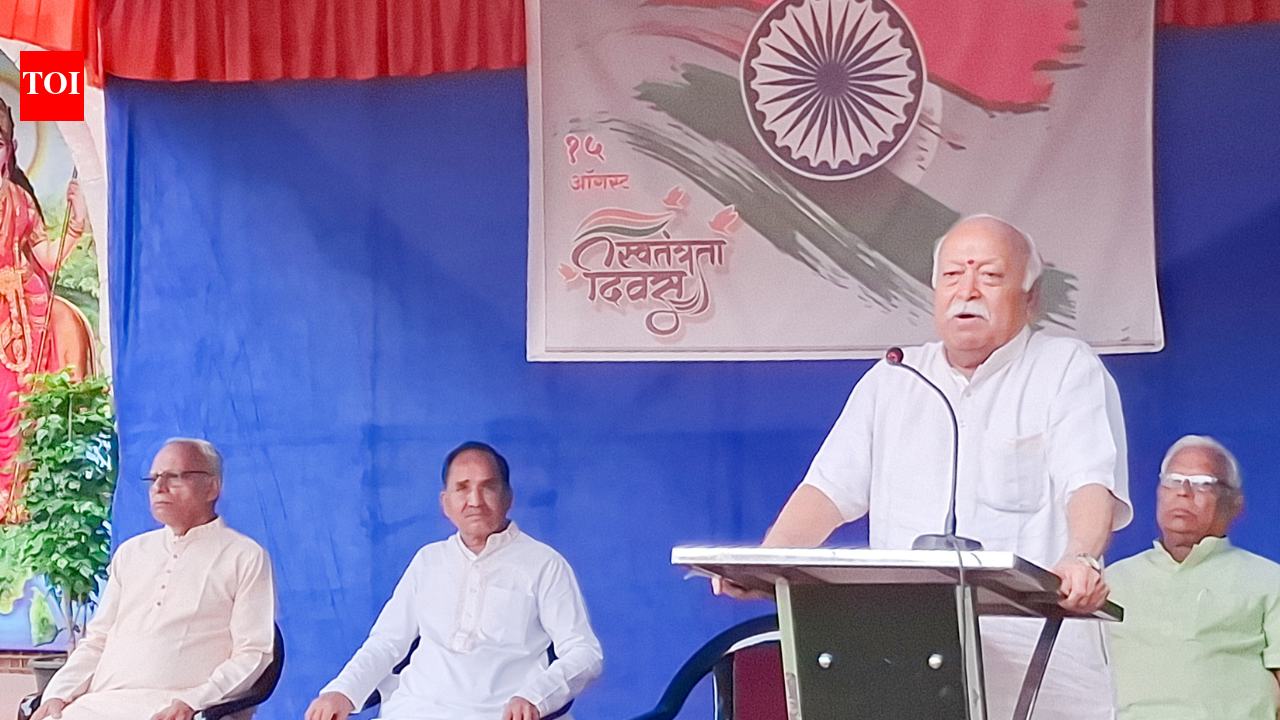
NAGPUR: RSS chief Mohan Bhagwat on Saturday said democracy allows room for divergent and even conflicting viewpoints, and that public-interest issues may sometimes need to be raised forcefully. However, he stressed that such expression must not harm the Constitution or the country’s social and cultural fabric.Speaking at an Independence Day flag-hoisting programme at Kasturchand Park in Nagpur, where he addressed youngsters, Bhagwat said differences of thought were natural and that trying to make everyone think alike would amount to coercion.“We are a democracy and there will be dialogue, debate, argument and counterargument,” Bhagwat said, adding, “this difference is an expression of unity”.He further said that when questions of public interest are raised, they sometimes need to be raised forcefully and enough pressure has to be exerted for action to follow. However, the RSS chief drew a line on dissent.“The laws and Constitution of the country should not be harmed. Our ancient and sacred culture should not be harmed, nor should our virtues and values or strength of character,” he said, while referring to Dr BR Ambedkar’s speeches on the adoption of the Constitution and the need to accommodate differences without allowing them to fracture society.At the Independence Day flag-hoisting ceremony at the RSS headquarters in Mahal earlier in the day, Bhagwat invoked Vinayak Damodar Savarkar while speaking on the responsibilities that follow political freedom. Referring to Savarkar’s words on all that is “noble, elevated, great and sweet”, Bhagwat said generations had made sacrifices from 1857 onwards to secure Independence and that the responsibility now was to preserve that freedom and ensure its finest manifestation in India.“Our nation has become independent and will remain independent — that is certain,” Bhagwat said. The task now, he added, was to make India “happy, prosperous and secure” and enable it to make its destined contribution to the world.“There are many obstacles and many people who are moving contrary to our path. But without deviating from principles, we have to face these challenges across the world and make India vishwaguru, one that makes a meaningful contribution to the life of all humanity,” Bhagwat said.Using the Dharma Chakra or Dhamma Chakra as a metaphor at the Kasturchand Park event, Bhagwat said its spokes point in different directions but originate from the same centre and remain bound within a common circumference. India, too, had diversity of language, region, caste and thought, he said, but differences should not turn into division.“We must never break apart. There should be no division among us,” he said.Bhagwat also recalled that at the time of Independence, some prominent foreigners had predicted that India would eventually “break and scatter”. India, he said, had disproved those predictions as it entered its 80th year of Independence.Turning to the youth, he cautioned against measuring India’s progress simply against other countries.“We are not America, we are not China, we are not Australia or New Zealand. We are India,” Bhagwat said, adding that India needed to determine the nature and scale of its development according to its own circumstances, resources and outlook.Describing the younger generation as the country’s demographic dividend, Bhagwat said its potential, if properly utilised, could help India become a Vishwaguru. He also urged youngsters to look beyond salaried jobs when considering employment.“Employment does not mean only a job. Working with one’s hands must also have dignity, and industry and entrepreneurship must have dignity,” he said, adding that enterprise involves risks and young people needed the courage to take those risks and succeed.To illustrate the point, Bhagwat narrated an episode involving Rabindranath Tagore’s visit to Japan, saying students at a university had declined to attend the Nobel laureate’s lecture despite recognising his stature, saying, “If he is so great, why is his nation still under British rule?”He used the anecdote to argue that honour draws strength from the nation’s stature.


