



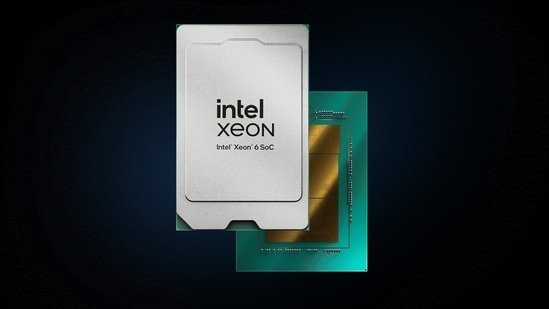
At Computex 2026 in Taipei, Intel launched the new Xeon 6+ processors, expanded its 800 Series Ethernet portfolio with the new Intel Ethernet E835 controllers and network adapters, and provided an update on its AI accelerator roadmap, including new details about Crescent Island.
What’s new with Intel Xeon 6+?
Intel says the Xeon 6+ processors focus on performance density, power efficiency and operational scale, and are designed for cloud-native, agentic AI-driven workloads.
Built on Intel 18A, the processors are designed to handle the orchestration, concurrency and data movement demands of agentic AI. Intel says they are optimised for environments where watts per rack, throughput per core and latency predictability are critical.
The processors feature up to 288 Efficient-cores, delivering up to 2.5x more performance compared to the previous generation and 45 per cent better performance per thread per watt, according to Intel.
Other features include 12-channel DDR5 memory, 96 lanes of PCIe Gen 5, CXL support, Intel Application Energy Telemetry, up to 9:1 server consolidation, and security built into the silicon.
Intel says the processors are already being tested in telecom network infrastructure and are being configured for deployment in data centres.
What’s new with Intel Ethernet E835?
As AI, cloud and distributed workloads continue to scale, Intel has introduced the Intel Ethernet E835 controllers and network adapters, which the company says are designed to deliver high-performance, power-efficient connectivity for modern data centres, enterprises and AI environments.
Key highlights include:
- Support for up to 200GbE throughput across multiple controller and adapter configurations, with data rates ranging from 10GbE to 200GbE.
- Multiple port configurations, including 2x25GbE, 4x25GbE, 2x200GbE and 1x200GbE, with additional configurations enabled through the Intel Ethernet Port Configuration Tool.
- Improved power efficiency. Intel claims the Intel E835-CQDA2 network adapter delivers up to 1.9x higher performance per watt than the NVIDIA ConnectX-6 Dx CX614106A and up to 1.4x higher performance per watt than the Broadcom BCM957508P2100G.
- A lifecycle of more than 10 years.
Intel says companies including Cisco, Dell, HPE, Lenovo and Supermicro will integrate the new networking solutions.
Intel Crescent Island
Intel says Crescent Island is its next-generation data centre GPU, designed to meet the growing demands of edge and AI workloads, particularly in areas such as memory capacity, bandwidth and efficiency.
Built on the Xe3P architecture, the GPU is designed to deliver improved efficiency and performance per watt while maintaining broad software compatibility for modern AI workloads.
It features LPDDR5X memory with up to 480GB of capacity to handle large, token-intensive workloads while helping reduce the overall cost of ownership.
The GPU uses a 350W air-cooled PCIe design and leverages Intel’s multi-generational Xe install base, according to the company.


