Says no plans to privatise power distribution companies
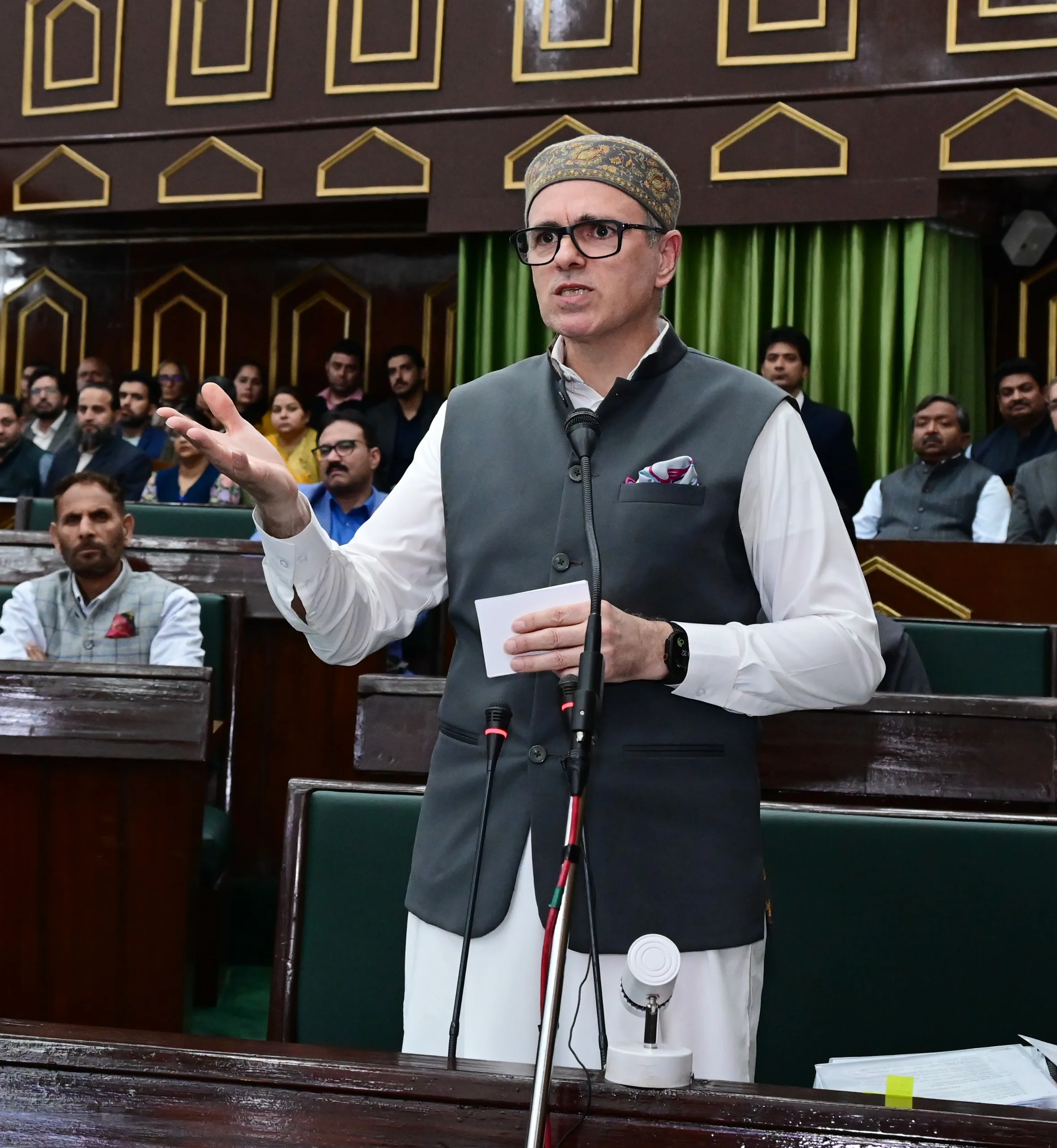
Srinagar, Feb 19: Chief Minister Omar Abdullah on Thursday said the government will initiate the regularisation of daily-rated workers, casual labourers, and other temporary employees in 2026 through a legally and financially sustainable framework. He also announced plans to fill nearly 30,000 vacant posts during the current year.
Replying to discussions on Demands for Grants and cut motions in the Assembly, the Chief Minister addressed issues related to temporary employees, recruitment, hydropower expansion, distribution reforms, and climate policy.
Omar noted that the issue of daily wagers and temporary staff has remained unresolved for decades. Many workers have been engaged for 20, 30, or even 40 years without regularisation, and successive governments were unable to address the matter fully. A committee, headed by the Chief Secretary, has already been constituted to frame a policy that is legally sound and financially viable.
“The government will not take any decision that cannot withstand scrutiny in courts or clearance from the finance department,” Omar said. “Regularisation cannot be implemented through a single executive order, it requires careful preparation.”
The exact number of eligible workers, he added, will be determined through a structured process and could range between 70,000 and one lakh. Currently, over one lakh daily wagers and casual labourers are engaged across J&K government departments. The Chief Minister provided a detailed breakdown, including 69,696 casual labourers, 8,836 daily-rated workers, 8,534 seasonal labourers, 5,757 helpers in the Food and Civil Supplies Department, 2,153 part-time sweepers, and 1,929 staff engaged through the Hospital Development Fund.
On employment generation, Omar said the government has already filled around 6,000–6,500 posts and aims to fill nearly 30,000 vacancies this year without creating new positions. Recruitment will be conducted transparently in coordination with the J&K Public Service Commission and the Services Selection Board.
Turning to the power sector, the Chief Minister highlighted that J&K has an estimated hydropower potential of 18,000 MW, of which only 3,000–3,500 MW has been developed. With planned projects, total generation is expected to rise to nearly 7,000 MW in the coming years. Detailed project reports will be prepared to harness the remaining 11,000 MW in coordination with the Central Government, with phased implementation over the next 10–15 years.
Omar said that Jammu and Kashmir currently consumes more electricity than it generates and does not fully realise revenue from its usage. He said that harnessing the full hydropower potential could reduce dependence on central assistance.
The long-term objective, he said, is to make the Union Territory self-sufficient in power and enable it to supply electricity to other states, particularly during peak summer demand.
The Chief Minister said that increasing generation alone would not resolve power sector challenges and emphasised the need to strengthen the distribution network.
He referred to the Revamped Distribution Sector Scheme (RDSS), stating that implementation has progressed in some districts, while others have experienced delays.
Omar said he is personally monitoring the implementation of the scheme and assured that it will be fully executed.
On revenue, he said electricity consumption must be paid for, with government support extended to those who are unable to afford it.
He referred to provisions such as up to 200 free units under schemes including PM Surya Ghar.
The Chief Minister said the government is committed to ensuring proper metering and addressing discrepancies transparently, including cases where departmental collusion may have occurred.
Responding to concerns about privatisation, the Chief Minister said there is no proposal or necessity to privatise power distribution companies.
He said the focus will be on improving accounting systems, budgeting and strengthening financial guarantees to improve their financial position.
Addressing climate concerns, Omar said extreme weather events in the past year highlighted the need for a structured climate response. A fund for climate change mitigation has been created, and the government will first assign a department responsible for studying climate impacts before introducing a dedicated climate budget. Once institutional responsibility is established, targeted budgetary interventions will strengthen climate resilience in J&K.