






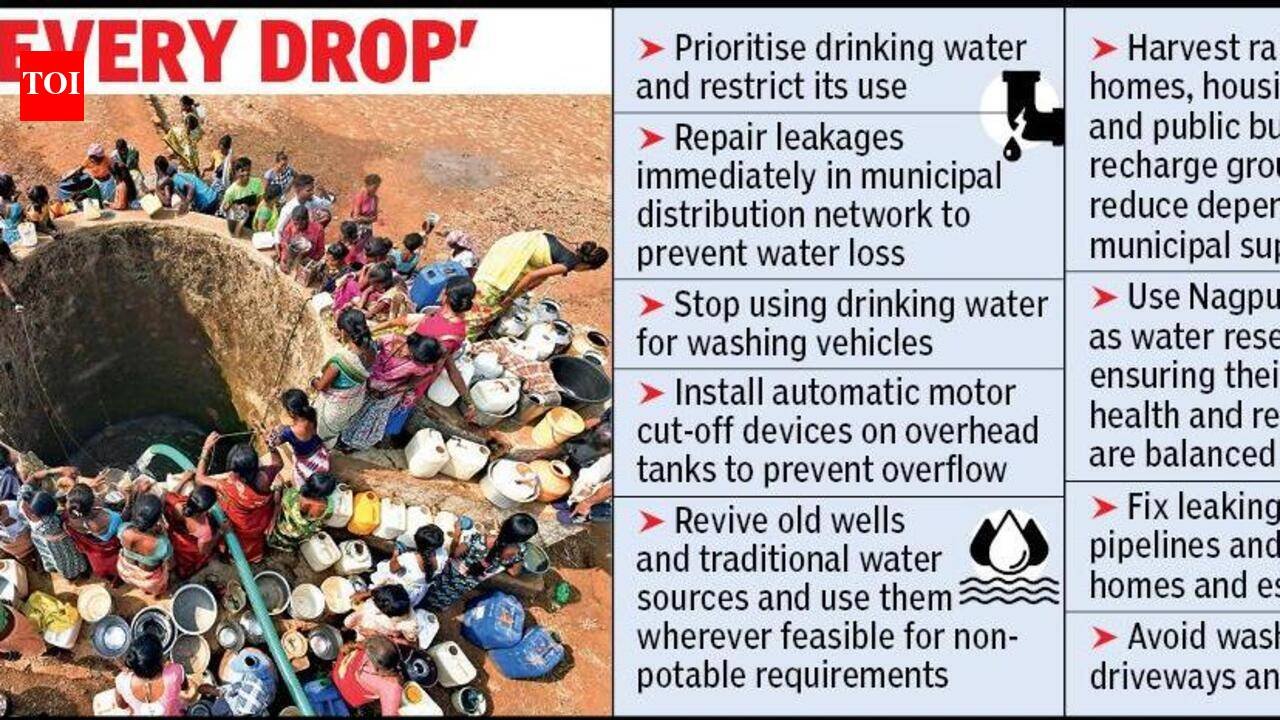
Nagpur: With the city likely to face water stress in the coming months, experts have called for immediate action by both citizens and the administration, stressing that preventing wastage and ensuring priority-based water supply will be crucial to avoiding a crisis.While citizens have been urged to stop avoidable wastage, Nagpur Municipal Corporation (NMC) has been urged to prioritise drinking water, repair leakages and prepare a long-term conservation plan.NMC is currently supplying around 770 million litres per day (MLD), only slightly below the nearly 780 MLD supplied during peak summer. The water stock in five reservoirs in Nagpur district is currently 70.45%, against 85.71% last year. Experts said the effective availability would reduce further due to evaporation, making conservation measures increasingly important.Hydrologist Yogesh Murkute said the administration needed to adopt both short and long term measures and strictly follow a priority-based approach to water allocation. “As per the National Water Policy, the priorities are set. First drinking water, then household usage, agriculture, industries and then others,” he said.For the immediate term, Murkute said drinking water should not be diverted for other purposes and nearby alternative water sources should be identified for non-drinking requirements. He also called for a long-term water conservation policy and revival of old wells.Murkute said Nagpur’s lakes should also be viewed as potential water reserves instead of being used primarily for recreational purposes. “It is ironical that Nagpur has so many lakes but they are not used as water sources. They should first be used as water reserves and then for recreational activities,” he said.Environmentalist Kaustav Chatterjee said the responsibility for conserving water rested equally with the administration and citizens. He said NMC must continuously assess available water storage and plan supplies according to priorities, with drinking water being given precedence, followed by agriculture and industries.“The NMC should reserve water and then supply it on the basis of priorities. Similarly, NMC and OCW must repair all leakages which waste drinking water,” Chatterjee said.For citizens, Chatterjee suggested several simple but immediate measures. Residents should stop using pipes to wash vehicles and instead use buckets, while household leakages should be repaired without delay.Another key measure suggested by him was installation of automatic motor-stopping devices for overhead tanks. Such devices can prevent motors from continuing to run after tanks are full, thereby reducing water wastage through overflow.Experts said conservation cannot be left until water levels fall further. While the administration needs to secure and prioritise available resources, citizens must reduce unnecessary consumption and prevent wastage at home. Coordinated action now, they said, could help Nagpur avoid more severe water-supply problems in the coming months.


