



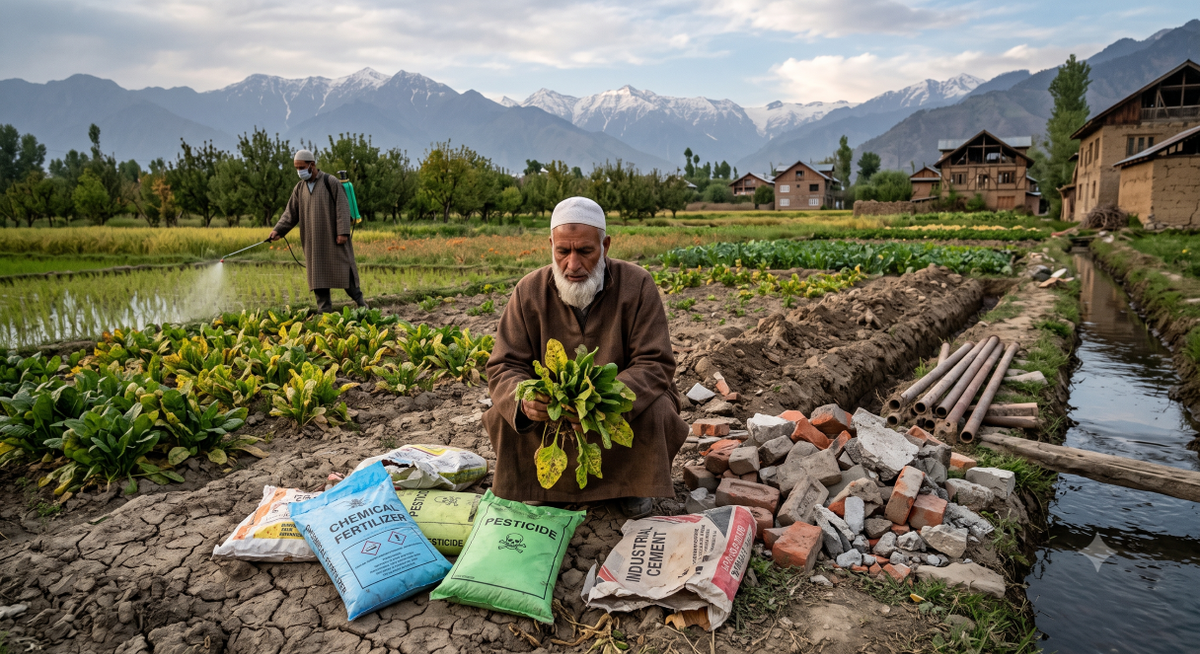
Srinagar, Aug 03: A crucial scientific study has raised serious concerns over the health of Kashmir’s agricultural soils, revealing widespread contamination by toxic metals and a parallel decline in essential micronutrients in one of the Valley’s most productive farming regions. The findings that researchers say could have far-reaching implications for food safety, agricultural productivity, livestock health and public health.
The study, published in the Scientific Reports—a peer-reviewed journal of the Nature Portfolio—and led by Geological Survey of India scientist Ishfaq Ahmad Mir, analysed 200 topsoil samples collected from nearly 800 square kilometres of the Bandipora and Ganderbal districts, encompassing paddy fields, apple orchards, grazing lands and forest fringes.
The findings paint a troubling picture. While the soils remain naturally rich in iron, researchers found alarmingly high concentrations of arsenic (As), chromium (Cr), nickel (Ni) and vanadium (V), with contamination levels exceeding internationally accepted thresholds across large parts of the study area. At the same time, several locations were found to be deficient in copper (Cu), nickel and zinc (Zn)—micronutrients essential for crop growth, livestock development and human nutrition.
“93 per cent of the samples exceeded the toxicity threshold for arsenic, 88 per cent for chromium, 81 per cent for vanadium and 17 per cent for nickel. Nearly one-third also recorded elevated cobalt concentrations,” the study reads.
Researchers say this combination of toxic contamination and nutrient depletion is particularly worrying because it not only reduces soil fertility and crop productivity but also increases the likelihood of harmful metals being absorbed by crops and entering the food chain.
The analysis recorded average concentrations of iron at 44,759 mg/kg, chromium 120 mg/kg, vanadium 114 mg/kg, zinc 89 mg/kg, nickel 44 mg/kg, copper 33 mg/kg, lead 23 mg/kg, cobalt 19 mg/kg and arsenic 11 mg/kg.
Although lead and zinc generally remained within permissible limits, the study found that around 8 per cent of samples were deficient in zinc, while copper and nickel deficiencies occurred in 3 per cent each. These micronutrients are indispensable for plant metabolism, disease resistance, grain formation and livestock health.
The researchers observed that soils developed over carbonate rocks, particularly in parts of Ganderbal district, were naturally deficient in copper, nickel and zinc, making them less productive unless supplemented with appropriate nutrients. In contrast, basalt-derived soils contained higher concentrations of beneficial micronutrients but also exhibited elevated levels of toxic elements.
The study identifies human activity as a key driver of soil contamination. Intensive use of arsenic-bearing pesticides and phosphate fertilisers in orchards and agricultural fields, emissions from vehicles and farm machinery, construction associated with hydropower projects, fossil fuel combustion and poor waste management have all contributed to rising concentrations of hazardous elements.
Higher arsenic concentrations were detected in intensively cultivated agricultural areas where pesticides are extensively used, while elevated lead levels were recorded near the Kishanganga Hydroelectric Project, pointing to possible construction-related pollution. Zinc enrichment was also linked to intensive farming practices involving fertilisers and pesticides.
Using internationally recognised pollution assessment methods, the researchers identified arsenic as the most significant contaminant in the region.
An integrated Toxic Risk Index showed that only about five per cent of the sampled sites posed no toxic risk. Nearly 63.5 per cent fell into the low-risk category, while 31.5 per cent were classified as posing a moderate toxic risk.
The highest contamination levels were concentrated around agricultural fields, human settlements and hydropower project sites, whereas forests, grazing lands and wastelands generally recorded lower pollution levels. Bandipora emerged as more vulnerable than Ganderbal, particularly in its northern and western areas.
The study warns that prolonged exposure to these toxic elements could have serious health consequences.
“Arsenic is a recognised human carcinogen linked to several forms of cancer and organ damage. Chromium exposure has been associated with neurological disorders and cancer, while excessive nickel can trigger allergies, respiratory illnesses and cardiovascular disease. High concentrations of vanadium may impair plant growth and are associated with lung, neurological and cardiovascular disorders in humans,” reads the research. “Toxic elements accumulated in soils can be absorbed by crops, transferred into food and fodder and gradually bioaccumulate in humans and livestock, creating long-term public health risks.”
Equally alarming, the study highlights a growing micronutrient crisis. Copper deficiency weakens plant immunity and lowers crop productivity, zinc deficiency reduces crop quality and contributes to nutritional disorders, while nickel—required only in trace quantities—is essential for nitrogen metabolism and healthy grain development.
The researchers note that micronutrient deficiencies already contribute to “hidden hunger”, a global public health challenge affecting more than two billion people.
To reverse the trend, the study recommends reducing dependence on synthetic agrochemicals and promoting sustainable farming through organic manures, compost, biochar, micronutrient-enriched fertilisers, eggshell meal and bone meal. It also suggests applying finely crushed basalt rock as a natural source of essential minerals to replenish depleted soils.


