






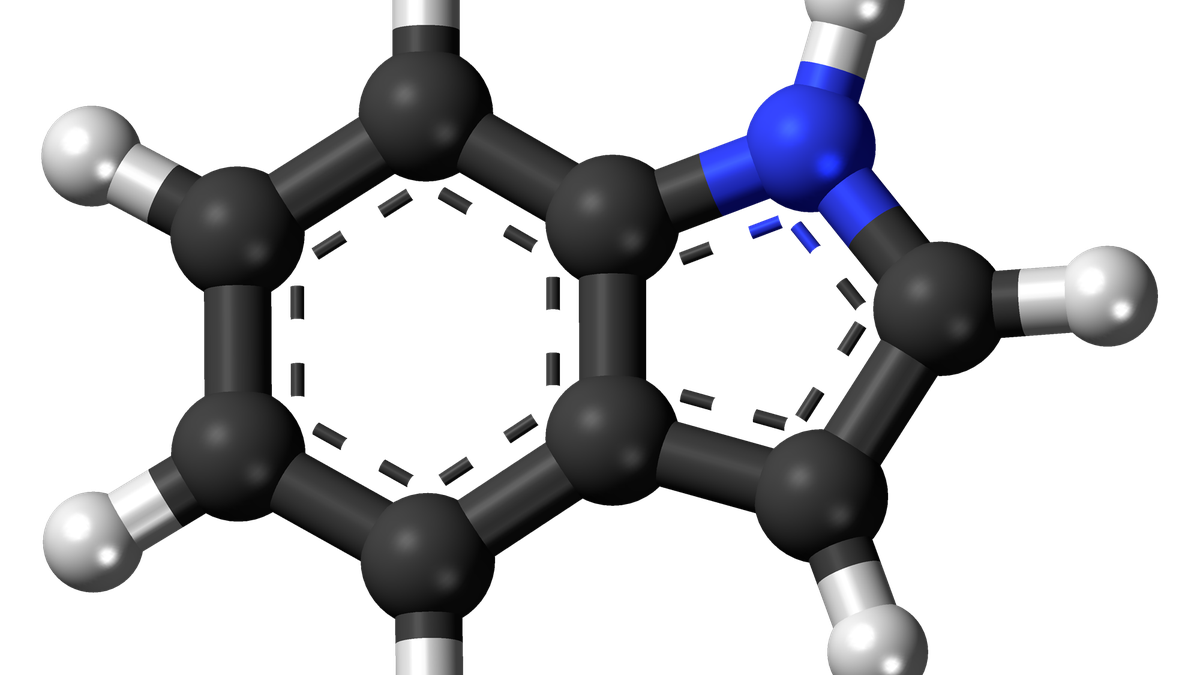
An illustration of an indole. The black orbs are carbon atoms, the blue a nitrogen atom, and the white orbs are hydrogen atoms. Molecules containing indoles and their derivatives are important in drug chemistry.
| Photo Credit: Public domain
When working with drug candidates, chemists sometimes like to replace a carbon atom in a ring of atoms with a nitrogen atom. This is because the switch can significantly alter the molecule’s properties, including how well it dissolves or how it interacts with biological targets in the body. But achieving it has been quite difficult, requiring chemical reactions with powerful oxidants, say, that can damage other parts of the molecule.
A new study in Science offers a breakthrough: researchers from the University of Chicago have reported a reaction to replace carbon with nitrogen in types of molecules often encountered in medical research and industry, in “mild conditions”.
Chemists had previously banked on a highly reactive intermediate compound called a nitrene to help push a nitrogen atom into a ring. The problem is nitrenes can have different electronic states, one of which — called the triplet state — doesn’t perform the desired reaction. But in the new work, the team set up a series of reactions that actually used the triplet nitrene state, together with blue light and oxygen, to temporarily open the ring, rearrange the atoms’ positions, and close it such that a nitrogen occurred where a carbon had been.
When they tested their technique on a type of indoles that had resisted existing methods, the researchers found the nitrogen-containing version in 73% of the reaction’s yield. After also trying it on other molecules, the team turned to biologically active molecules, which can be quite complex. The team modified one of the cancer-fighting compounds called the Vinca alkaloids to produce a version with nitrogen, which they found had better metabolic properties and less inhibited the hERG potassium channel — which drug-developers monitor for signs of dangerous heart-rhythm problems.
Finally, the team was also able to produce nitrogen-containing versions of two natural compounds: yohimbine, a veterinary drug, and catharanthine, one of the precursors of the chemotherapy drug vinblastine. This is valuable because synthesising them with nitrogen at the outset can change the molecules’ reactivity, putting paid to established synthetic routes.
That said, the method is not universal, as the authors have acknowledged, and includes toxic compounds called aryl azides among the starting materials. Even so, as they wrote in their paper, “The mild reaction conditions and broad skeletal diversity … lend an unexpected degree of generality to this method” and that they “anticipate that this addition to the toolkit for C-to-N transmutation will find promising applications in medicinal chemistry.”
Published – September 23, 2026 09:30 am IST


