





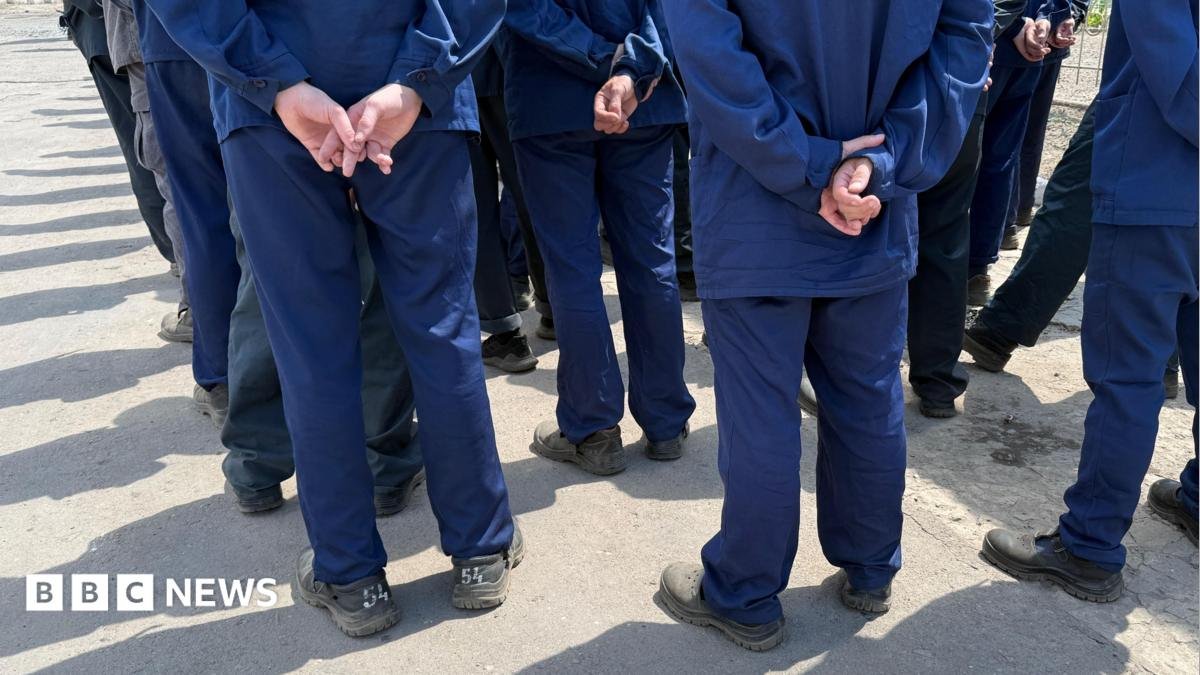
All the Ukrainian-born PoWs we interviewed came from areas occupied since 2014 and almost all joined the Russian army voluntarily.
But one man from Donetsk region told us he had been forced to fight.
His eyes darted around as he talked, unsure who he could trust.
One official tally, citing “intelligence”, suggests more than 50,000 Ukrainians have been conscripted against their will in occupied areas. Others put the figure far higher.
This man told us that when the Russians invaded, his family had stayed, not through any political or national allegiance but because Donetsk was their home.
Now, his only ambition was to get back to his wife and children, then avoid being returned to the front. “I’m just going to hide,” he confided.
Beneath the hospital windows and newly whitewashed walls there are rows of strawberries and cucumbers planted by the prisoners.
Further on, the stench of varnish from an outhouse is overpowering.
An official lifts a gold-coloured plastic handle from a bag near the door. “Guess what this is for?” he challenges us, grinning.
Inside, I do a double-take: the men working inside are hammering together wooden coffins. I am told the last contract the prison got was for garden sheds. This one feels macabre.
Across the courtyard in another workshop a handful of PoWs are making artificial Christmas trees, gaudy baubles strung from their machines. Like the coffin-makers, they tell me they use their wages to buy extra food and cigarettes.
Sergei was born in the Ukrainian city of Luhansk but says he is Russian like his parents, who moved to the Donbas when both countries were part of the Soviet Union.
He joined the Russian army a decade ago “to defend my homeland”, but claims he will retire when he gets back, not return to the front. “I’ve done my bit.”
Most will have no choice.
Stacking plastic branches next to Sergei is a drug dealer who signed up, like many, “exclusively” to avoid a long jail term.
“For me, 15 years in prison was too much,” Konstantin explains. “I know it probably doesn’t excuse me, but it’s a fact. I’m 44 now, I would be 60. So no.”
But Vshniki, or convict-soldiers, have to survive to the end of the war to be released and in the assault troops the odds are not good.
Three convicted murderers told us they had thought they could walk free after fighting for a year, only to have their contacts renewed automatically.


