



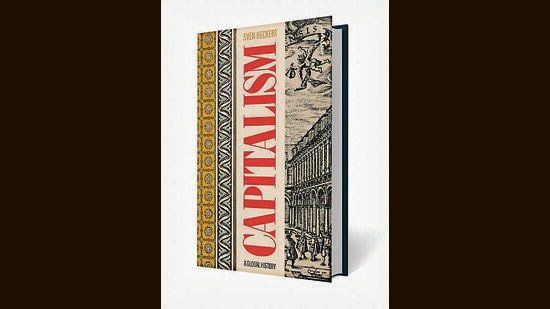
To understand capitalism, we need to be able to see it. This is difficult. Many people believe we can understand capitalism from our own experiences, which makes sense, considering how powerfully it structures our individual lives. Unfortunately, our own experience is a terrible guide. We see only a tiny part of capitalism at any given moment, and we miss the vast story in time and space in which it is embedded. Understanding capitalism from our own experience is like taking a movie frame and looking at one detail, then trying to deduce the movie’s plot from that particularity. While such a strategy might lead to some insights, even good ones, it is highly unlikely to help us understand the whole. Capitalism as a planetary phenomenon is not graspable from a biographical, local, or even national perspective.
Another problem is that most of us live in capitalist societies: We are immersed in capitalism like fish in water. We cannot look at capitalism from a distance. As the French sociologist Pierre Bourdieu observed in a different context, “a successful institution is forgotten.” Because capitalism is all around us, we often miss its peculiarities and its radicalism. It is easier to look at the Stone Age, Europe, or Song-era China, because those economic orders are so different from our own that we immediately perceive them as strange and in need of explanation. In the twenty-first century, however, when capitalism looks so normal, it is difficult to fathom that it has a history. All of this makes it hard to see that capitalism is not simply the way that economic life works, and to realize that it makes up a very small part of the totality of economic life over centuries.


