



Clad in a pair of pink swim shorts, Max Greenerz stood amid lapping waves on a sunny Dubai beach, recording a video about the city’s real estate market. He told the camera he was “bullish” on Dubai — despite the war.
“This country has been very good for me,” said Mr. Greenerz, 33, a real-estate investor from Britain, praising the tax exemptions and plentiful opportunities.
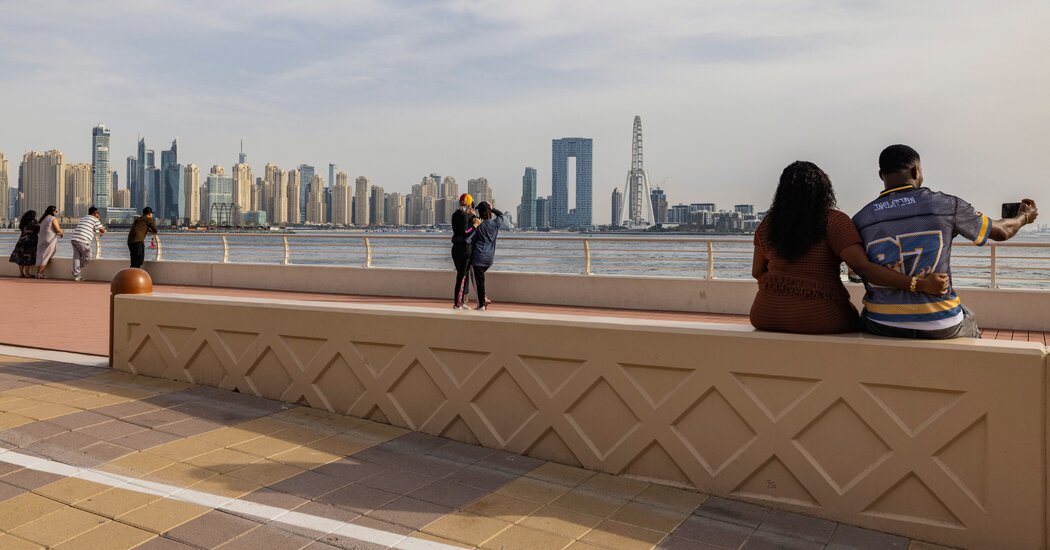
The so-called Dubai dream, burnished by opulent malls and five-star hotels, has attracted millions of expats to the Persian Gulf city over the past few decades. Yet that image has been challenged by the U.S.-Israeli war with Iran as it has engulfed the Middle East.
The United Arab Emirates has experienced more than 2,000 drone and missile attacks since the war began, with at least eight civilians killed, according to the defense ministry. The country has borne the brunt of Iran’s retaliatory strikes on the Gulf countries.
In Dubai, where fewer than 10 percent of the some four million residents are Emirati, the authorities have sought to preserve the idea of the city as a safe haven in a volatile region. At least 35 people have been arrested on accusations of taking or sharing videos of attacks or their aftermath, according to the state news agency.
Some residents, like Mr. Greenerz, who has lived in Dubai for five years, appear almost equally invested in preserving the city’s image as a land of near-limitless opportunities, even as many residents fear the war could have a long-term impact on the economy.
Gaith Abdulla, an Emirati who runs the Bayt AlMamzar art gallery in Dubai, said that while he had heard some residents say “the Dubai dream is dead,” others were firmly of the view that “nothing is wrong and everything is sunshine and roses.”
Residents often compare the conflict to the Covid-19 pandemic. Mr. Abdulla said the armed forces and the infrastructure of the country had been able to contain the war in such a way that many people lived life under a sense of heightened alert, “as opposed to, we are literally under attack.”
In a clip widely shared on social media, the Emirati president, Mohammed bin Zayed Al Nahyan, was seen strolling through the Dubai Mall in the early days of the war, in an effort to reassure people and encourage them to go out in the city.
Earlier this month, on the third day of Eid al-Fitr, a holiday marking the end of Ramadan, Saieda Qureshi brought her 7-year-old daughter and 20-year-old son to an ice-skating rink in the mall.
Ms. Qureshi, 44, said that she, like many residents, was nervous during the first days of the war. Though things have largely returned to normal, she said — even as missiles are still being intercepted overhead — she has had to reassure relatives back home in Britain that she is safe.
“They are seeing images from Tel Aviv and Tehran and they think that’s what’s happening in Dubai,” Ms. Qureshi said as dancers performed on the ice to a dizzying mix of Arabic songs.
“When you don’t live in Dubai, you underestimate how convenient everything is and how cushy of a lifestyle we have,” she said. “I mean, we’re in the middle of an active war zone and we came to the ice rink.”
Khateeb ur-Rahman, a 38-year-old from India who has lived in Dubai for two years, said he and his friends had gotten used to the sound of missile alerts on their phones. “It’s the new normal,” he said.
In front of the mall, the Dubai Fountain puts on a nightly choreographed show in which jets of water “dance” to soaring music. The surrounding pavilion and restaurants were packed with people, many taking selfies in newly purchased Eid outfits.
“You see how busy things are,” said Faiza Al-Jassmi, a 35-year-old Emirati mother of four, whose children were buying ice cream cones. “Things are normal, they’re more than normal.”
Her husband, Nader Al-Mansouri, agreed. “We haven’t felt anything different,” he said.
“Emirates!” their youngest son yelled, as the nearby Burj Khalifa tower lit up in the colors of the country’s flag. Moments before, a passing fighter jet had roared overhead — a reminder that a war was still raging around them.
Before the conflict began, Dubai’s main airport was among the busiest in the world, and tourism is a key part of the city’s economy. Initially, that traffic all but ground to a halt, and some airlines have continued to suspend flights in or out of Dubai.
The impact has been felt across the city, with reduced room rates at many of its high-end hotels. Residents pass around lists of those rates, encouraging each other to consider taking “staycations.”
On Feb. 28, the first day of the war, a projectile struck the Fairmont hotel on Dubai’s man-made Palm Jumeirah island, causing a large explosion and external damage to the building. Four people in a parking lot near the hotel were injured, the hotel said in a statement.
At the time, Sumit Augustine, 37, who has lived in Dubai for three decades, was sitting on the terrace of her apartment on the Palm with her son.
“The moment we heard the sound of the boom, we ran inside quickly,” she said. From her apartment, she could smell smoke.
She was worried at first, but Ms. Augustine said she now feels reassured because the city has not experienced the same kind of disruption as other parts of the Middle East. She has even taken her son to the Fairmont hotel’s children’s play area.
“Now I feel a lot safer,” she said.
Omnia Al Desoukie contributed reporting.


