



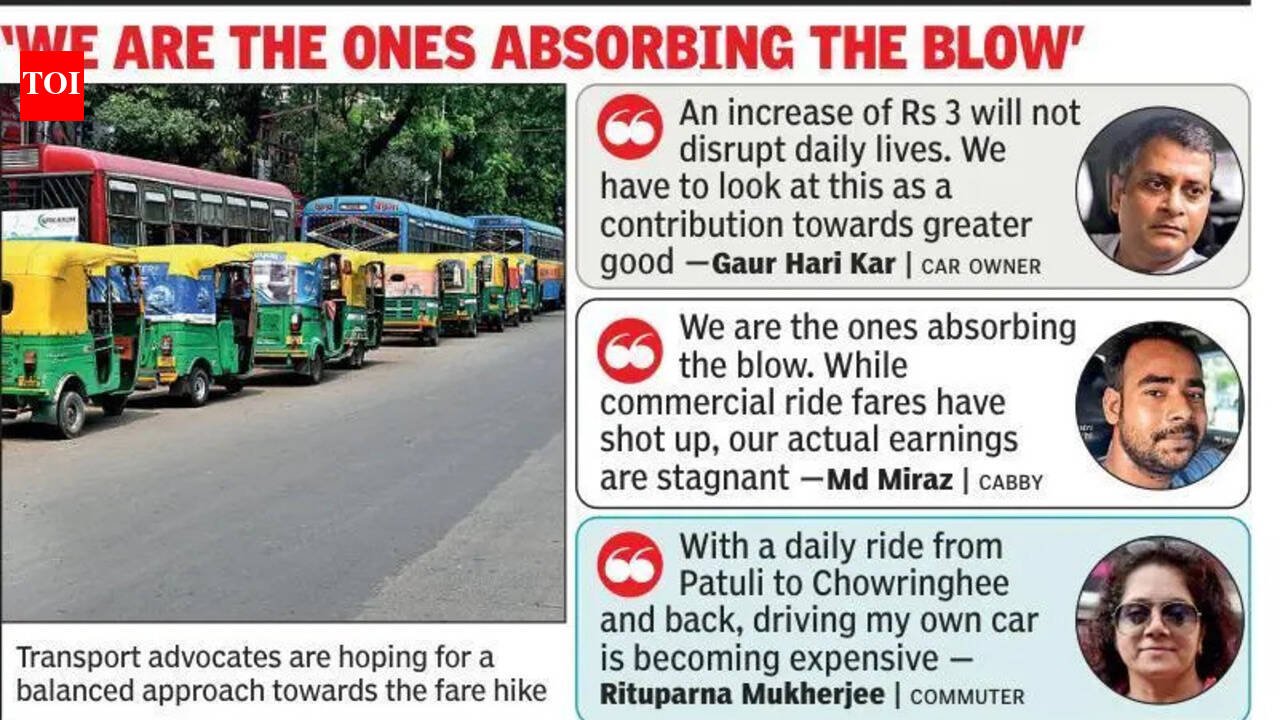
Kolkata: The revision in fuel prices might hit Kolkata’s public transport sector hard. Following international market volatility and escalating tensions in the Strait of Hormuz, the price of diesel has crossed Rs 95 per litre mark. While economists said that central interventions managed to prevent a worse price shock, the Rs 3 hike has pushed private transport operators to the brink, triggering urgent demands for a fare revision.Private bus syndicates argued that survival is impossible without immediate intervention. The last official bus fare revision in the state took place in 2018. However, bus operators in consultation with the commuters have already charged much higher fare compared to what was revised in 2018.“The previous govt held talks with us, but nothing concrete ever materialised. Fares must be revised according to current ground realities.” said Titu Saha, general secretary of the City & Suburban Bus Service. In a coordinated effort, at least five major bus organisations tallied current stage fares against competitive local transit options like autos and the Metro. Under their new proposal, operators are pushing for a restructured minimum fare for the first three km — a distance that currently stretches to four km under the outdated chart. “We are also asking for an incremental price jump for distances up to six km. For anything beyond nine km, we will not need major changes,” Saha explained.Echoing these concerns, Tapan Banerjee of the Joint Council of Bus Syndicate confirmed they are drafting a formal charter of demands for the state govt. “With a Rs 3 rise in diesel, we are suffering directly. We are hoping that chief minister Suvendu Adhikari will listen to our demands,” Banerjee stated.However, transport advocates urge a balanced approach. Aniket Banerjee, general secretary of Kolkata Bus-o-pedia, acknowledged that while a fare hike is a genuine necessity, implementing flat Rs 5 jumps between stages would be predatory. “The stages should be increased progressively by Rs 2,” Banerjee suggested. “In Assam, the minimum AC bus fare is Rs 10. In Ahmedabad, AC transit starts at Rs 5, and Bhubaneswar keeps its minimum fare below Rs 6. Why should Kolkata commuters pay Rs 15 for a barely four-kilometre journey in an AC bus?” For everyday passengers, the cascading effect of diesel pricing is double-edged.“Any increase in fares right now will severely hit our monthly budgets,” said Sagnik Roy, a bank employee commuting daily from Garia to Dalhousie. “The buses are often in deplorable condition with broken seats and terrible ventilation. If they want to charge more, they must first ensure these vehicles are roadworthy and run on time,” noted Sunita Mishra, a teacher. (With inputs from Eeshika Banerjee & Ritika Mukherjee)


