



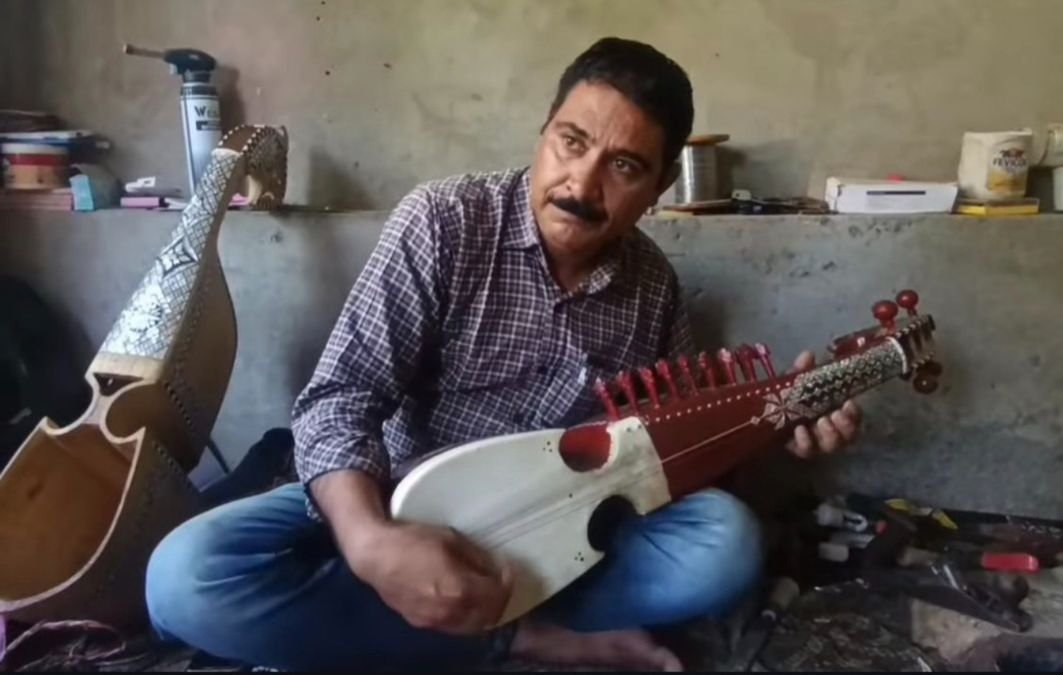
Budgam, Aug 23: Every instrument that leaves the hands of 40-year-old artisan Mushtaq Ahmad Dar carries more than music—it carries a fading tradition, decades of patience and the memory of a craft he inherited from his father.
For the past 32 years, this craftsman of Narbal village in Budgam has been quietly fighting to keep Kashmir’s traditional musical instruments alive. He began learning the craft when he was just eight years old, sitting beside his father, a veteran artisan who devoted more than five decades to the profession.
Today, Dar works from his home, spending weeks and often nearly two months painstakingly preparing a single instrument. His work includes the Rabaab, Santoor, Saz-e-Kashmir, Kashmiri Sitar, Sikh Rabab and Kashmiri Surnai.
“It takes nearly two months to prepare one musical instrument. We cannot make these instruments in 20 days if we want to maintain their quality,” he told Rising Kashmir.
While demand for his instruments continues to come from Jammu and Kashmir and other parts of India, Mushtaq said the biggest challenge is finding young people willing to learn the craft.
“There are only a few family members and relatives who are involved in this work. Young people are not interested because it takes a lot of time to prepare one instrument,” he said.
His father taught him the craft at an age when most children are busy with school and games. That early training became his life’s work. For more than three decades, Dar said he has remained focused almost entirely on his craft.
“I work day and night to prepare these products for my customers. My focus has always remained on my work. My father taught me this art, and I want to preserve it for our future generations,” he said.
Mushtaq believes Kashmir’s traditional music loses something essential without its indigenous instruments.
“Kashmiri music, particularly Sufi music, is incomplete without these traditional instruments. The sound produced by them touches the hearts of people,” he said.
Quality, he said, is the reason customers continue to return to him. Rather than producing instruments in large numbers, Dar gives each one the time required to achieve the desired sound and finish. Many customers place orders in advance and pay part of the amount beforehand.
The traditional Kashmiri Rabab, according to him, can last for generations if properly maintained, although it requires periodic repairs.
The making of these instruments also depends heavily on the choice of wood. Dar said mulberry wood is used for the instruments and that selecting suitable material is essential to producing good-quality instruments.
His family’s contribution to the craft is also a source of pride. Mushtaq said his father received a State Award in 2024 for his contribution to traditional craftsmanship. Now elderly and unable to continue the work, his father has nevertheless witnessed the continuation of the craft through his son.
“My father is very old now and is no longer doing this work. It was his dream that this art should be transferred to the next generation. That dream has been fulfilled,” Dar said.
Orders from outside Jammu and Kashmir have given Dar hope that the traditional craft still has a place in the modern world. Yet the future remains uncertain as fewer young artisans are willing to devote months to mastering a skill that offers little immediate financial return.
For this craftsman, the work is not merely a means of livelihood, but a promise made to his father—and a desperate attempt to ensure that the music of Kashmir does not lose the instruments that give it its soul.
After 32 years of labour, Mushtaq Ahmad Dar continues to carve, shape and tune each instrument by hand, hoping that when his generation is gone, the sound of the Rabaab, Santoor and other traditional instruments will not disappear with them.


