








The conversation around industry–academia collaboration is hardly new. Yet despite years of policy interventions, roundtables and partnership announcements, one question persists: why do so many collaborations struggle to move beyond intent and into sustained action?
The stakes are no longer abstract. Research on India’s skilling ecosystem finds that close to 40% of core job skills are expected to be disrupted within the next five years, while separate analysis of the workforce pipeline finds that roughly six in ten entering candidates lack the blended technical and business skills employers now require. The gap between what universities produce and what industry needs is no longer a matter of perception — it is measurable, and by most available evidence, it is widening.
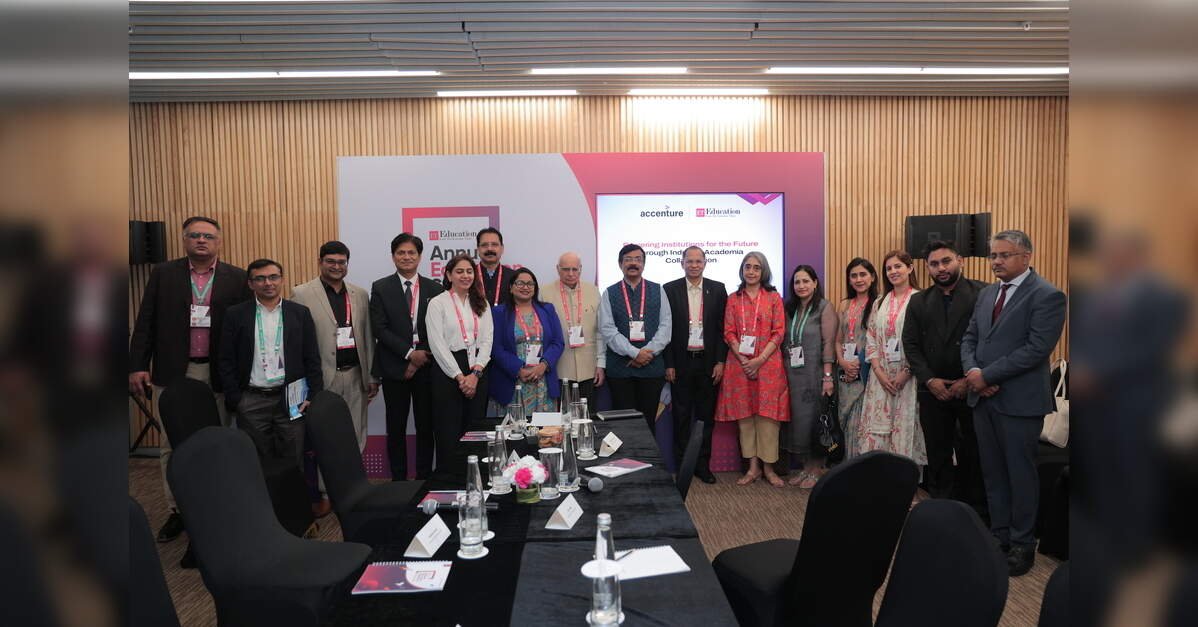
This question sat at the center of a closed-door roundtable convened during the ETEducation Annual Education Summit 2026 in partnership with Accenture LearnVantage in New Delhi. Conducted under the Chatham House Rule, the discussion brought together vice chancellors, academic leaders, industry practitioners and ecosystem partners, to move past familiar debates and identify practical pathways for building partnerships that last.
Participants included Prof Nilanjan Chattopadhyay, Vice Chancellor, Jagran Lake City University; Prof Satish Chander Sharma, Vice Chancellor, BBD University; Dr Anupama Raina, Director, ICFAI Business School (IBS); Amit Mittal, Pro Vice Chancellor, Research Programs; Prof (Dr) Raviraja N Seetharam, Vice Chancellor, Chandigarh University; Gitanjali Gandhiok, Senior Vice President, Ashoka University; Prof Prem Vrat, Pro Chancellor, Professor of Eminence and Chief Mentor; representatives from NASSCOM; and leaders from Accenture LearnVantage, including Anurag Bansal, Managing Director, Accenture LearnVantage, Asia Oceania & Middle East; Natasha Banth, Managing Director, Global Academia and Ecosystem; Tanya Bajaj, Lead – Institution Business; and Deepika Kapoor, Enterprise Lead. The session was held under the Chatham House Rule and moderated by Yasmin Taj, Editor, ETEducation and ETHRWorld, The Economic Times.
Why the conversation matters now
Three forces converge to make this moment different from previous cycles of the same debate. The National Education Policy 2020 has accelerated expectations around multidisciplinary learning, apprenticeship-linked education and stronger employer engagement, while accreditation and ranking frameworks increasingly reward demonstrable industry ties. At the same time, the shelf life of technical skills keeps shrinking, making curriculum relevance a moving target rather than a periodic review exercise.
The result is a familiar disconnect, now backed by harder numbers than before: employers want graduates who are workforce-ready on day-one, while institutions contend with job roles and skill requirements that rewrite themselves faster than curricula can be revised. The mismatch is no longer confined to any one sector — research based on an analysis of more than 550,000 job postings and professional profiles found that roughly 60% of candidates lack the blended technical and business capabilities employers now look for.
Increasingly, this is a boardroom concern rather than a hiring-desk irritation. A recent global survey of 3,000 C-suite leaders across 19 industries and 20 countries found that closing workforce skills gaps — particularly around AI — is being treated as a strategic risk requiring enterprise-wide reinvention, not an incremental training fix. The consensus at the roundtable was correspondingly clear,collaboration can no longer remain an occasional activity. It must become an institutional operating model.
The persistent gap between intent and execution
A recurring theme throughout the discussion was that the problem is rarely one of intent. Both industry and academia understand, in principle, the value of working together. The real challenge lies in execution, and it tends to break down in predictable ways
partnerships often begin with enthusiasm but lose momentum soon after a memorandum of understanding is signed. Without clear ownership, timelines and measurable deliverables , agreements remain symbolic rather than transformative.
Different institutional rhythms further compound the problem : academic calendars, governance structures and faculty commitments operate on a different clock from quarterly business cycles, unless both sides design for that mismatch explicitly, collaboration slows by default
Participants also pointed to a dependence on individual champions; a single faculty member or corporate leader whose enthusiasm carries a partnership. . When that person moves on, the relationship often lapses with them. Faculty engagement surfaced as a related concern, with many noting that industry-facing work receives limited recognition within institutional appraisal systems and that engagement which goes unrecognized rarely gets sustained.
The participation question
An equally important theme was what participants described as the “participation question”. On both sides, there often exists an unspoken perception that the other is less responsive, slower to act or insufficiently invested in the partnership.
Industry leaders sometimes expect faster academic adaptation, while institutions seek deeper and more sustained engagement beyond placements and recruitment cycles. This mismatch in expectations can erode trust even before a collaboration has the chance to mature. What emerged instead was a shared conviction that meaningful partnerships require mutual ownership, regular engagement and a genuine willingness to understand each other’s constraints, priorities and timelines.
Rethinking the collaboration model
The discussion pointed towards a more holistic framework for engagement—one that spans the entire education value chain rather than concentrating on placements or guest lectures alone.
curriculum and certification co-design, emerged as a starting point, ensuring programmes stay aligned with current and emerging industry requirements rather than trailing behind them . Experiential learning – through internships, live projects, capstone assignments and apprenticeship pathways – was viewed as equally critical , putting students in front of real problems before they graduate.
Faculty immersion was raised repeatedly: structured opportunities for educators to spend time inside industry environments were seen as essential to keeping curricula current at the source, rather than relying on periodic external review. The conversation also underscored the need for stronger investment in applied research, Centres of Excellence and innovation ecosystems jointly supported by universities and employers – models, participants argued, could create more meaningful connections between knowledge creation and real-world problems. A further, more pointed observation was that skilling initiatives now need to address emerging-technology gaps directly: separate research finds that only about a quarter of the workforce has received formal training on how to work alongside AI, suggesting that even well-designed curricula risk falling short if this specific gap is left unaddressed.
A working charter for collaboration
Perhaps the most significant outcome of the roundtable was the proposal of a working charter designed to move partnerships from goodwill to accountability- one that assigns clearly defined responsibilities to industry, to academia, and to both parties jointly.
Industry stakeholders , in this framing, commit to contributing live problem statements, capstones, internships, apprenticeship opportunities, curriculum inputs and support for Centres of Excellence and applied research. Academic institutions, in turn, commit recognizing faculty engagement, building flexibility into academic calendars, and appointing empowered points of contact who can actually move a partnership forward
Jointly, both sides commit to time-bound action plans, quarterly review mechanisms and a small set of shared metrics that can measure success collectively rather than through separate institutional lenses.
“ The underlying principle was simple: partnerships should be run by accountable owners, not merely commemorated by signatories.”
Building partnerships that last
The roundtable ultimately articulated five principles that should guide future collaboration efforts: symmetry, ownership, timeliness, shared measurement and replicability.
Symmetry — every commitment on one side has a counterpart on the other; no relationship runs on goodwill alone.
Ownership over signatures — partnerships are run by named owners, not commemorated by signatories.
Time-bound by default — intent converts to a first deliverable on a clock, not “in due course.”
Measured together — a small, shared scorecard beats two separate ones.
Replicable by design — outcomes are documented so models travel between institutions.
Participants agreed that sustainable partnerships cannot depend solely on goodwill or individual enthusiasm. They require structures that survive leadership transitions, transparent governance mechanisms and documented practices that can be replicated across institutions.
As India positions itself as a global talent and innovation hub, already home to a rapidly growing share of the world’s technology and AI talent pipeline, bridging the gap between classrooms and workplaces has become a strategic imperative rather than an aspirational one. . The discussions reinforced a simple but powerful idea: the future of industry–academia collaboration will not be determined by the number of MoUs signed, but by the number of partnerships that deliver measurable outcomes.
Moving from agreements to action—and from intent to execution—may well define the next chapter of higher education in India.
This article draws on a closed-door roundtable held under the Chatham House Rule. Views are presented thematically and are not attributed to named individuals or institutions.


