








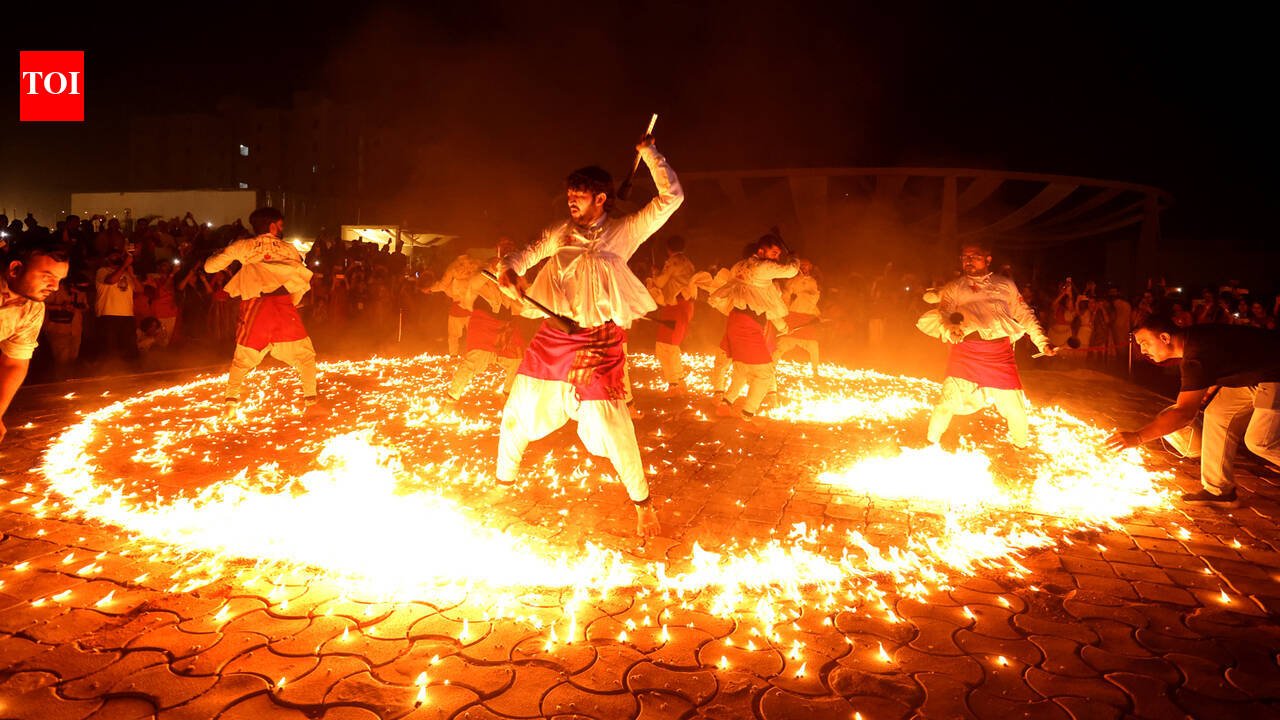
Vadodara: When the garba grounds fall silent around midnight, the city’s Navratri celebrations are far from over. As commercial venues wind down, traditional mandali garbas take centre stage, while fire-lit ‘mashal raas’ and sword-wielding ‘talwar baazi’ bring the city’s rich folk heritage alive in a spectacular new way.This Navratri, some of these traditional performances are making a debut in Vadodara, offering revellers an alternative to the increasingly commercialised garba circuit. The move also responds to a growing appetite for community celebrations that continue long after the music stops at mainstream venues.An earlier survey indicated that around 10,000 people from Vadodara travelled to Ahmedabad after midnight to participate in mandali garbas once venues in their home city closed. The emergence of traditional mandalis in Vadodara aims to bridge that gap, allowing people to experience the spirit of community garba without leaving the city.Among the initiatives leading this revival is ‘The Social Mandali’, inspired by Ahmedabad’s traditional community celebrations. Organisers Kaushal Dave, Yashraj Solanki and Moksh Verma are seeking to recreate the charm of old-style society garba, where the rhythmic strains of the shehnai and the powerful beats of the dhol accompany circles of dancers.The focus, they say, is on preserving the cultural soul of street garba and the sense of belonging it fosters, rather than transforming the celebration into a commercial spectacle.The revival, however, extends well beyond garba. For the first time, Vadodara is hosting ‘mashal raas’, performed on alternate days by Shri Patel Yuvak Garbi Mandal from Jamnagar. Tracing its origins to 1957, the troupe brings to the city a spectacular fire dance deeply rooted in the folk traditions of Saurashtra.Twelve male performers, dressed in traditional kediyu-choiyanu, move in synchronised circles with flaming torches, creating intricate patterns inspired by the sathiya and trishul. The performance reaches a thrilling climax as the dancers leap over burning cotton balls, blending precision, courage and tradition in a mesmerising display.Another traditional art form adding to the festive fervour is ‘talwar baazi’, presented by a local all-women group that wields swords in carefully choreographed displays. Surat-based fire artist Rahul Kadvabhai Chosla, known for his wooden-stick performances and two world records, further enriches the line-up of traditional performance arts.This renewed interest in folk traditions builds on Vadodara’s longstanding cultural legacy. At the Faculty of Fine Arts, instruments such as the harmonium, dhol, kansi-joda, manjira and conch shells have accompanied garba performances for more than seven decades, keeping the city’s traditional musical heritage alive.This year, the mandali celebrations are also embracing devotional rituals, adding a spiritual dimension to the festivities. A Ganga Aarti and a Maa Durga Aarti, scheduled for Oct 17 with participants from West Bengal, are set to bring another layer of cultural diversity to the celebrations.As midnight draws the curtain on one kind of Navratri celebration, another unfolds in Vadodara — one rooted in community, devotion and the timeless rhythms of folk culture. By reviving traditional mandali garbas and showcasing rare folk performances, the city is not merely extending its festive nights; it is reclaiming a vital part of its cultural identity.


