



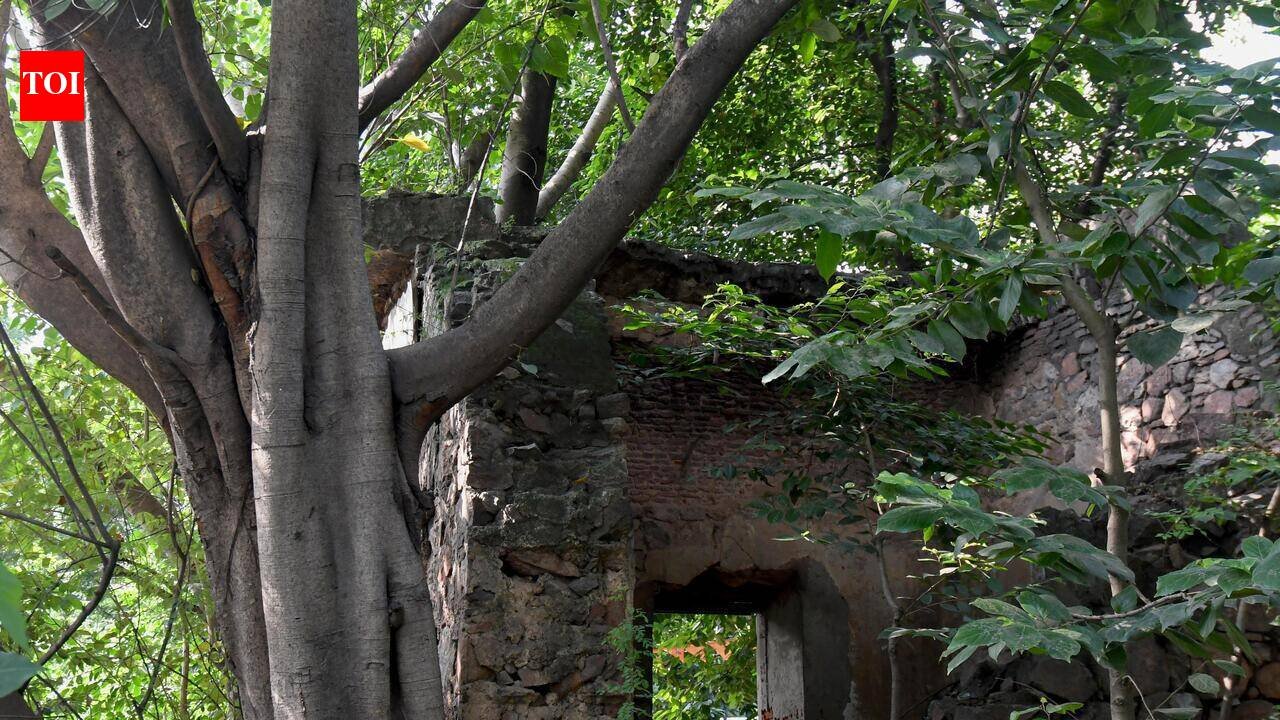
New Delhi: For centuries, travellers entering Delhi from Agra would have approached the capital along a road once known as the Sadak-e-Azam — the great imperial highway that later became part of Grand Trunk Road. Along this route stood sarais, wells and other facilities that provided travellers with a place to rest and find water before continuing their journeys.Today, almost nothing at the site beneath the Modi Mill flyover on Mathura Road suggests it was once part of that landscape.Hidden behind trees and a small temple lie fragments of what experts believe may be an old inn. The structure is now reduced to a few portions of old masonry, two rooms in poor condition and a large, old well. Much of the original building has disappeared over the decades, with the remains gradually swallowed by vegetation and the expansion of the city around them.Yet, for heritage officials, what remains is significant. Aqil Ahmed, member secretary of MCD’s Heritage Cell, said, “The ruins could be those of Sarai Juliana, an 18th-century travellers’ inn associated with Dona Juliana Dias da Costa. The sarai is believed to have been built around 1720, during the reign of Mughal emperor Muhammad Shah Rangeela.”The sarai once served a practical purpose. Travellers heading from Agra to Delhi would pass through the Mathura Road corridor, then part of the old imperial highway. In an era when journeys between cities could take days, reliable sources of water and accommodation along such routes were essential.The surviving well is perhaps the most striking reminder of that past. Its broad masonry walls and old construction remain visible, while traces of Lakhori bricks and older masonry can still be found around the site. According to Ahmed, these warrant further examination to establish the historical significance of the remains.What once appears to have been a substantial complex has, however, been steadily erased by time. Portions of the building have vanished while the surviving rooms are in a poor state. The remains are difficult to distinguish from the surrounding greenery, and many people living in the area are unaware of the site’s history.Ahmed said MCD is considering whether the remains should be taken up for formal protection and inclusion in the city’s next heritage list. He said the declaration of heritage buildings is carried out as per the provisions of Unified Building Bye-Laws, 2016, and Delhi Municipal Corporation (DMC) Act. Ahmed added that after obtaining the necessary approvals, action may be initiated to get the structure notified as a heritage building.Identifying Delhi’s lesser-known heritage structures is an ongoing exercise and cannot be completed in a single survey, Ahmed said. MCD prepared the first list of heritage structures in 2010 and the second in 2016. A third list is yet to be prepared and several structures could be taken up for consideration. Such sites would need to be surveyed in a phased manner before their heritage value can be established. “The exercise is not merely about documenting old structures, but also about identifying vulnerable remains that need to be preserved before they disappear,” he said.Sarai Juliana is not simply that of an old building lost to Delhi’s expansion; it is also a reminder of how the capital once functioned — through roads, water sources and resting places for travellers. Today, the road outside carries a relentless stream of traffic. A flyover runs overhead. Trees have grown around the remains, and the old sarai has largely disappeared from public memory.According to Ahmed, the next survey would help determine which forgotten structures merit preservation and consideration for inclusion in the heritage list. For Sarai Juliana, that process could offer a chance to formally recognise what remains of a site that has survived largely unnoticed beneath one of Delhi’s busiest modern corridors.


